The Life Outdoors

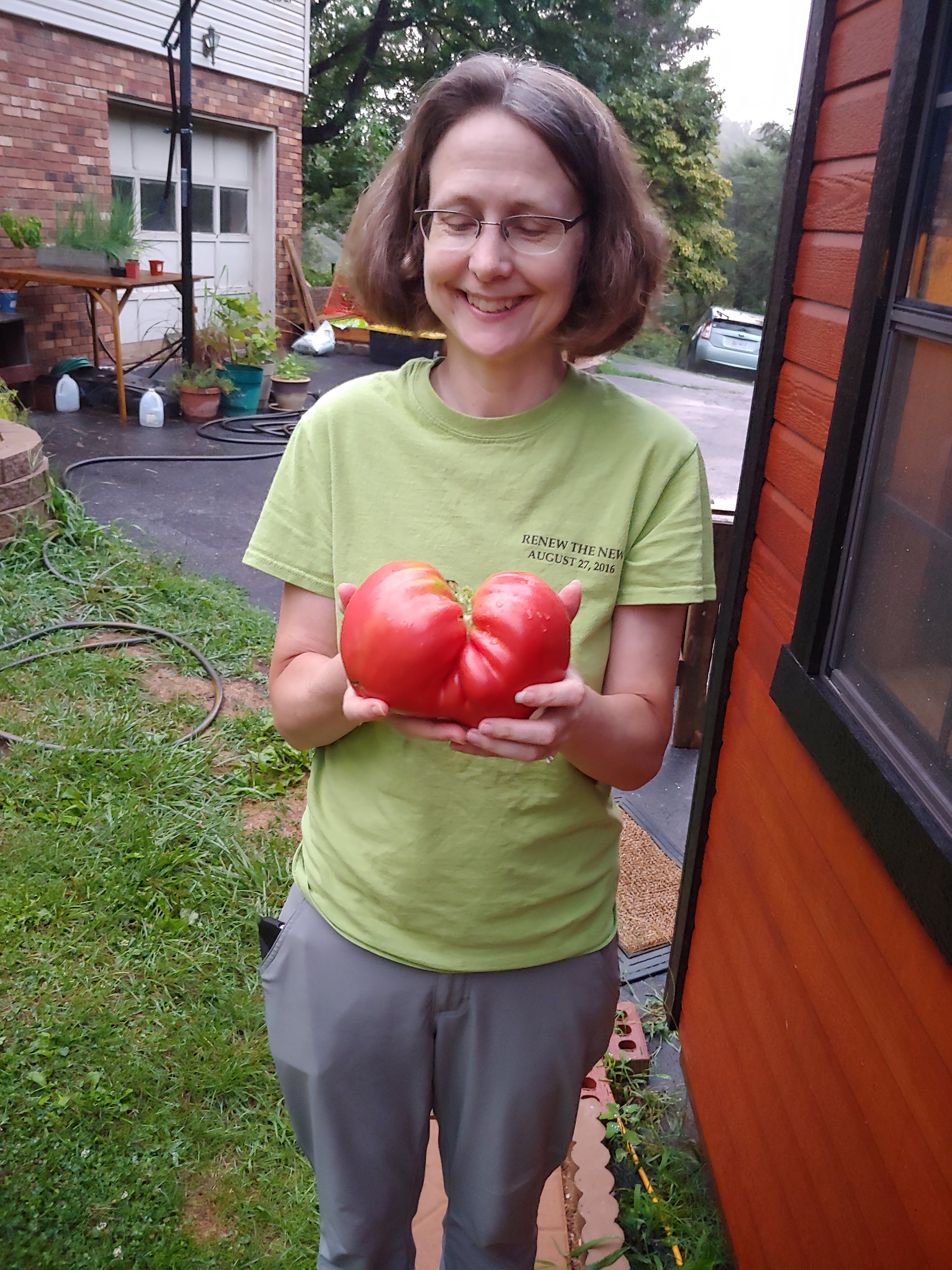
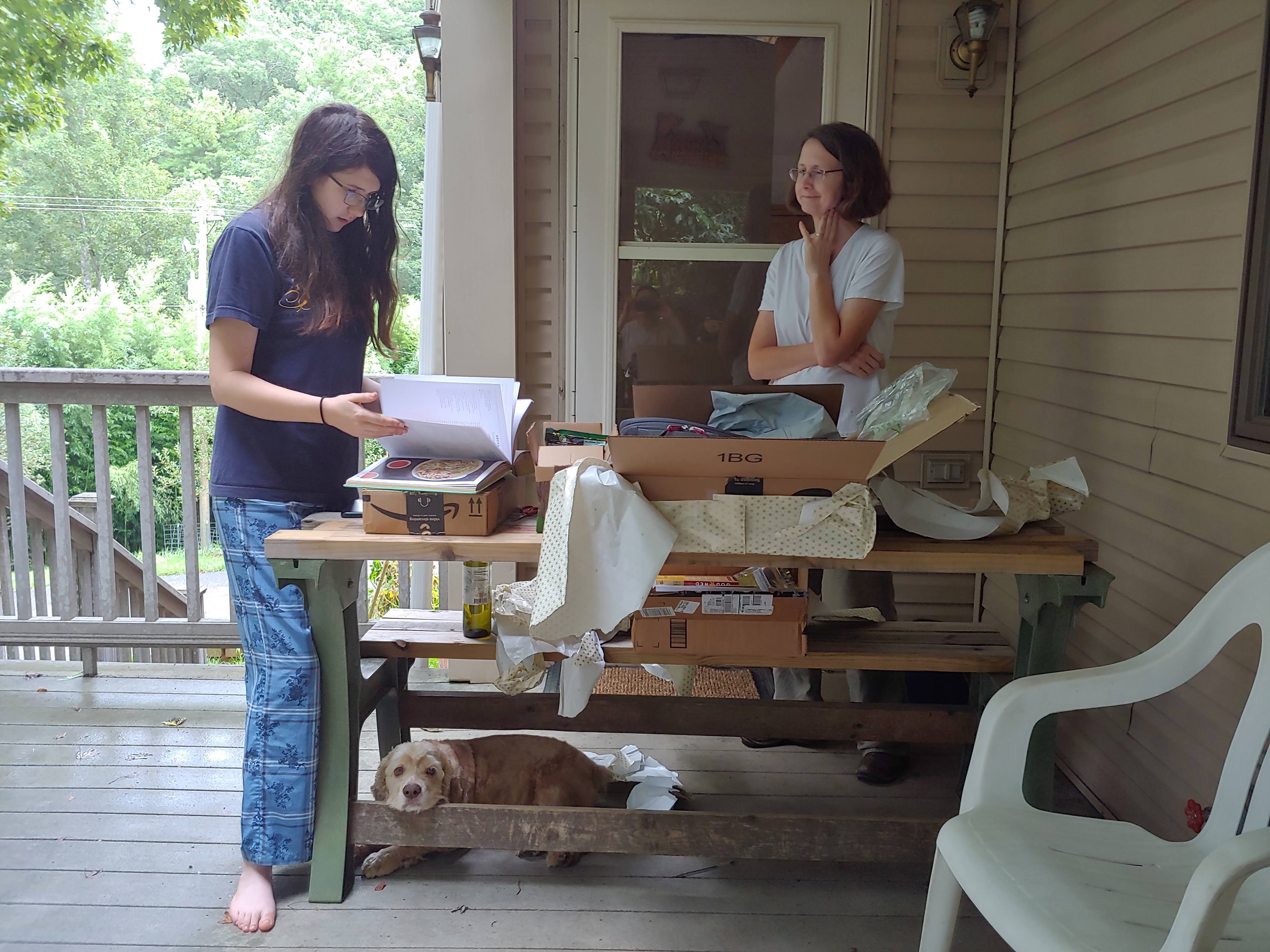
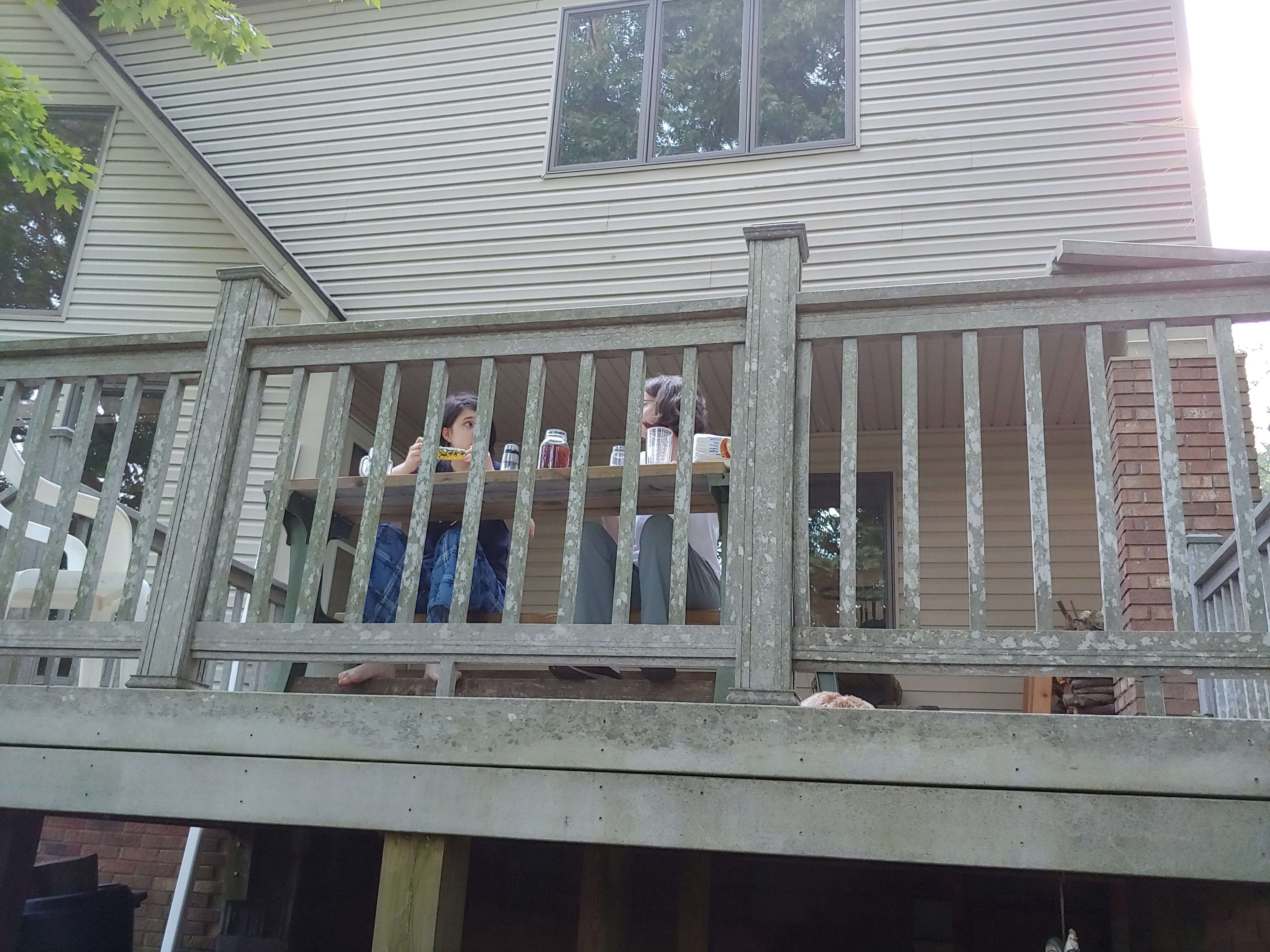
Despite the physical separation from family, we still spent time together while distancing outside. It was August and the garden was producing. Lydeana grew a 2.6 pound beefsteak tomato, one of many giants we had. We celebrated Shayley’s birthday out on the porch, where we had meals on tables about 8 feet apart. At one point there was a scare about a possible exposure at work so I started eating down in the yard instead of on the porch. We brought out the old folding table temporarily until I made something else to use. I could have taken the half of a picnic table I used on the porch, but it was cumbersome to move up and down stairs by myself.
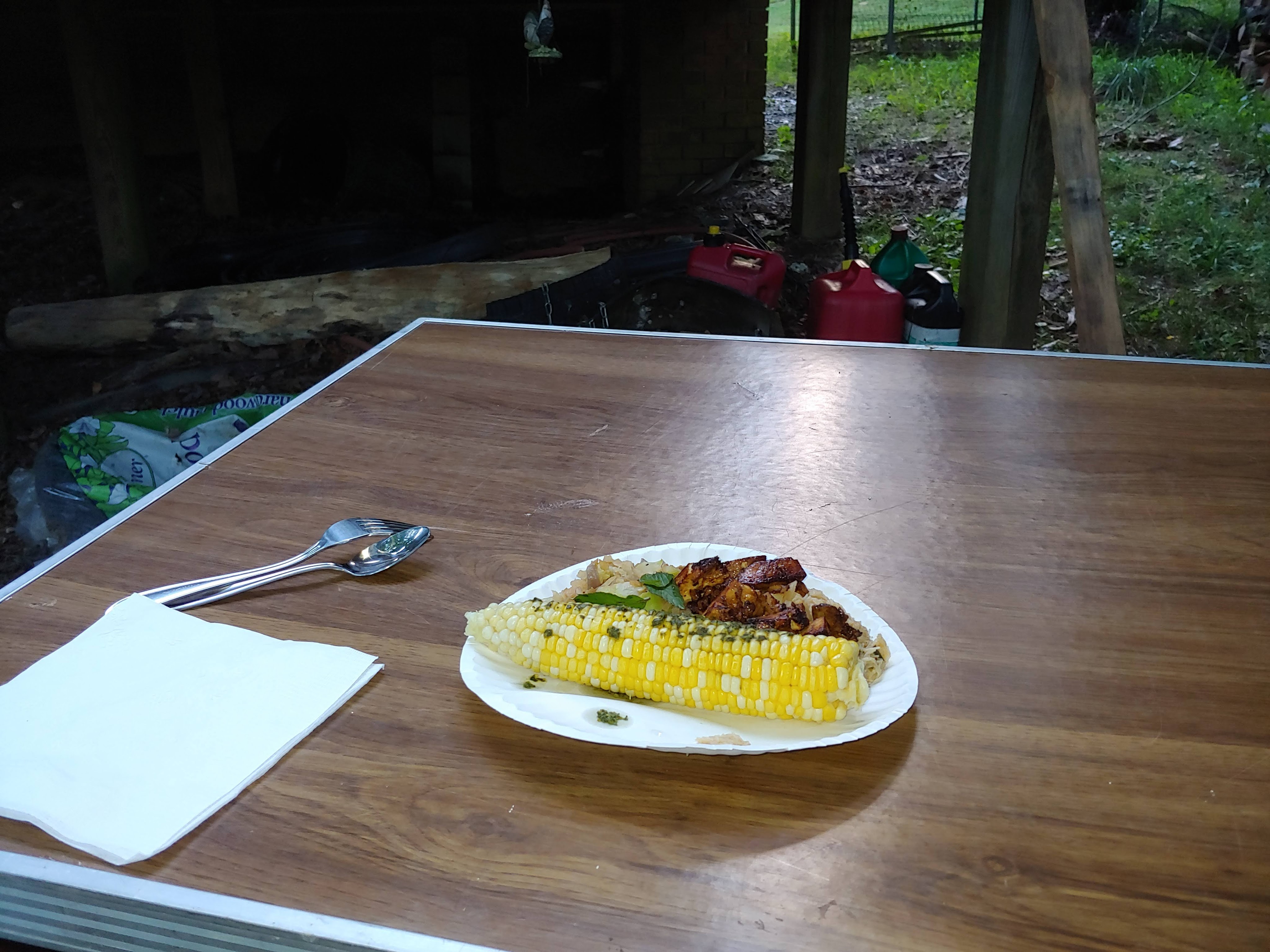
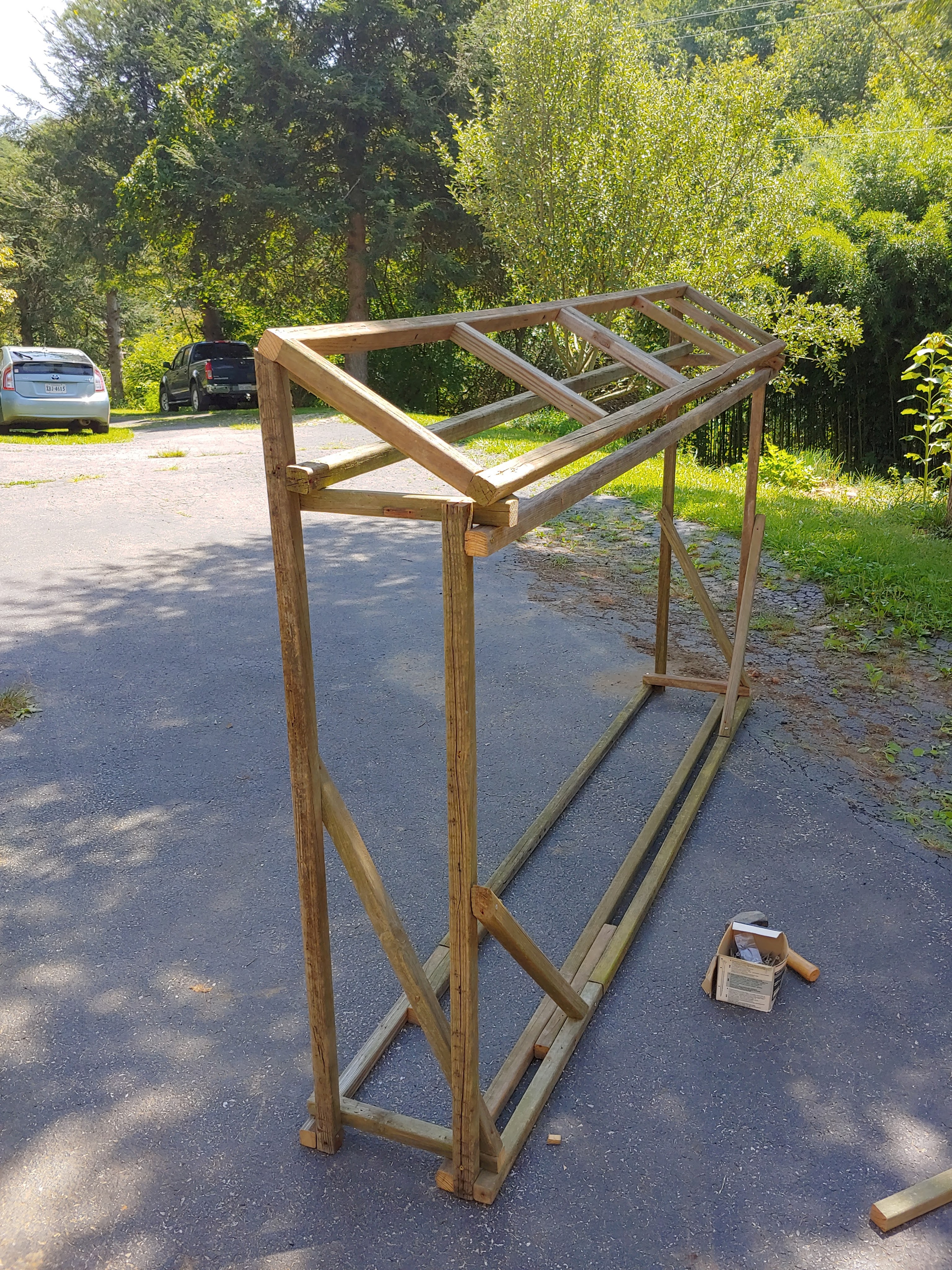
I had in mind to build something smaller that would fit under the covered portion of the porch behind a wood rack I was building. This would give me a more sheltered place to eat in the winter if I chose to eat outside the window to the dining room. I stack wood on the porch in the winter just under the overhang and cover it with tarps since rain always finds a way to blow back under and soak everything. I was in the process of building a wood rack that could sit just out from the overhang and provide more room while keeping both the wood and me dry.

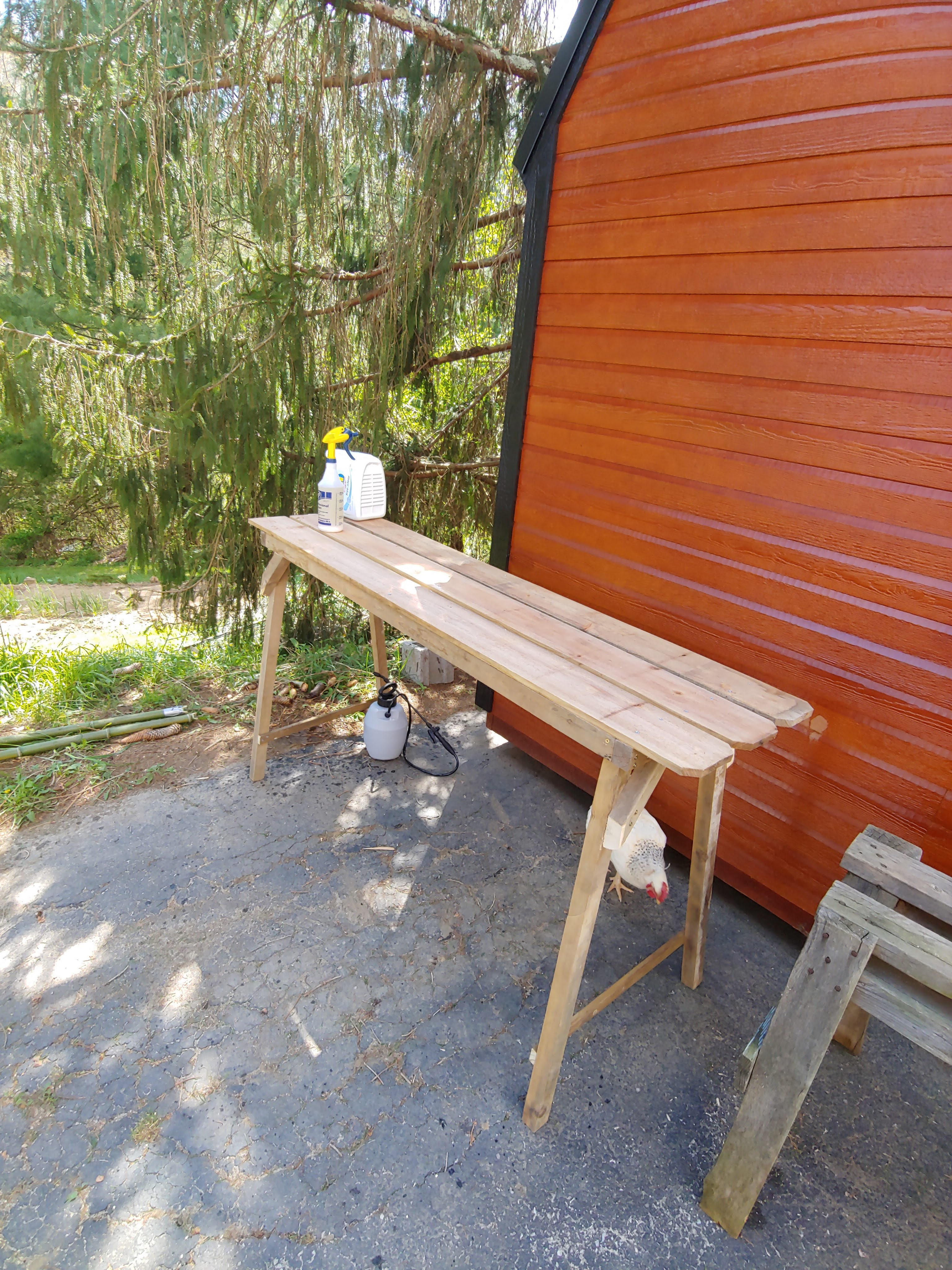
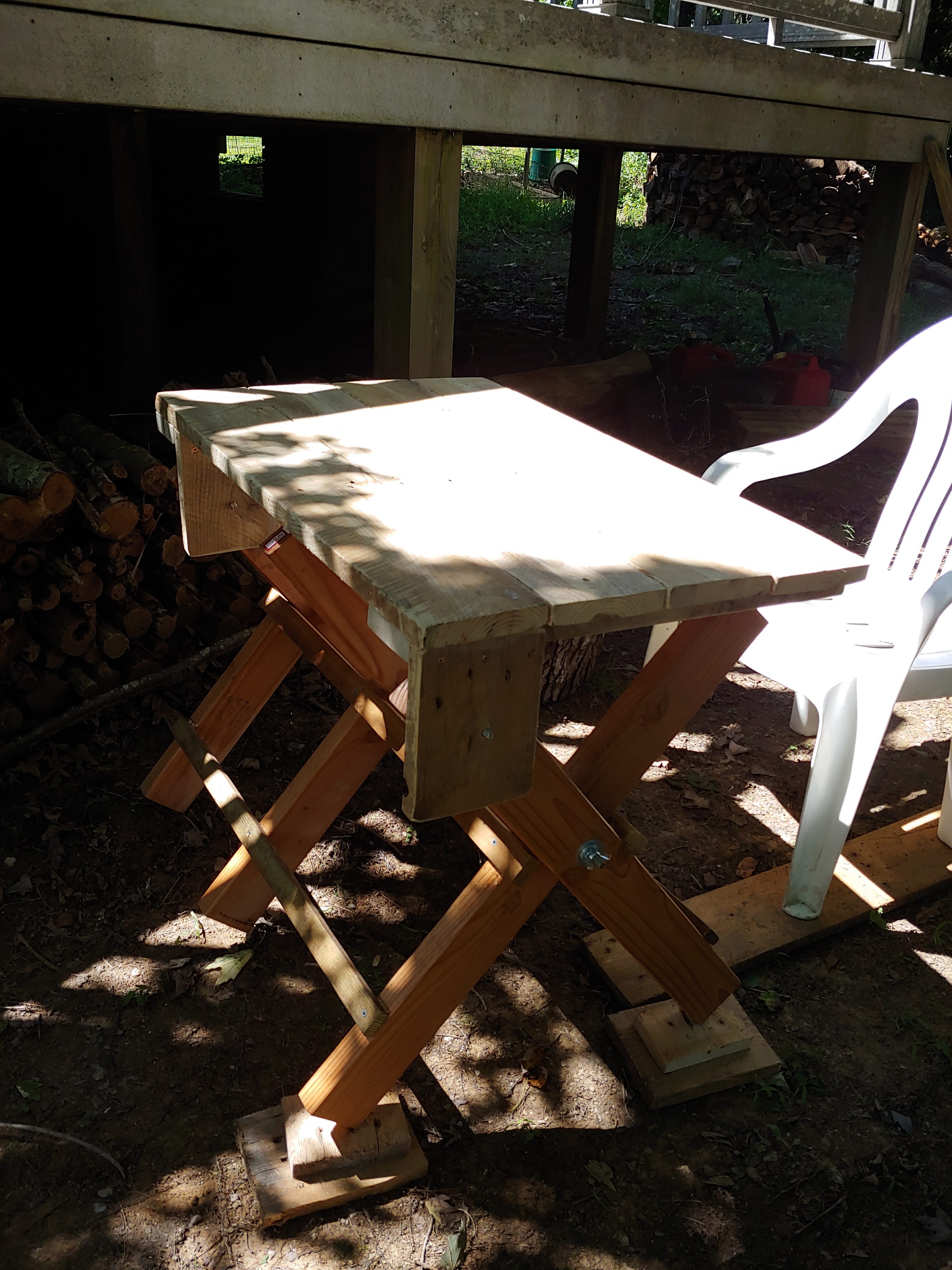
The new quick table was constructed from old pallet boards for the top that would be attached to a folding saw buck I made. This was very temporary since the saw buck would cause it to be a little cluttered for my legs and feet. I believe I had used it in the yard for about three weeks when we decided it was safe for me to come back up on the porch again.

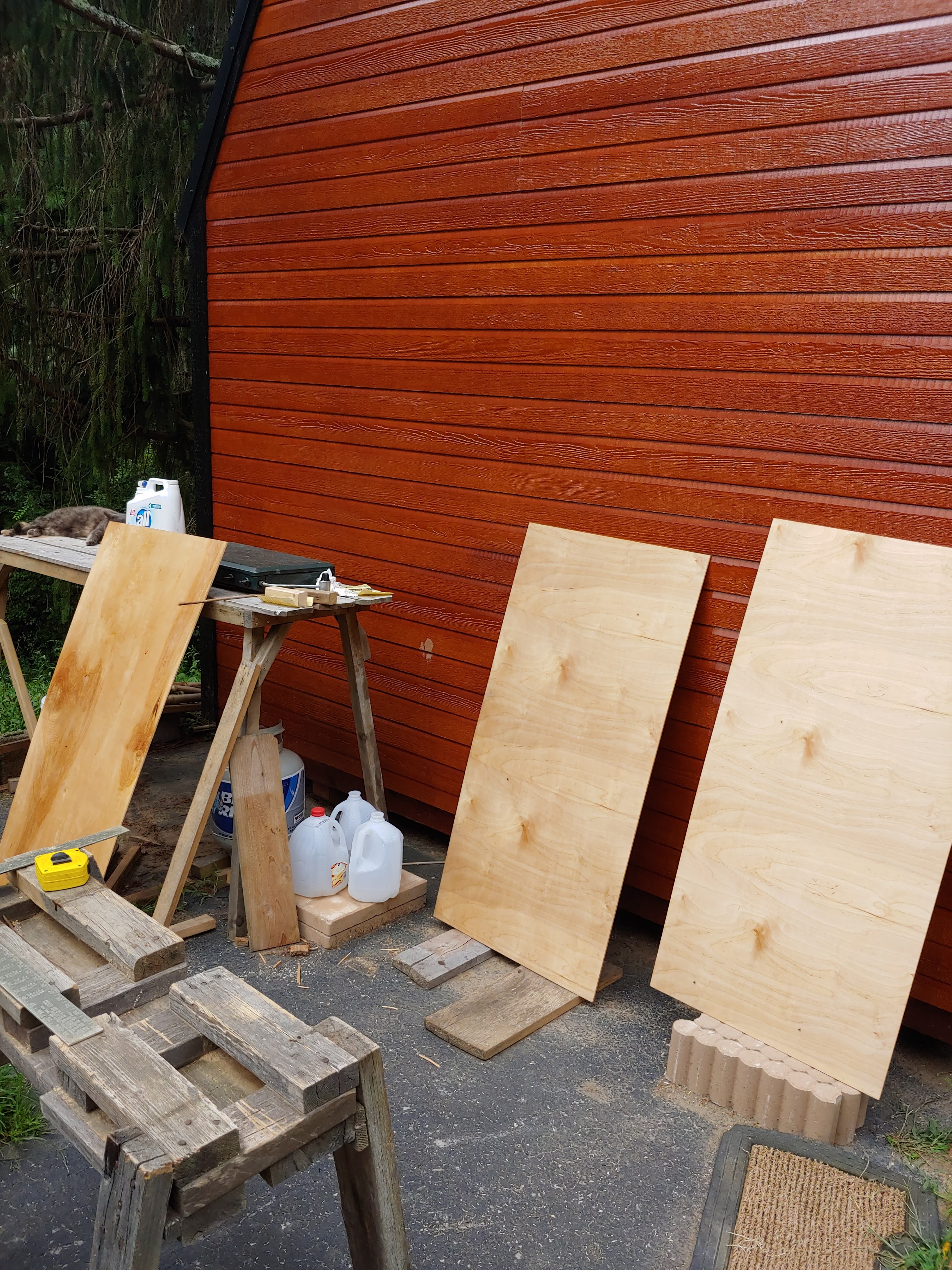
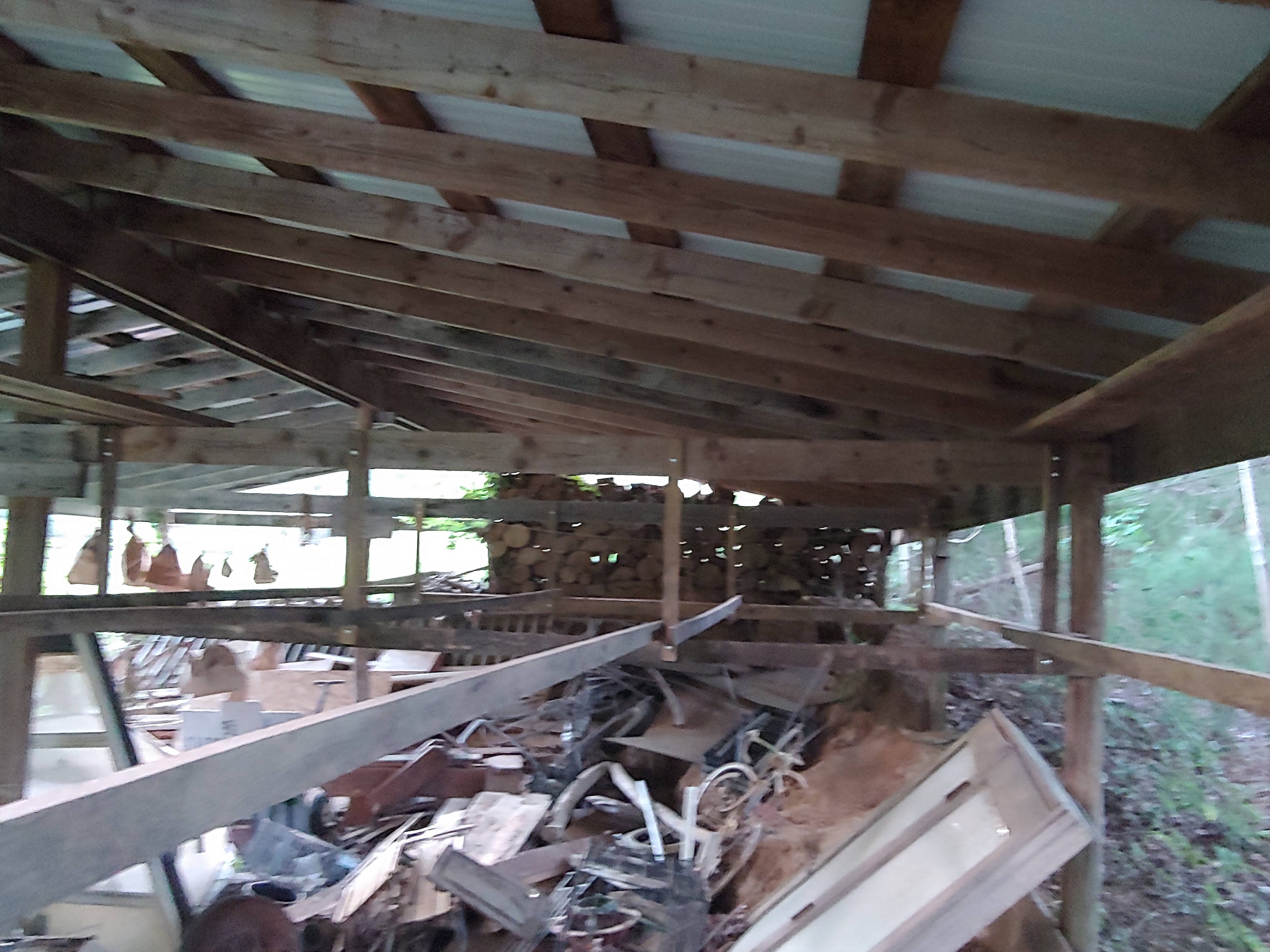
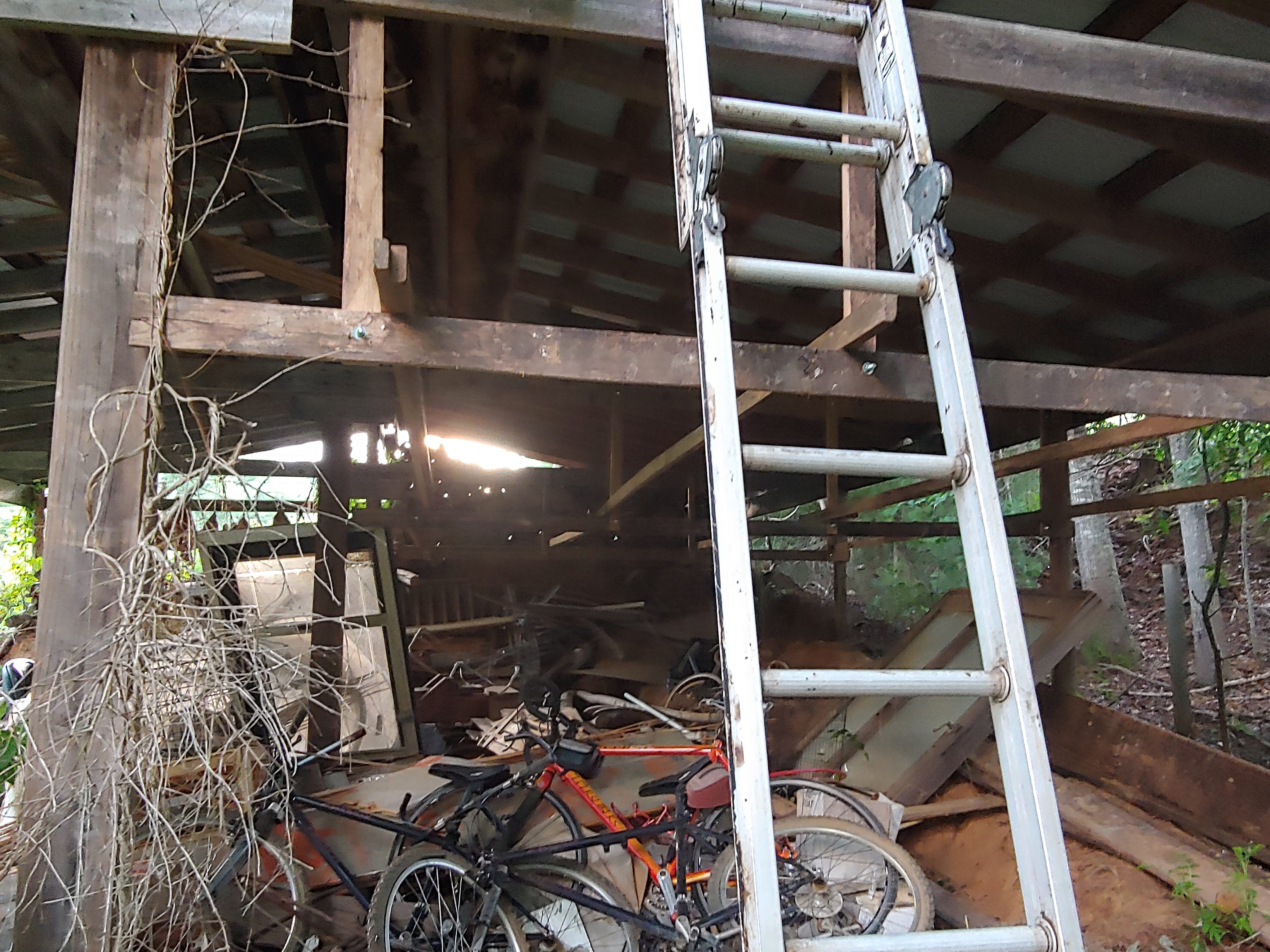
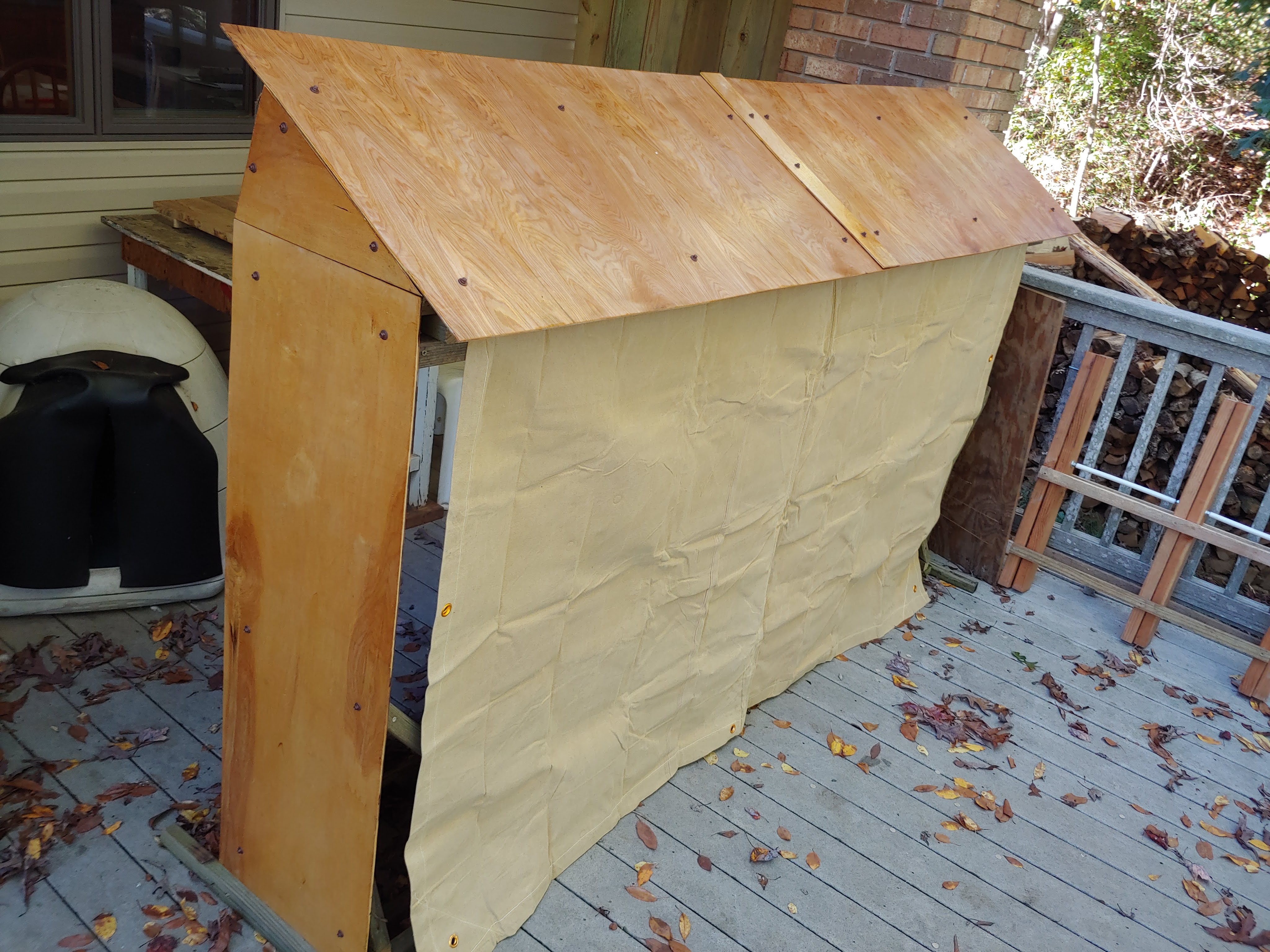
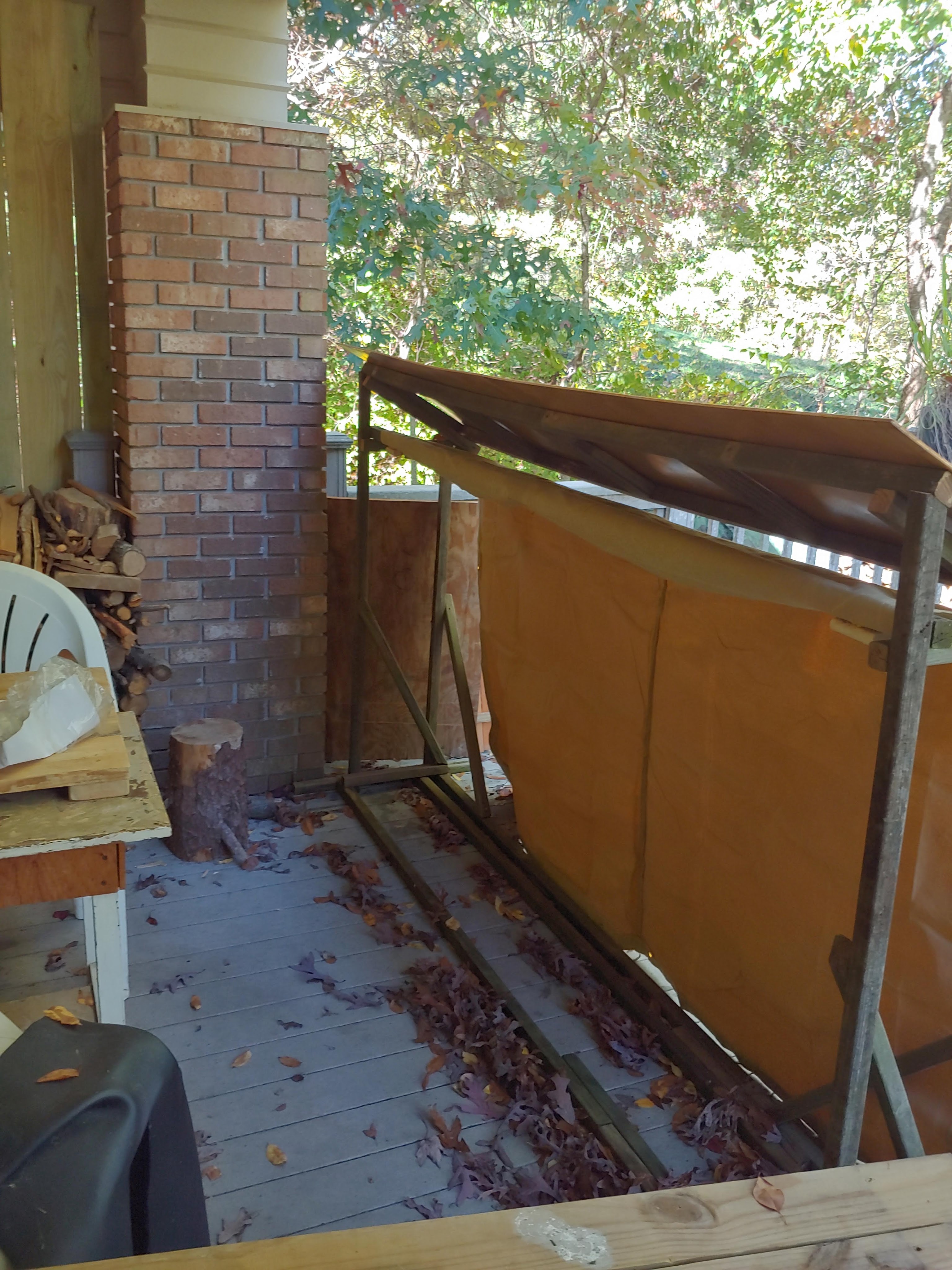
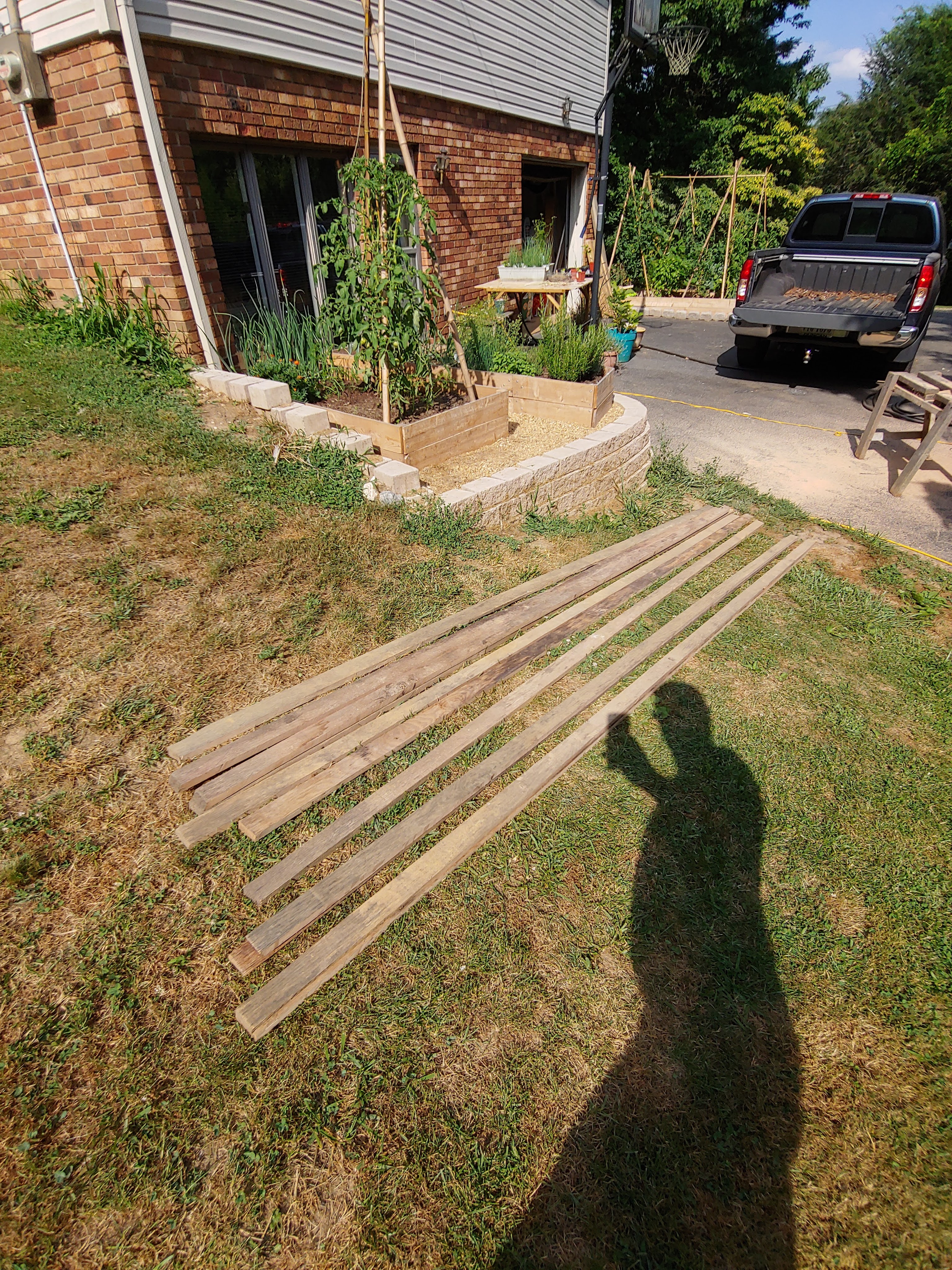
Years back I had built a chicken tractor to house the chickens and move them around. Later I built an 8 x 16′ cage with treated 2 x 2’s and chicken wire along with several wire tunnels to connect the chicken tractor and cage. The cage had long since started breaking down and I salvaged the decent 2 x 2’s that were left. These were transformed into a wood rack. Three 2 x 4′ underlayment panels were coated in spar varnish for the top. The exposed front of the rack would have a canvas tarp to protect the wood and would fold back so it could be stacked more easily. It would be fall before I put the rack up on the porch in its finished form. An improved version of my smaller table would sit behind it by then.
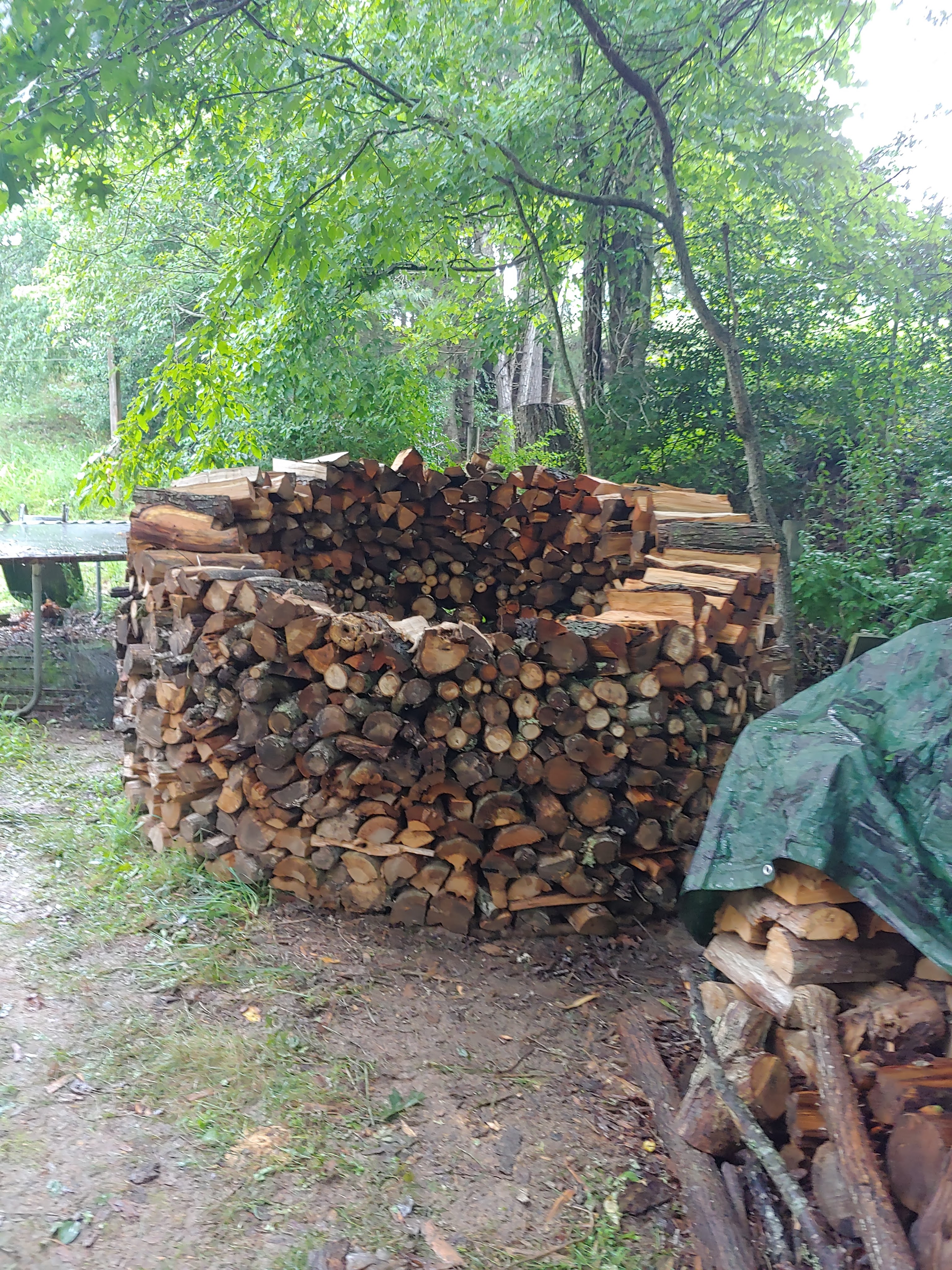
Living and working outside in the heat and eating fresh garden veggies didn’t prevent me from feeling the urgency of the upcoming winter, which was just around the corner. I had a bunch of wood to cut up, split and stack along with many other projects to come. I had a bunch of cherry from my mother-in-law’s property that a tree trimmer had cut. He didn’t cut it to cater to a woodstove, so I had to cut it down more and split the big stuff. I decided to get fancy and stack it in a ring that could be filled in the middle with small odd pieces and covered with a tarp. Unfortunately, later on, a bear would feel the need to climb through it and tear it half apart. I believe he thought about sleeping in it, but when it gave way as he crawled over it, he just decided to keep going through the other side.

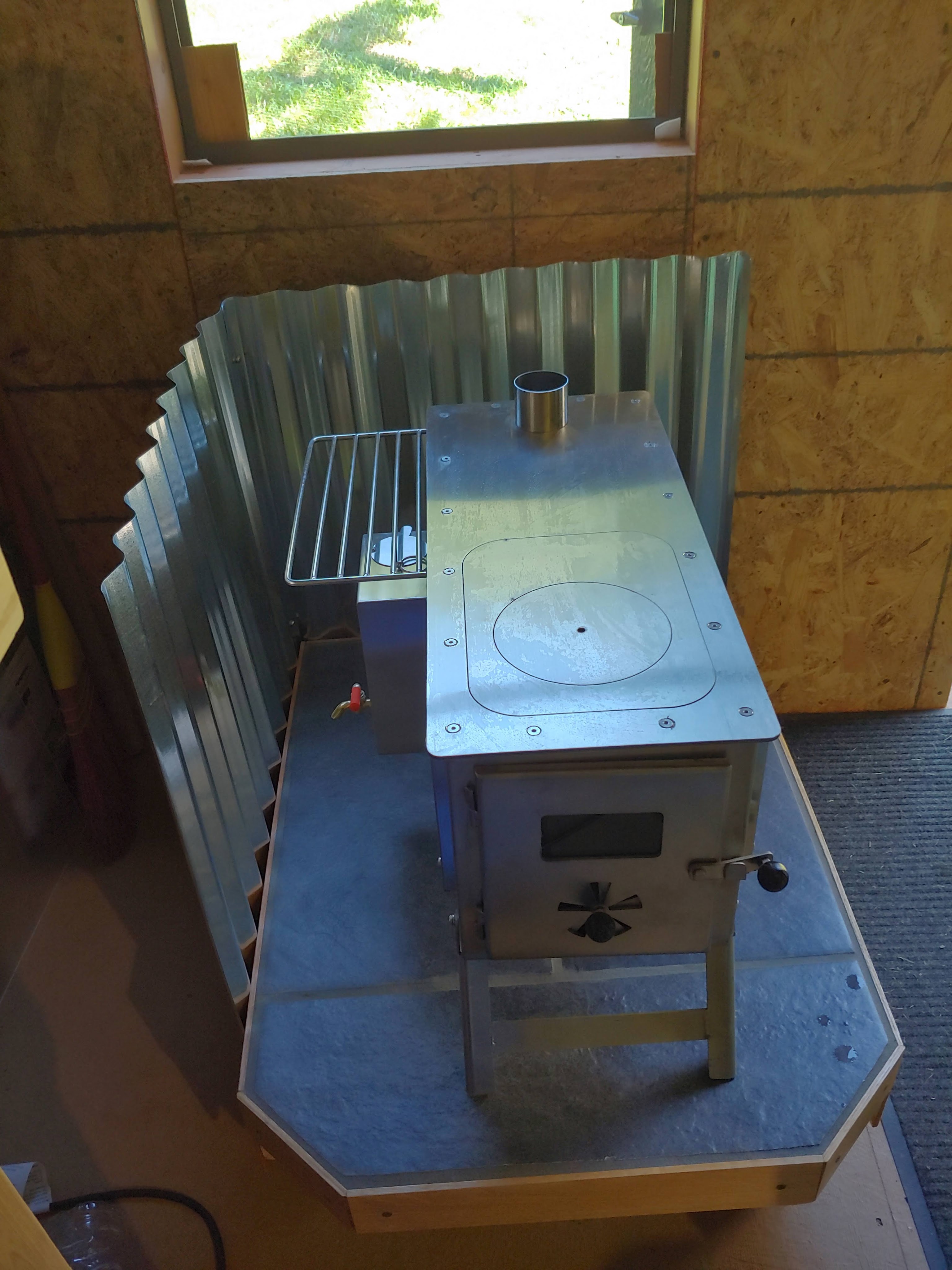
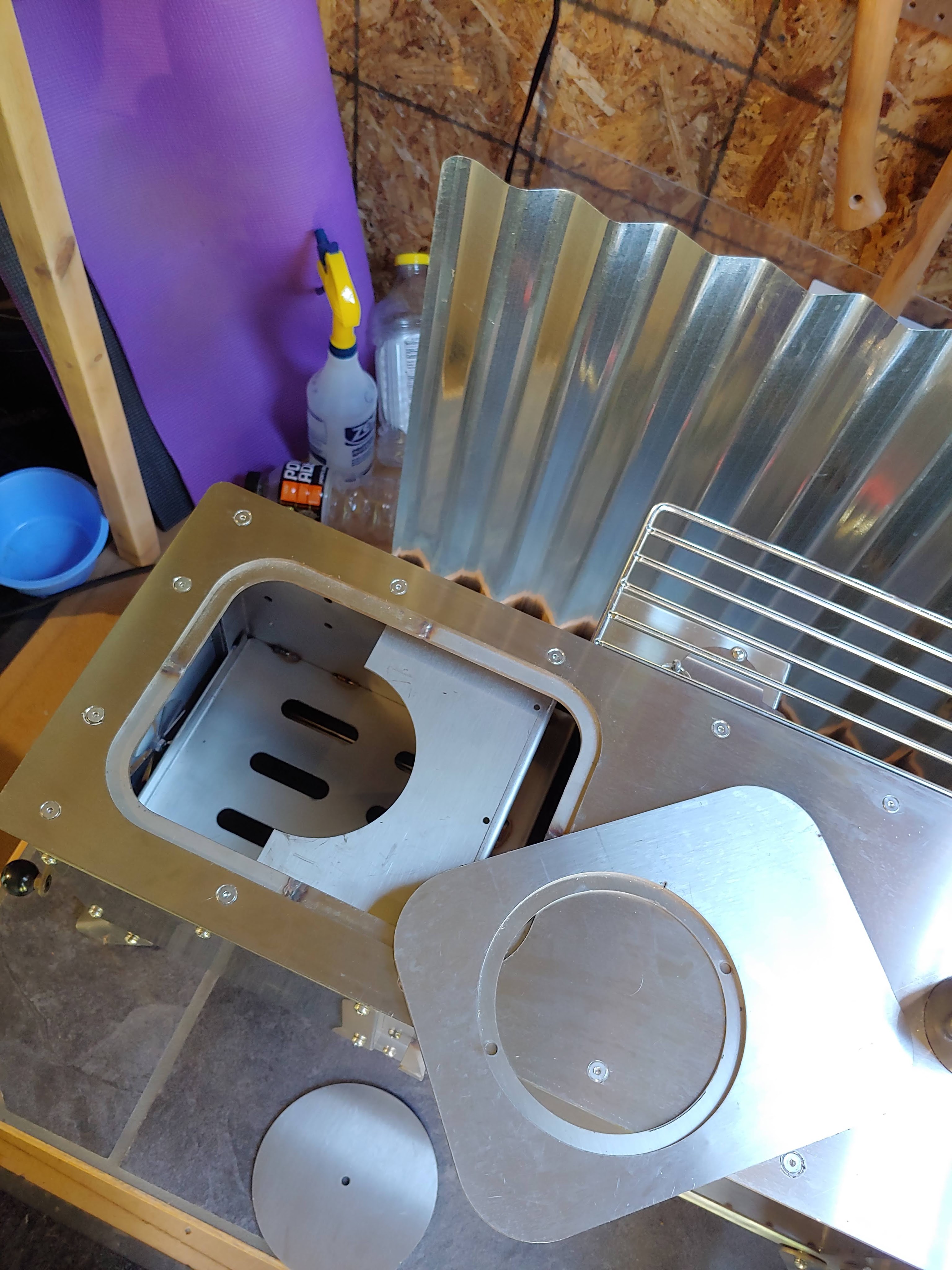
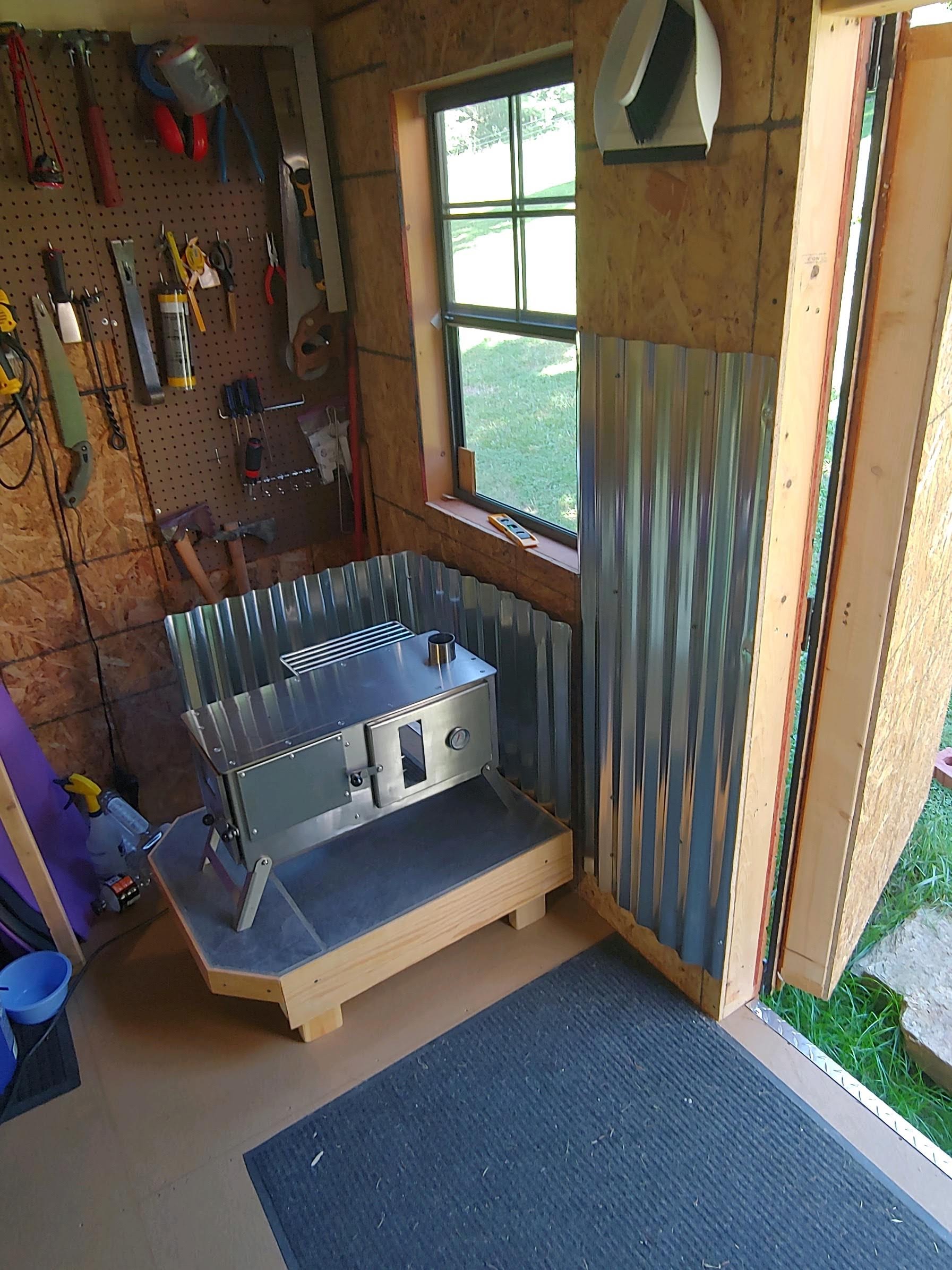
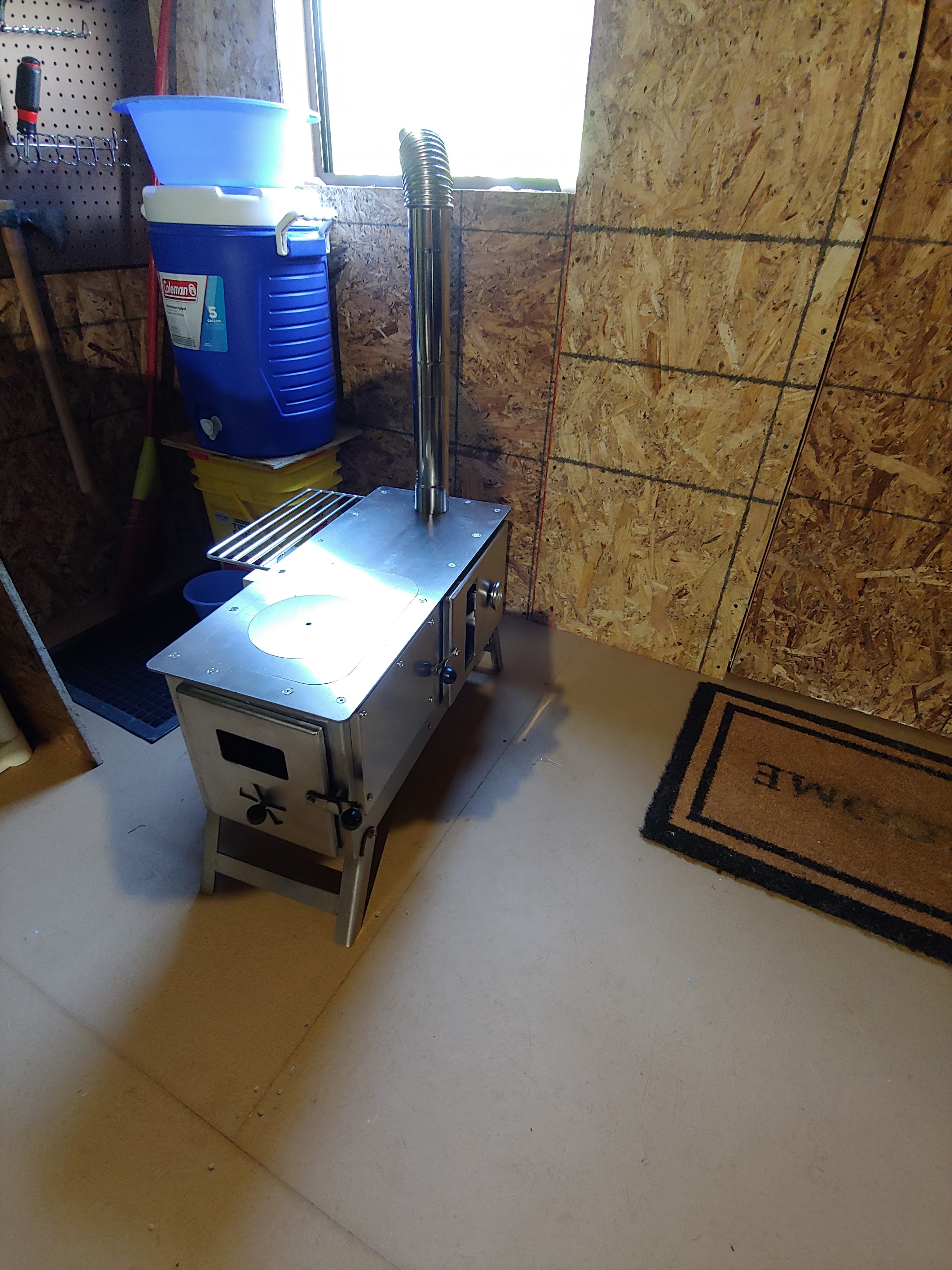
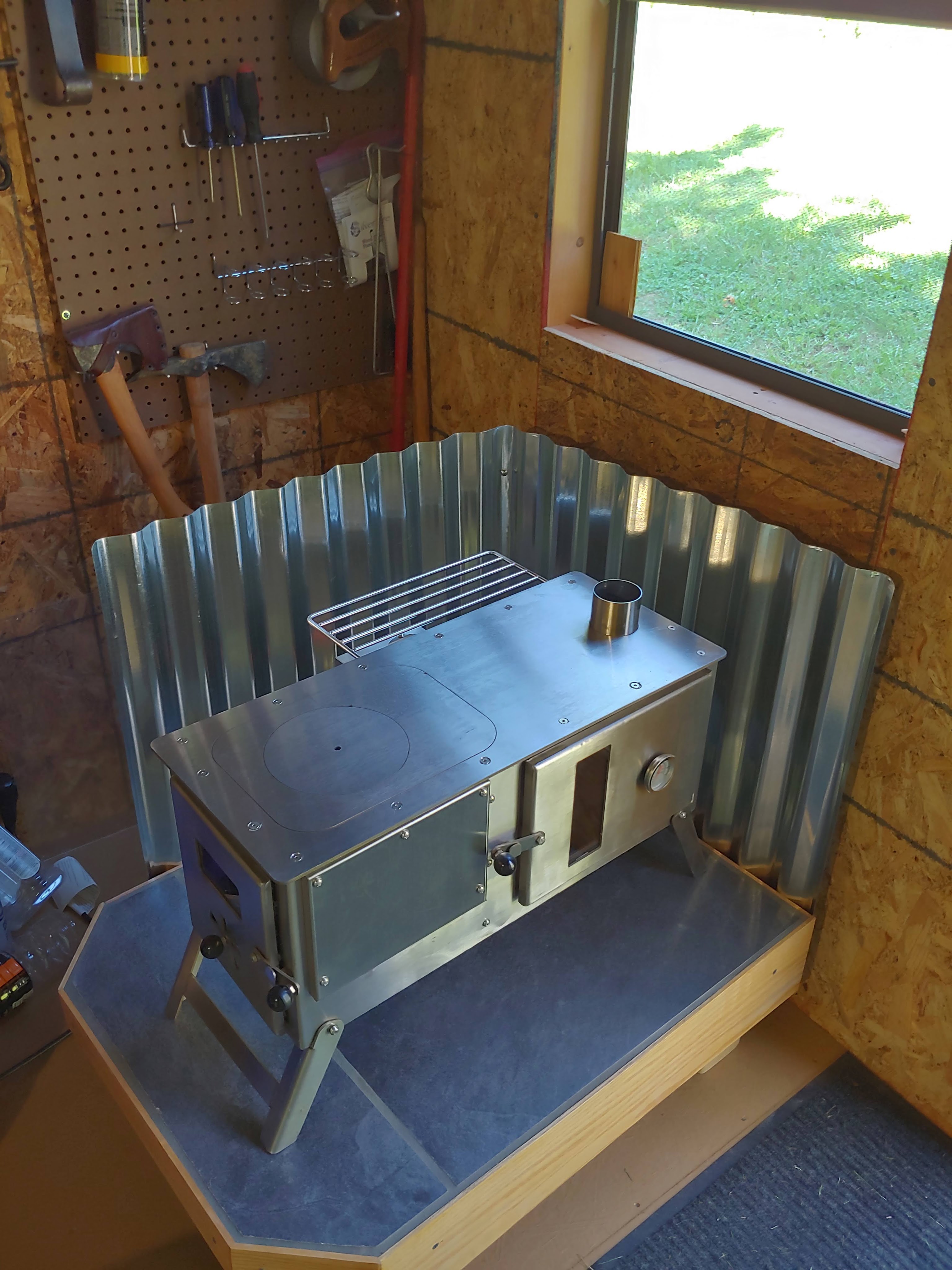
I managed to mostly finish my stove hearth and set my stove in place. The next piece to that puzzle would be the window setup to accept the stove pipe. The hearth was designed to provide heat shielding around the stove so it wouldn’t set the building on fire. The metal shielding would hopefully create an updraft to help circulate the heat as well. In my small space I’m not sure that was necessary. Later I would put more shielding on the wall and the ceiling above the stove because it would burn so hot. It is a gasifier stove, which means it has extra air vents arranged around the firebox so that the smoke and gases inside would ignite and burn and very little smoke would come out the chimney. Fires in a gasifier are very smoky initially and I had a steep learning curve later on with how to manage it without smoking myself out. On some cold, bitter nights later on, I would spend a lot of time out under the stars after opening up the building and fanning it out until the air was breathable again. I never realized how much I smelled like a smoked ham until I moved back into the house.

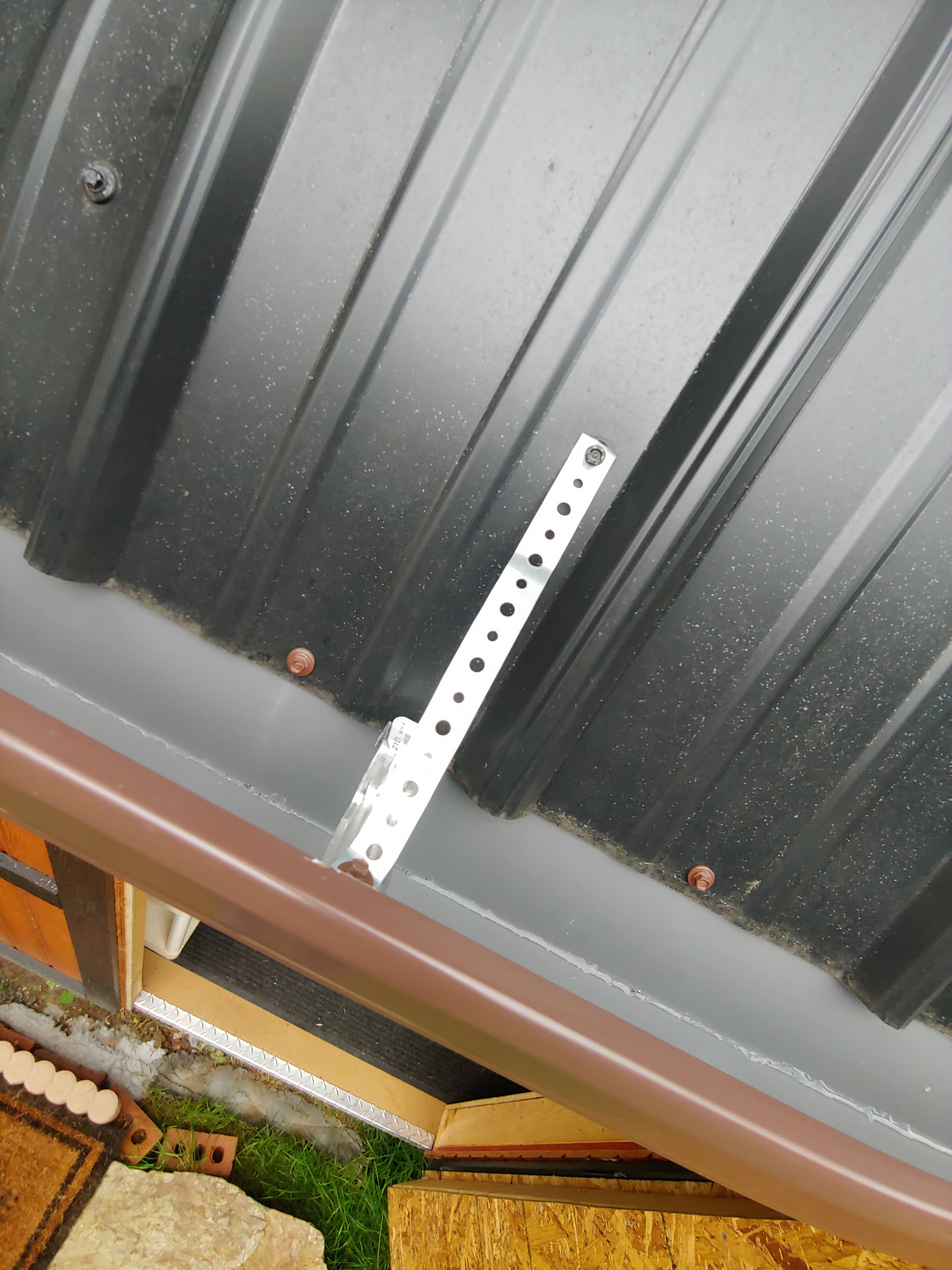
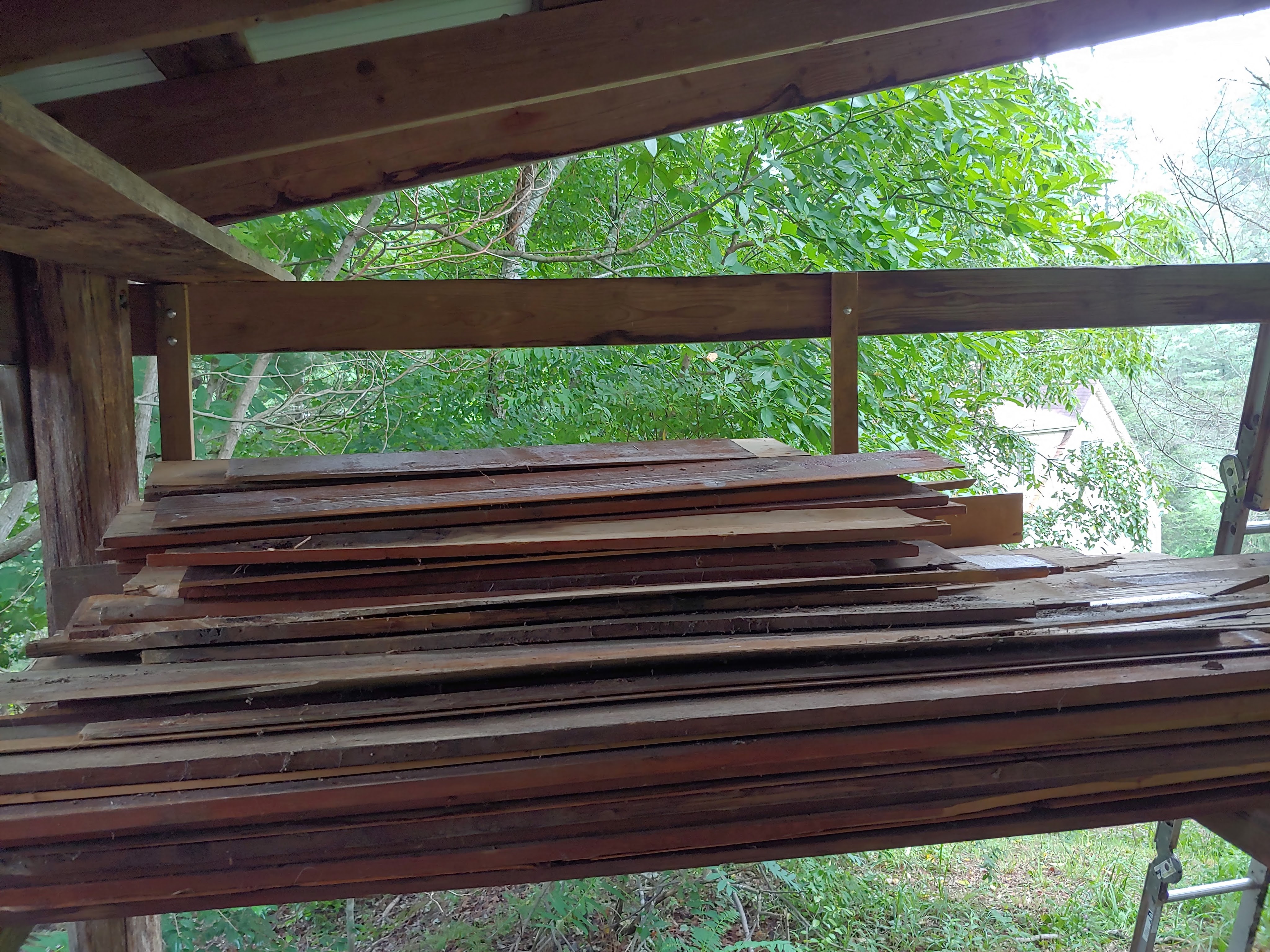
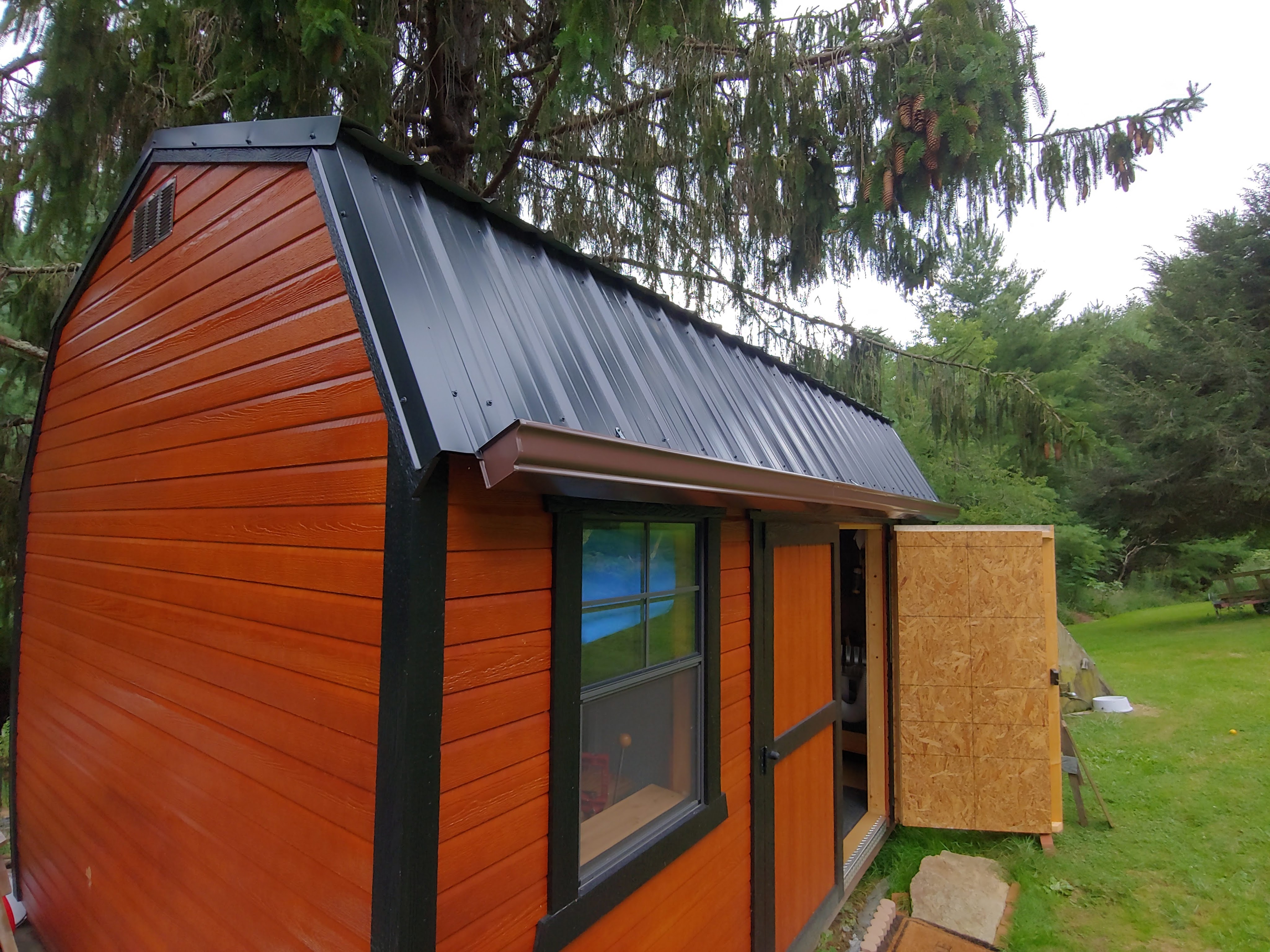
I worked more on tidying up the shed, where I built a rack to store stuff. All the extra cedar siding I had went up on the rack. The front of my building also dripped during the rain. I couldn’t open the door without getting a lot of splashing on it and into the building. I bought a length of gutter with the hardware and some metal plumbing strap to fortify it. I planned on it surviving a heavy snow load and it was a good thing I did. In time, it would pass the test with flying colors. The gutter helped it go from a mere outbuilding to a civilized housing unit.
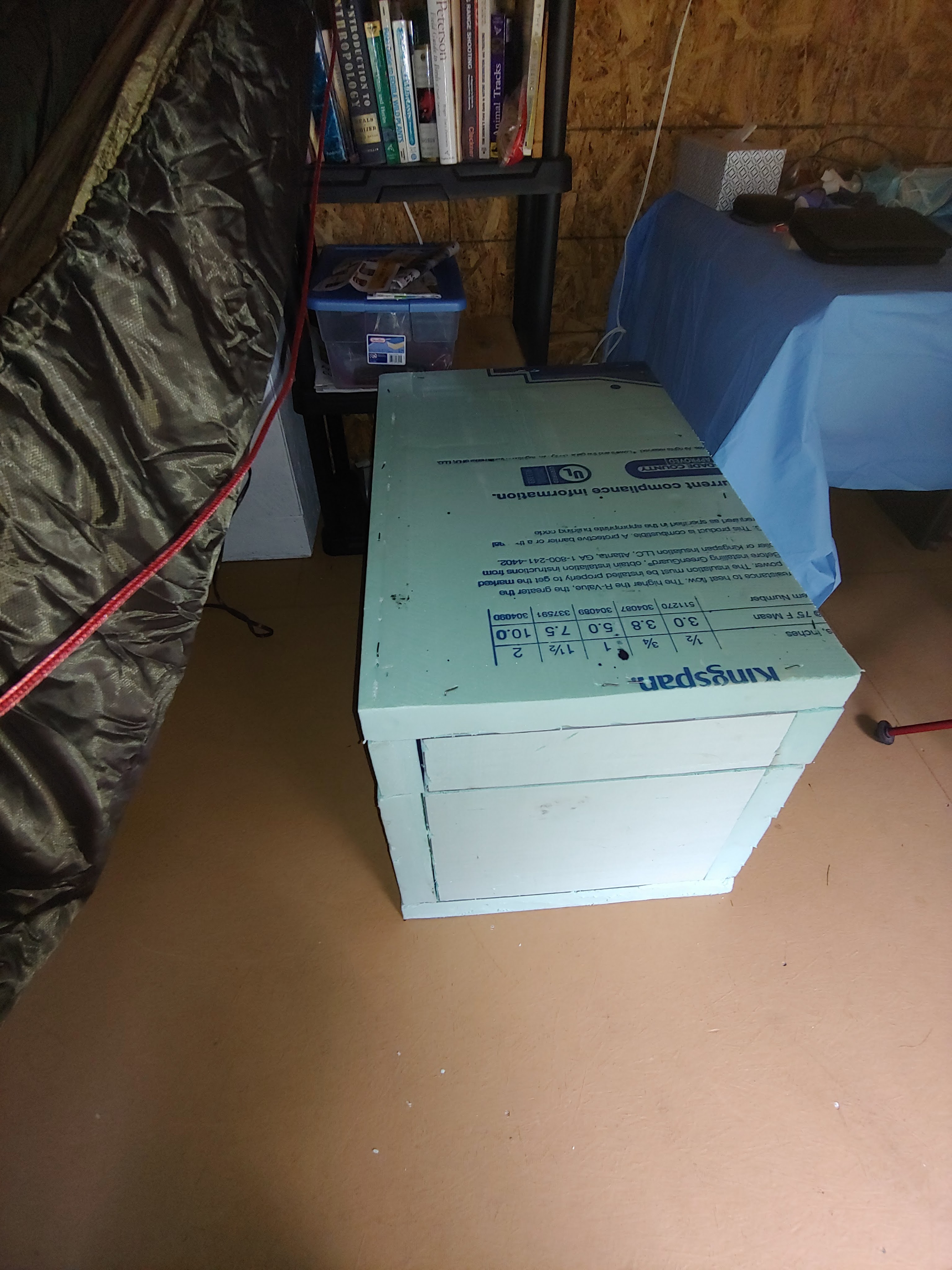
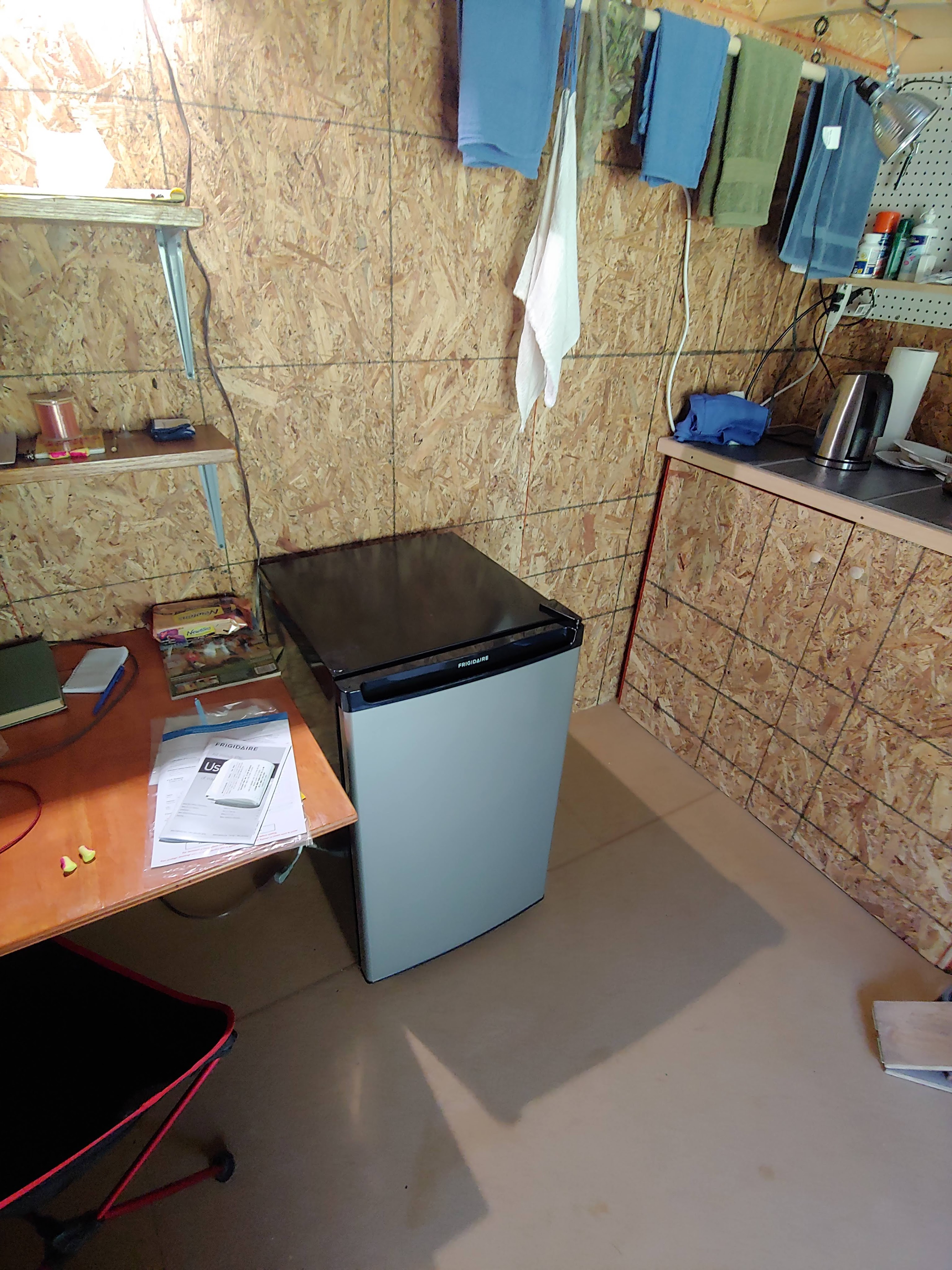
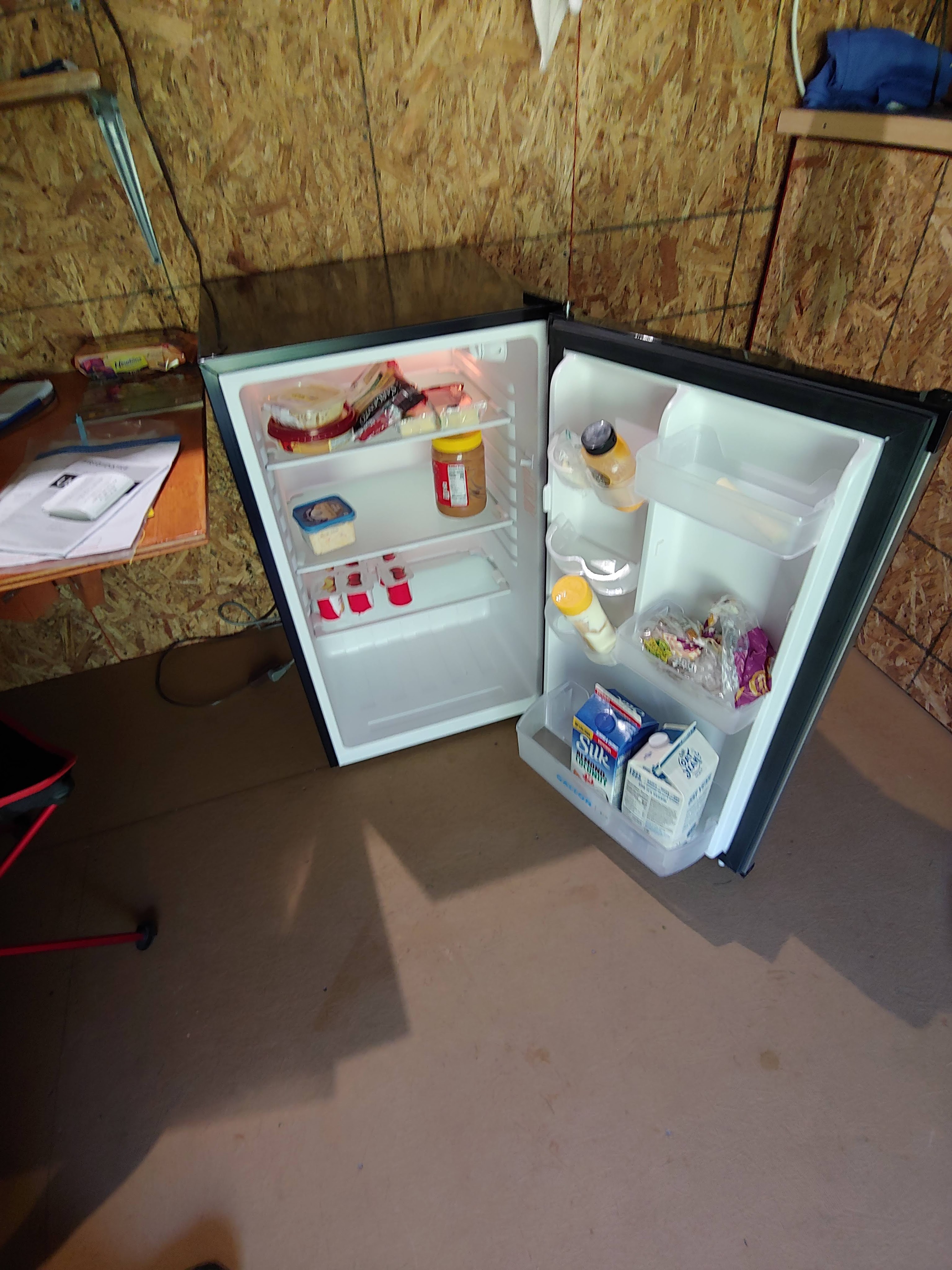
The next improvement came unexpectedly. I was keeping any food and drink cold in a cooler for which I had contrived a foam board box to make it more efficient. It was a pain to keep switching out frozen jugs and such in the August heat. Worse yet was the fact that the cooler would sweat inside the box continually, which required the occasional mopping out. It still wanted to develop black mold from the moisture. Somewhere I saw an advertisement for a mini fridge on sale at Lowe’s. I researched it along with other available models. I had to carefully consider the load it would place on my simple electrical system. After a short conversation with Lydeana about it, I picked up one of the last three they had. College was about to start back up and even though most weren’t going to classes, a lot of students were coming back to live locally, so those little fridges were flying out the door.

Having that fridge made it much nicer. I moved out that behemoth box and didn’t have to bother with jugs of ice, dampness or mold anymore. Modern convenience has its price of course. Sitting beside a fridge during a long cold winter while watching Netflix or reading will guarantee the need for a weight loss program later on. At that moment, as I stood there looking at my new fridge, that wasn’t a problem because with everything I was doing I was working it off faster than I had time to eat it.
A Table Makes a Home

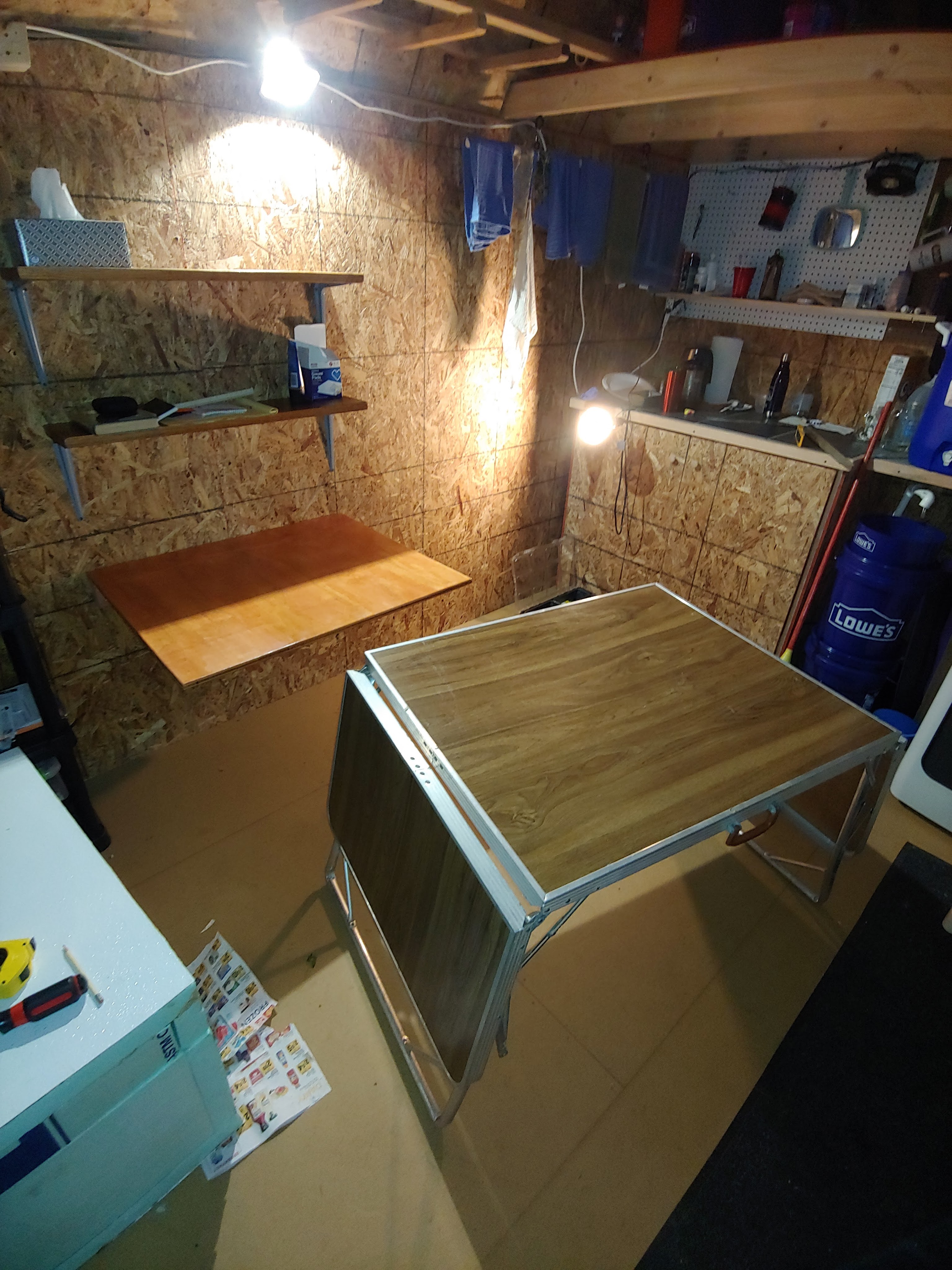
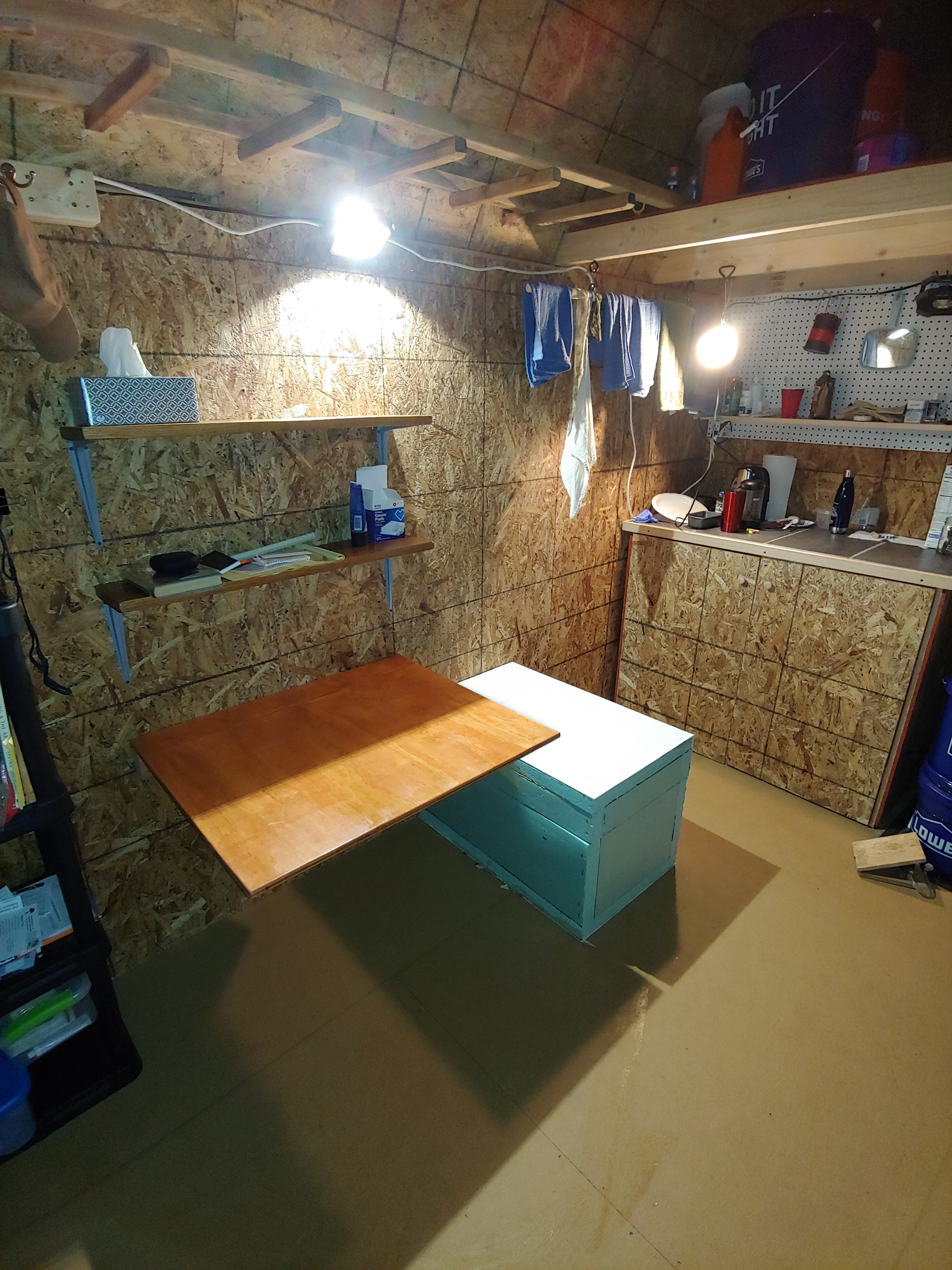
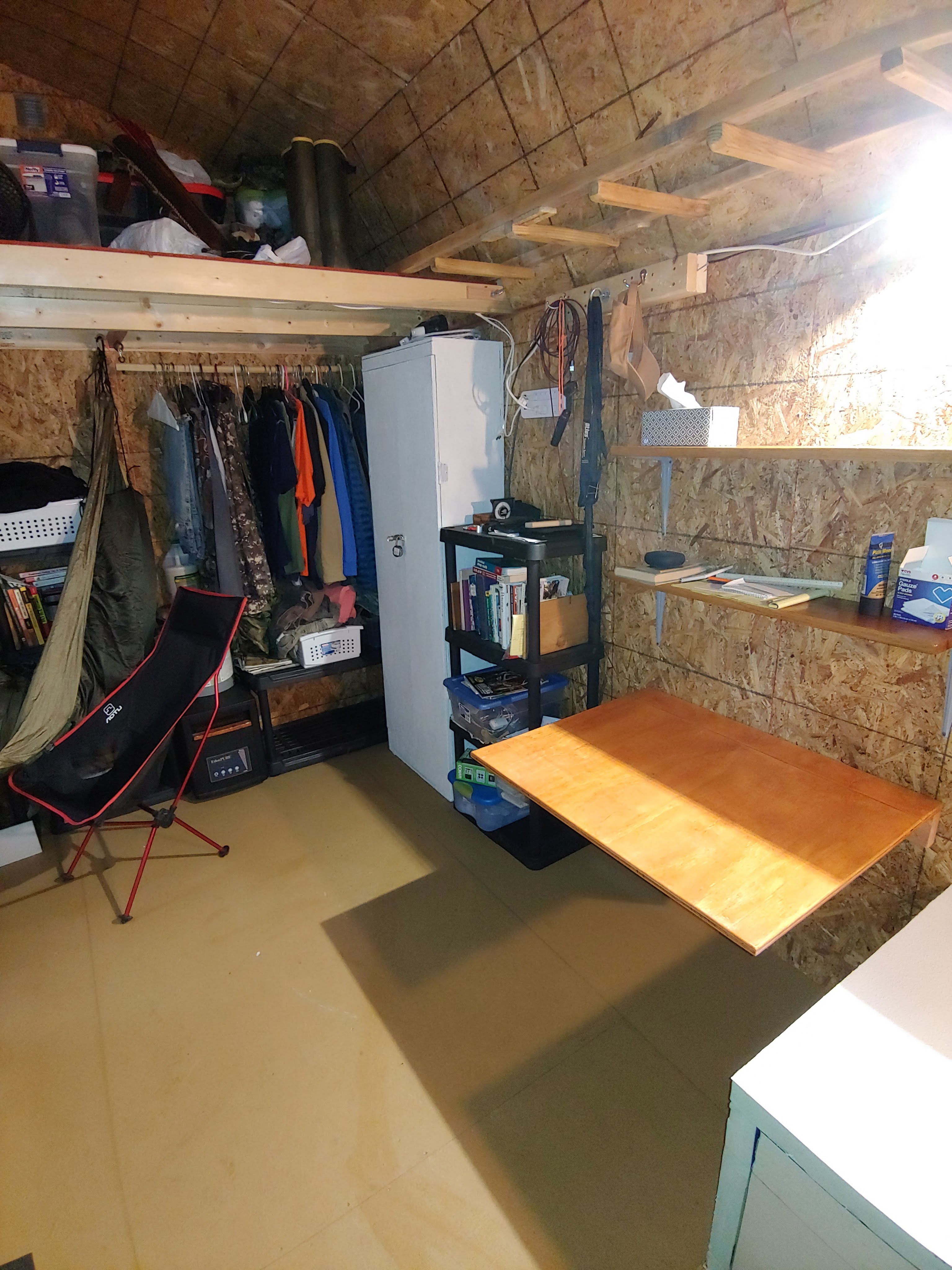
In our house there always seem to be three places where the most waking time is spent: the couch, the kitchen and the table. The shack doesn’t and most likely will never have a couch because of its space limitations. Two steps in the door and take an about-face to the right and you’re in the kitchen. About-face to the left and you’re in the bedroom. The literal centerpiece of the room is the table. I pulled an old folding table out of the garage to use initially until a better option was available. It took up far too much room, wasn’t very sturdy and the top sagged in from moisture damage to the thin Masonite top.

The search began in my mind to figure out what would best suit my needs. I wanted something the right size to be usable, but without taking up too much space or offering me too much room to clutter it up. If it were freestanding but shallow enough to leave plenty of room in the building, it might be a little tippy. The location would remain the same since all the other furniture and accoutrements were fairly well settled in place. Sitting at the table placed me squarely in the center of my little world. Measuring everything I could think of gave me some idea of the dimensions it would take. Several searches on Pinterest for design ideas and perusing various sites to look at commercially-made tables helped me form some ideas.

A folding table appealed to me to allow more space when desired or to tuck out of the way if I ever changed the layout. I didn’t expect this to be a work bench so it didn’t have to be a tank, but it needed to be reasonably sturdy and steady. Most decent folding plans had legs attached with crosspieces on the floor. I don’t like bumping my knees or my feet on stuff under a table. A solid one-piece table would be a space hog and might not fit well elsewhere if the layout was ever changed. There are several folding wall-mounted designs out there, which made good sense. Of course, none of them were exactly what I wanted, so the process of redesigning started.

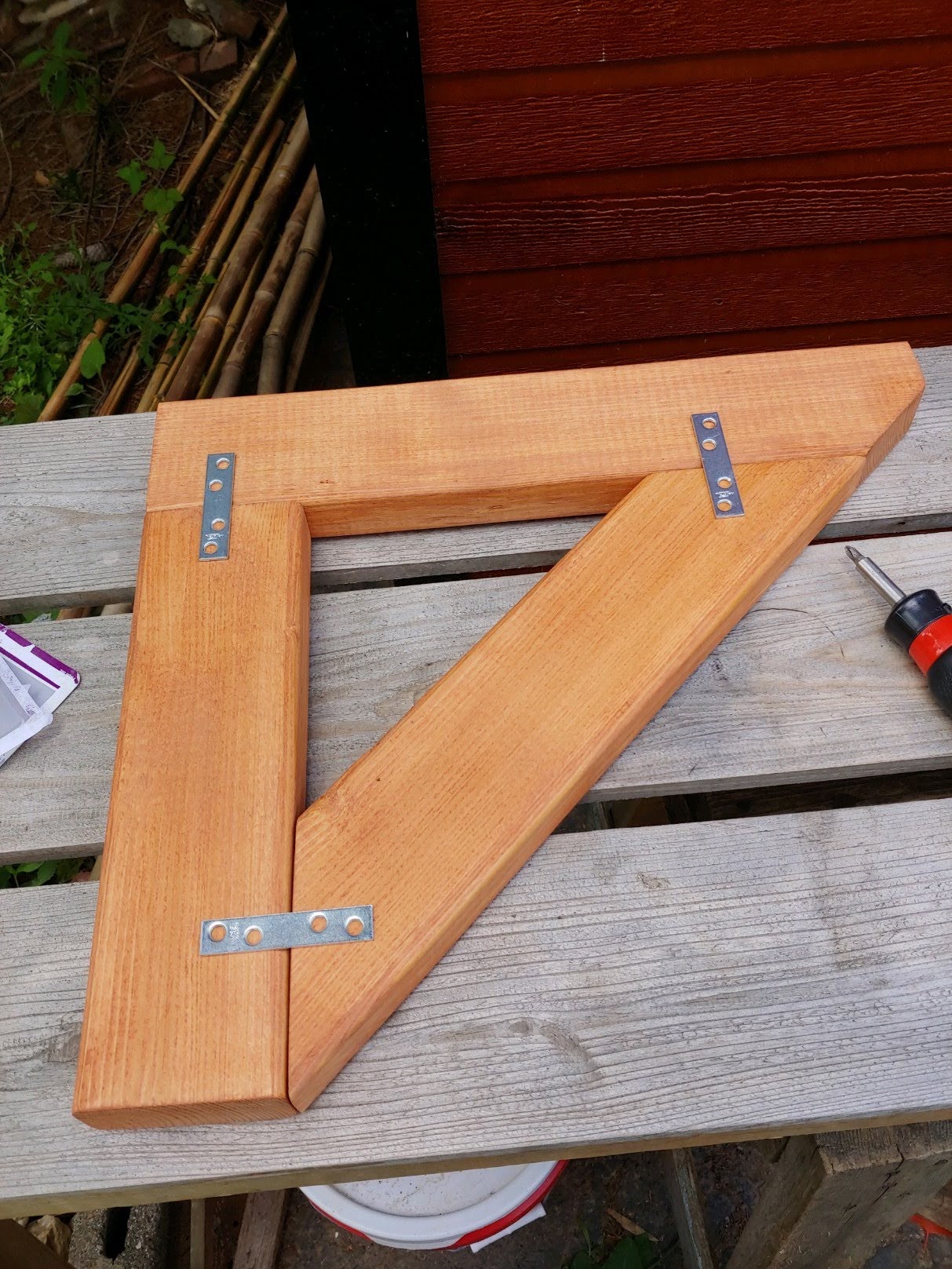
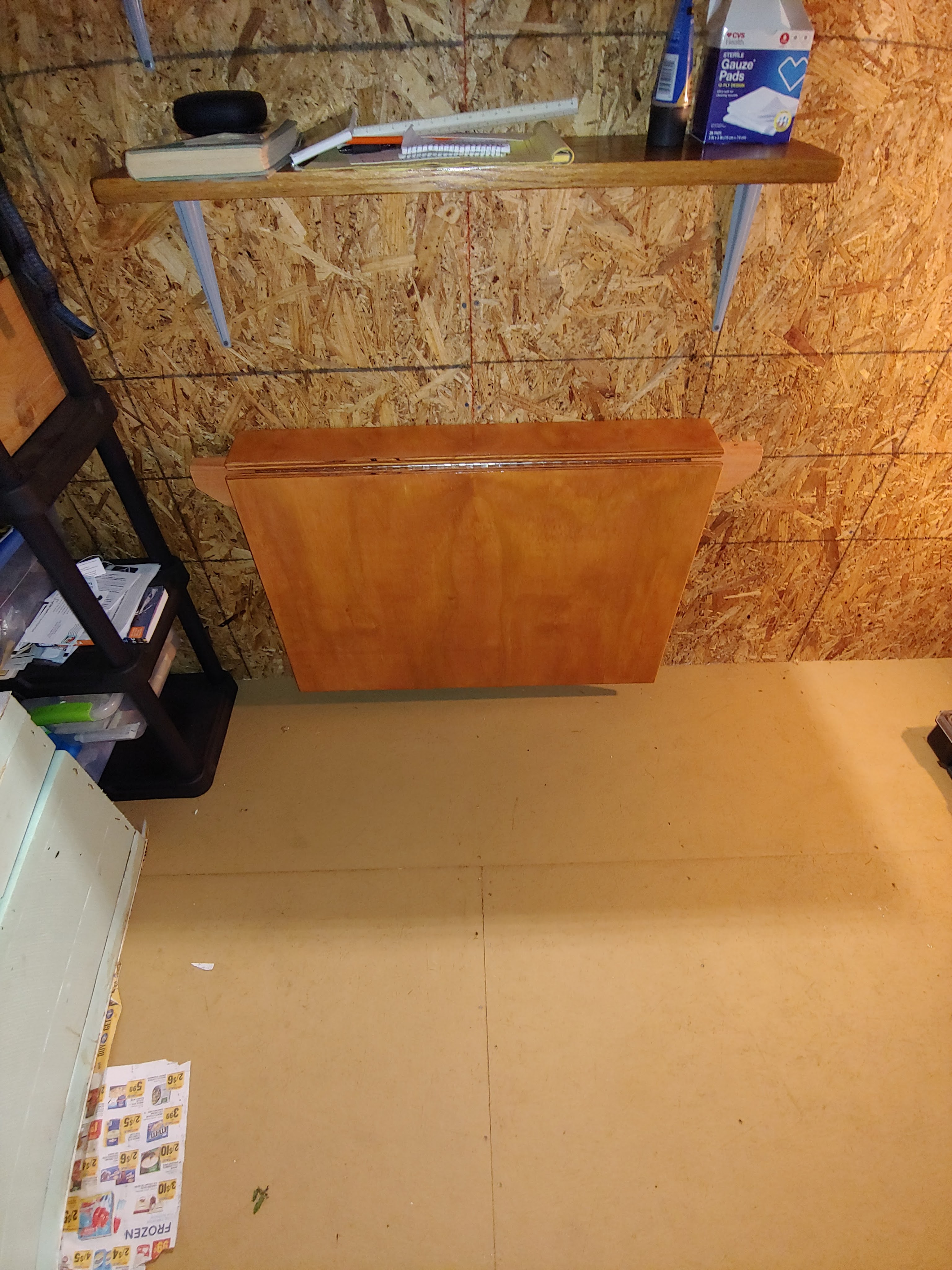
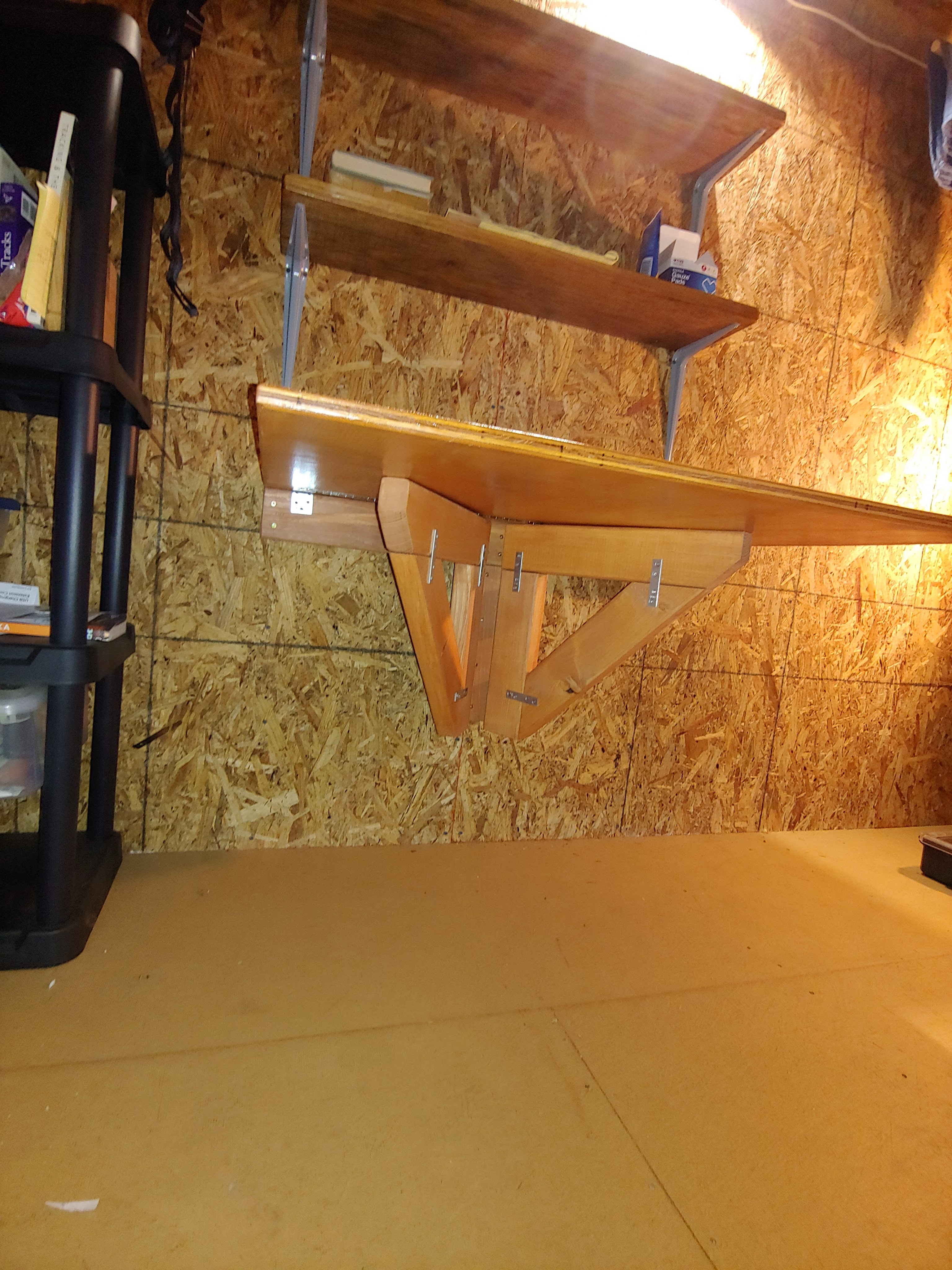
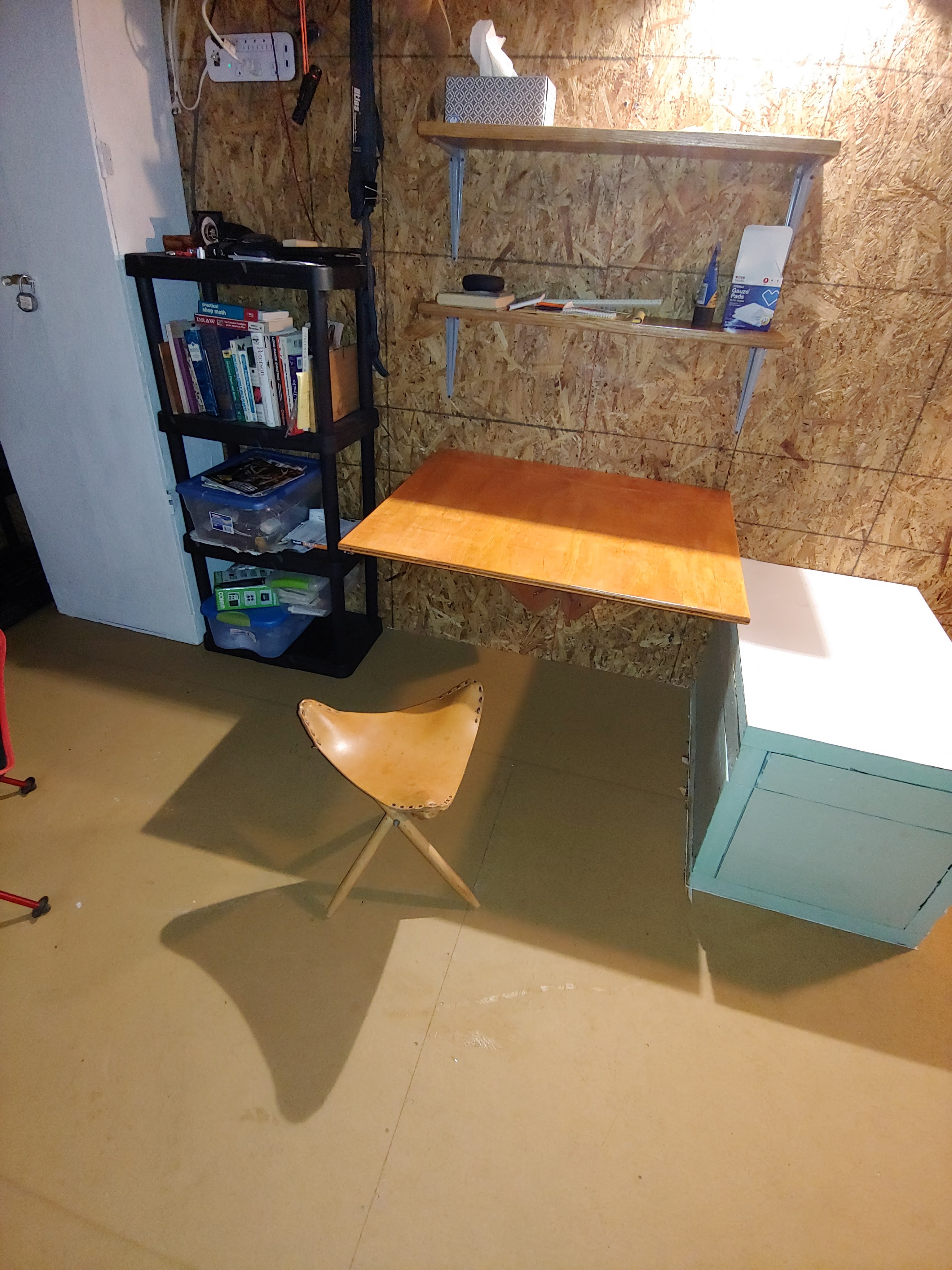
First and foremost, it had to be extremely affordable, i.e., cheap. Scrap 2 x 4, a piece of 3/4 inch plywood, some hardware, stain and preservative were necessary. All that, except some of the hardware, was on hand. The concept was a table that would fold down to the wall if not needed and could be instantly raised and supported with swing-out supports that would leave full leg room around three sides. But I had to keep in mind that the shack might ultimately live on beyond its beginnings as a pandemic-induced man cave– for example, when the power goes out. So the table needed to be just big enough for three people to eat off of if we ever had to camp out during a long power outage in the future. Unfortunately, it also only allowed for a three-hand game of cards during said outage. We would be out of luck if company came by to join for a game or two.

I drew up some plans for the dimensions dictated by the materials and available space. I had to do a lot of measuring while sitting at the old table to come up with the acceptable sizes of the swing-out supports so they would provide the most support without being obtrusive. I would be cutting a couple of angles and worked out the lengths on paper so I could cut the pieces once and put them together. Some paper, ruler, pencil and basic math skills made it pretty easy. I’d like to say I remembered some algebra, geometry and trig equations and figured it out, but that stuff is a distant vapor in my mind and works against the K.I.S.S. method I generally employ (Keep It Simple Stupid). I purchased the hardware I needed and started sorting out the wood pieces to cut.

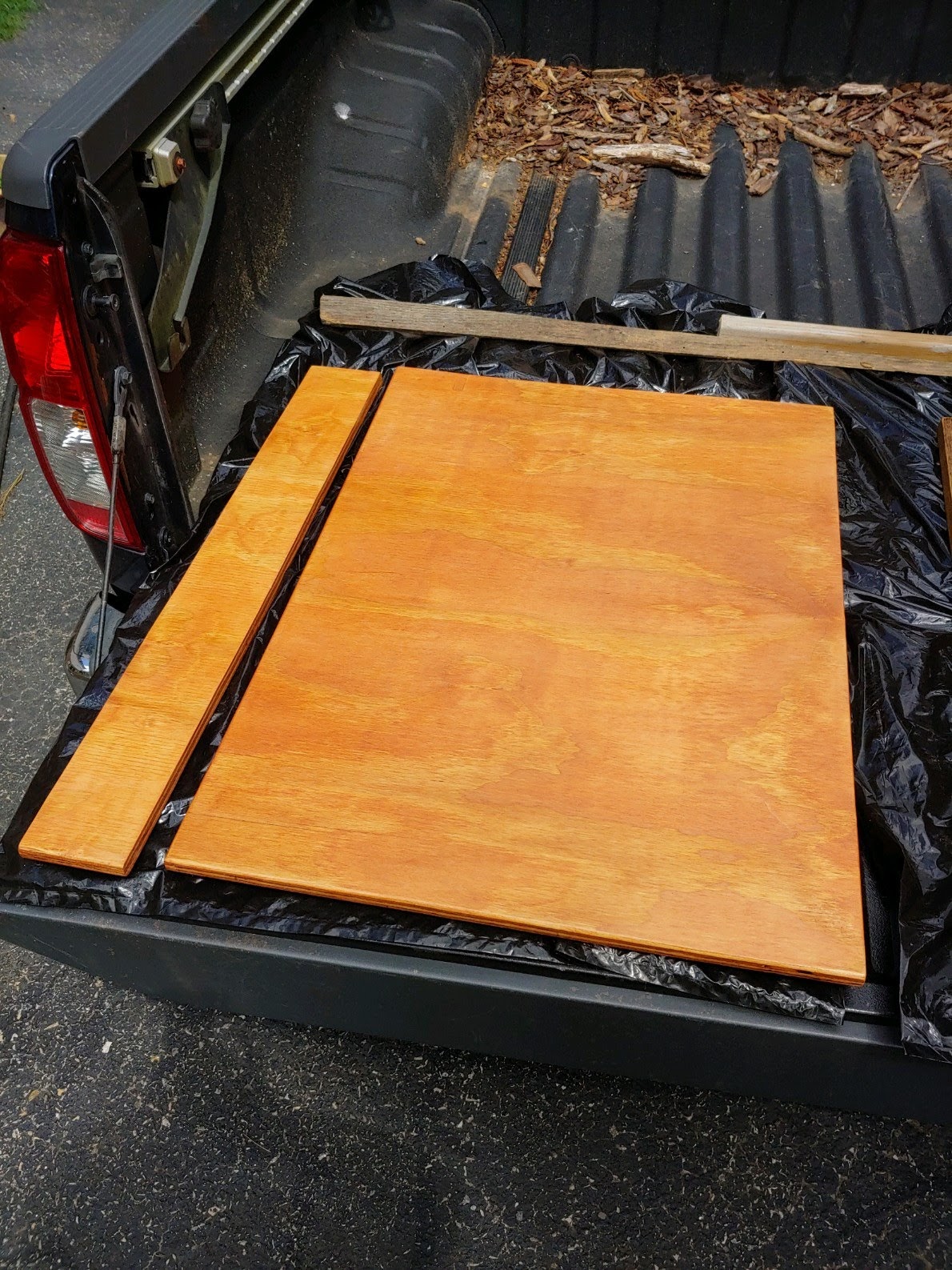
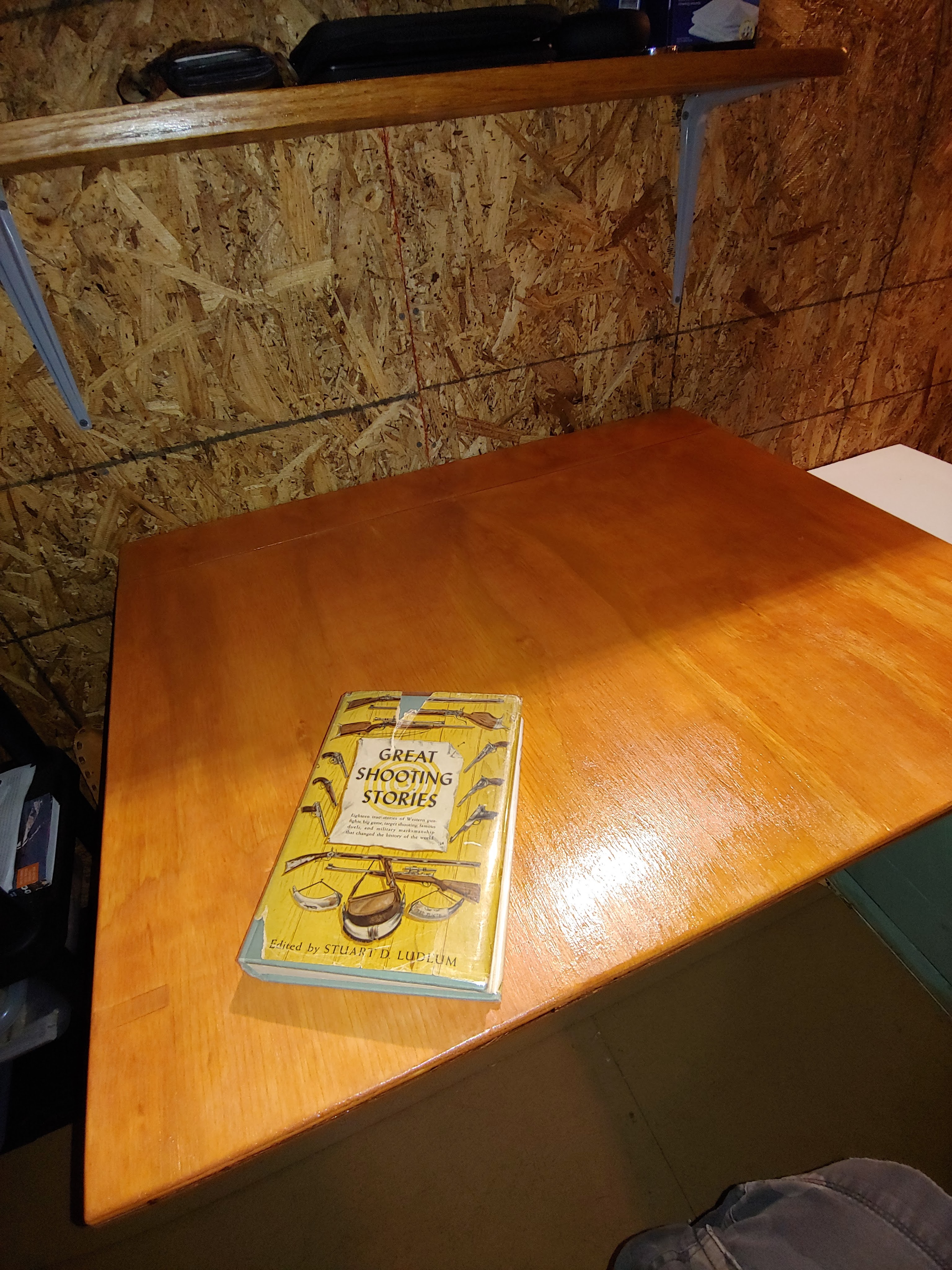
Several scrap pieces of 2 x 4 were used for my wall mounts and swing-out supports. A 28″ x 34″ top was cut from a 4′ x 4′ piece of plywood. A 4″ strip was cut off along the long side of the table top to mount to the wall and the rest would hinge off of that and cover the support braces and mounts when all was folded back. I don’t do fine woodwork or fancy joinery, so a piano hinge, some simple flat brackets, hinges and a bunch of screws would keep it together. I did use a router to round off the edges of the table, which helped give it a better look and feel. After staining all the wood parts and several coats of spar varnish on the top, it was time to put it together.

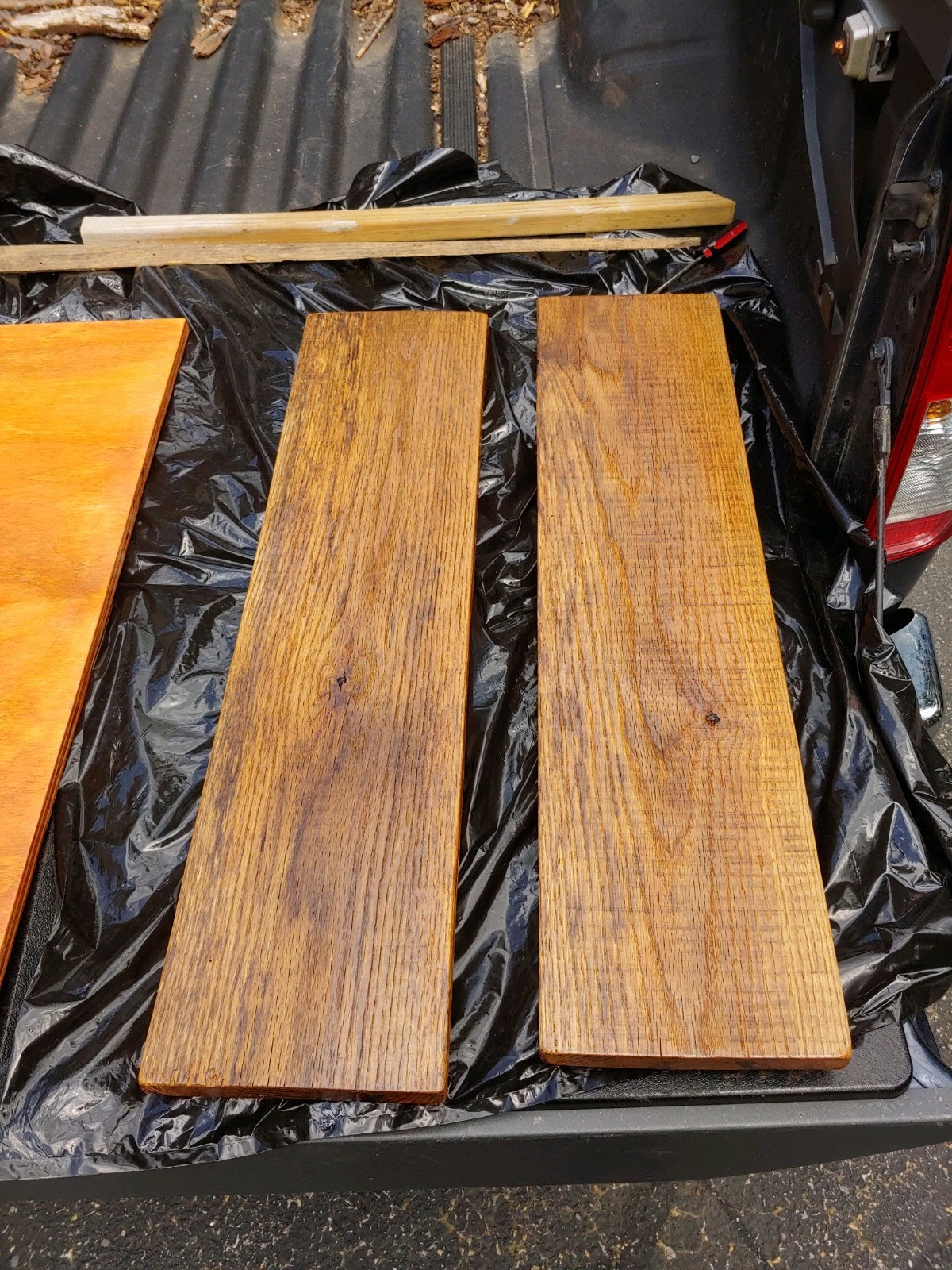
Two oak boards from the same stuff I used to make my shed rack were cut and sanded to be varnished along with the table top. They were going to be a couple of shelves over the table. All the cutting, shaping and sanding of things is no problem for me. Waiting for varnish to dry is torture. Doing it outdoors is a pain since you have to try to keep debris and insects out of it in the process. Poor light in the building helps a lot to hide those little gnat-induced imperfections.

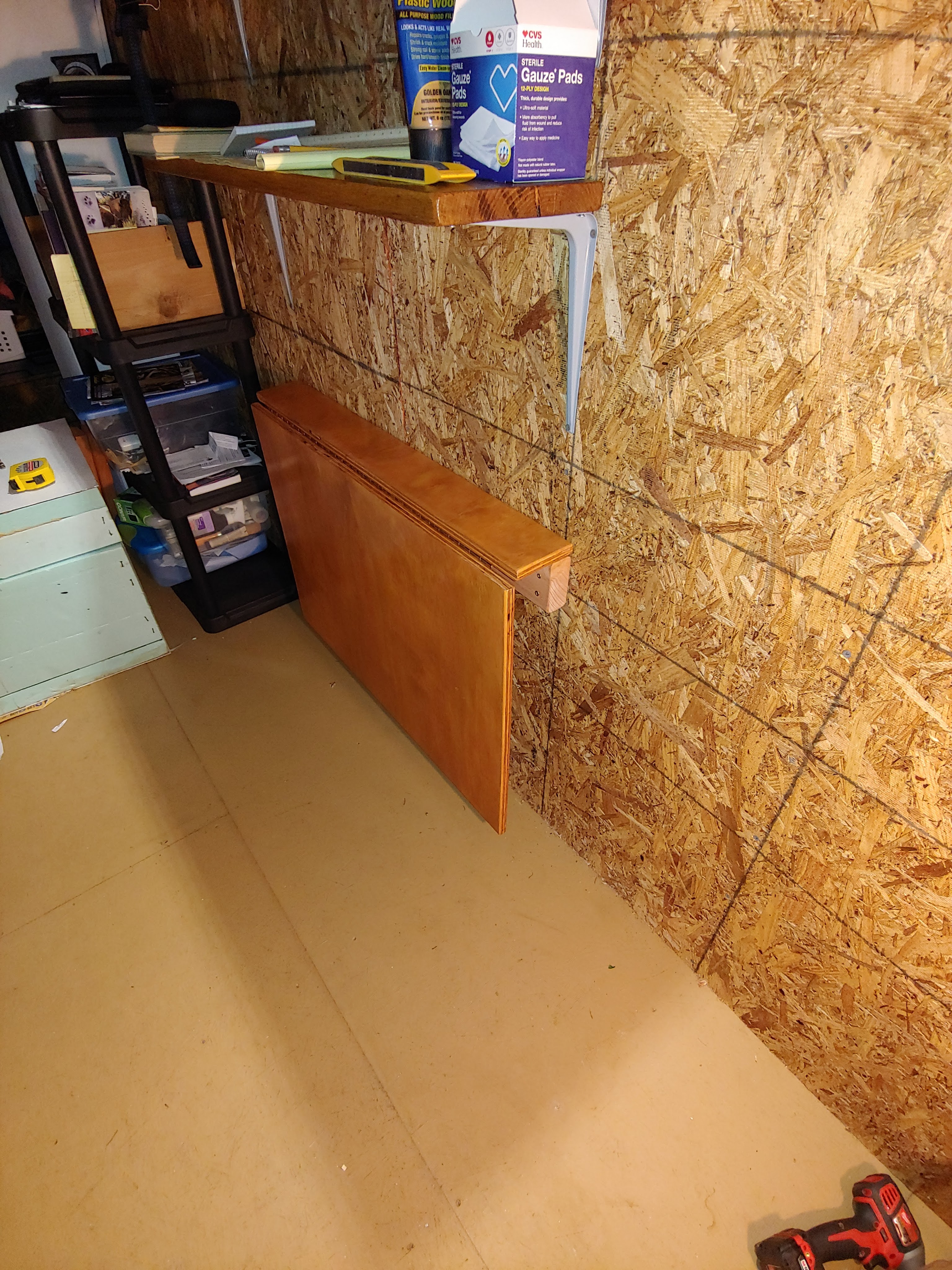
The finish was complete and dried a day before some rain set in. With nothing to be done outside, it was time to finish assembling and installing everything. The shelves went up quickly. The piano hinge was installed along with the 2 x 4 that would support the back strip of the table top. Using the old table to support the new, a level was used while screwing the whole piece to the wall. A single piece of 2 x 4 was screwed vertically to the wall to mount the swing out supports to. The swing-outs were attached with hinges and the whole thing was tested to see how well it fit. It was nearly perfect. One swing-out uses a shim from a piece of cereal box for it to be snug under the top. Everything was absolutely level, which shocked me considering the simple methods I used to put it together and mount it.
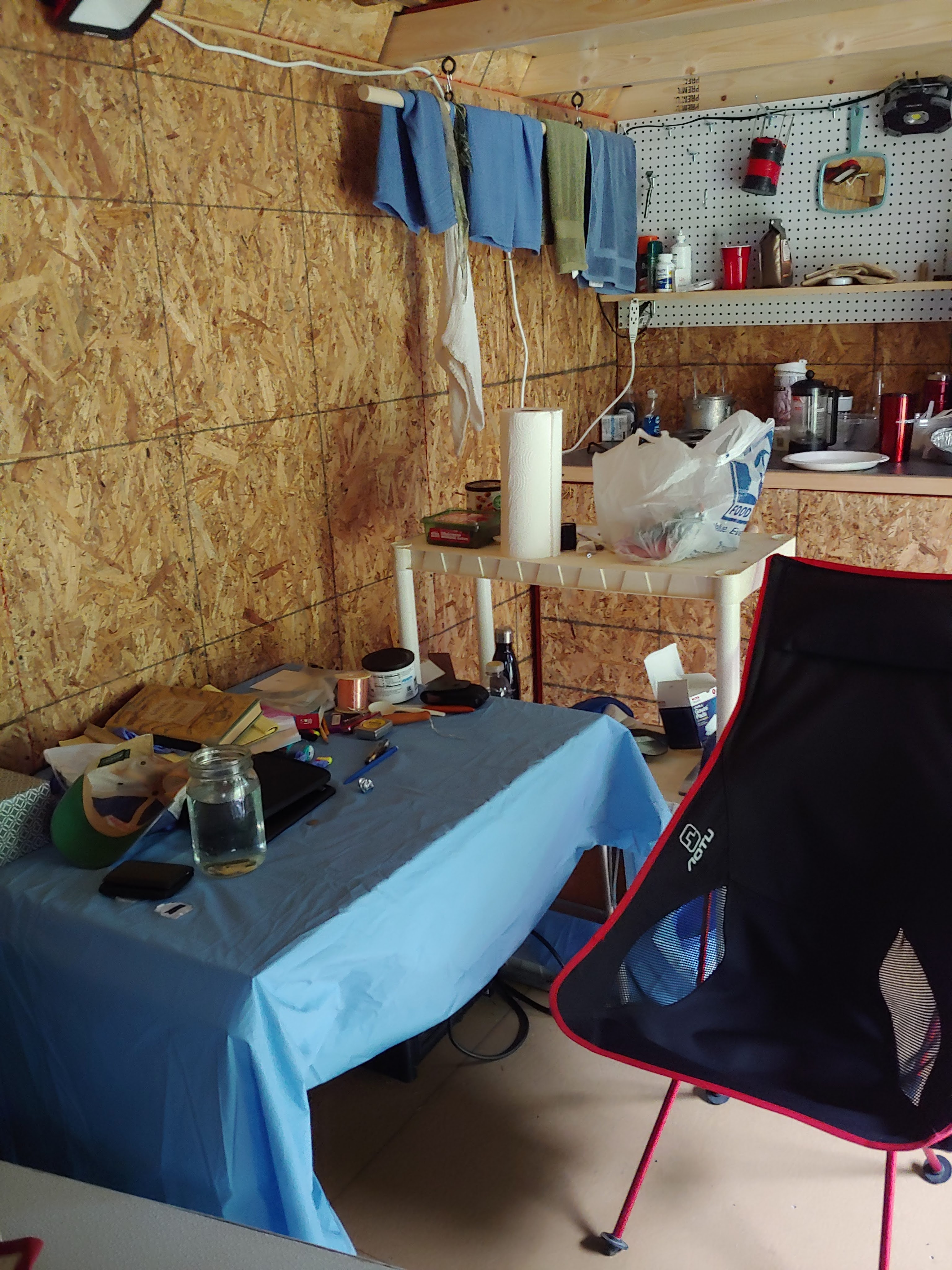
Once upon a time, long long ago, my brother and I rented an old cinderblock house on a farm out in the middle of nowhere. It was cold and very minimal, being more like a tool shed since we kept all the tools and materials for a handyman business in there with us. He put a couple of knickknacks up on the mantle over the stove. I asked him why and he said it made it feel a little more homey. I thought it was funny at the time given the setting. I walked into my little building to this new table and shelves that seemed to glow compared to the old contraption with a blue surgical drape for a table cover. It helped open up the space and took away the shed feel it had before. It would be the centerpiece for many a long, cold night to come. Now I understood. I was home.

The Rack of Pain

The hardest part of being a hoarder is knowing you have something you need and never finding it until after you’ve replaced it. This situation just magnifies the buildup of already unreasonable piles of junk. My dad would lay something down and that is where its home would be until laid elsewhere. My stepmom was a neat freak of the highest order. She organized similar things together for the most part, and no matter what, it would be in a neat if not outright decorative pile of items or boxes. She often covered cardboard boxes with contact paper to make them look nicer. Her organizational pattern was obvious in her mind, but not so much to the outside observer. It took someone with extensive personal experience to understand how her mind worked. I was that person.
We were thrown together early in my life, and as a family we had a large learning curve in how to live together. In some respects it never happened, and in others it did. I was an obedient, easygoing kid who became very rebellious over time. Along the way I somehow learned how to be both. My parents came from a time that a kid never said no or ignored an order or request. When told to do something, I did it no questions asked or suffered the consequences. When it wasn’t done to par, the consequences were not too great either. Somehow communication lines were cut from our brains to mouths and thus to each other, creating a plethora of consequences. It was a long, painful process to figure out how and what she was thinking. In the meantime I also learned both my parents’ organizational skills, or lack thereof.

It was vital to keep everything neat, clean and organized. Dad didn’t, but Mom did in her own convoluted way, and so did I. After leaving home I regressed into less regard for neatness, was particular about only certain things being clean, and my mind would retain the location of any item I laid down or put in a particular place. I did have particular places for particular things. As life went on and I accumulated stuff, the problem was having a place for it all. I would put something somewhere intending to organize or properly store it later as time became available. Just like storage space, time is rather limited, so I moved on without ever going back to complete my intentions.

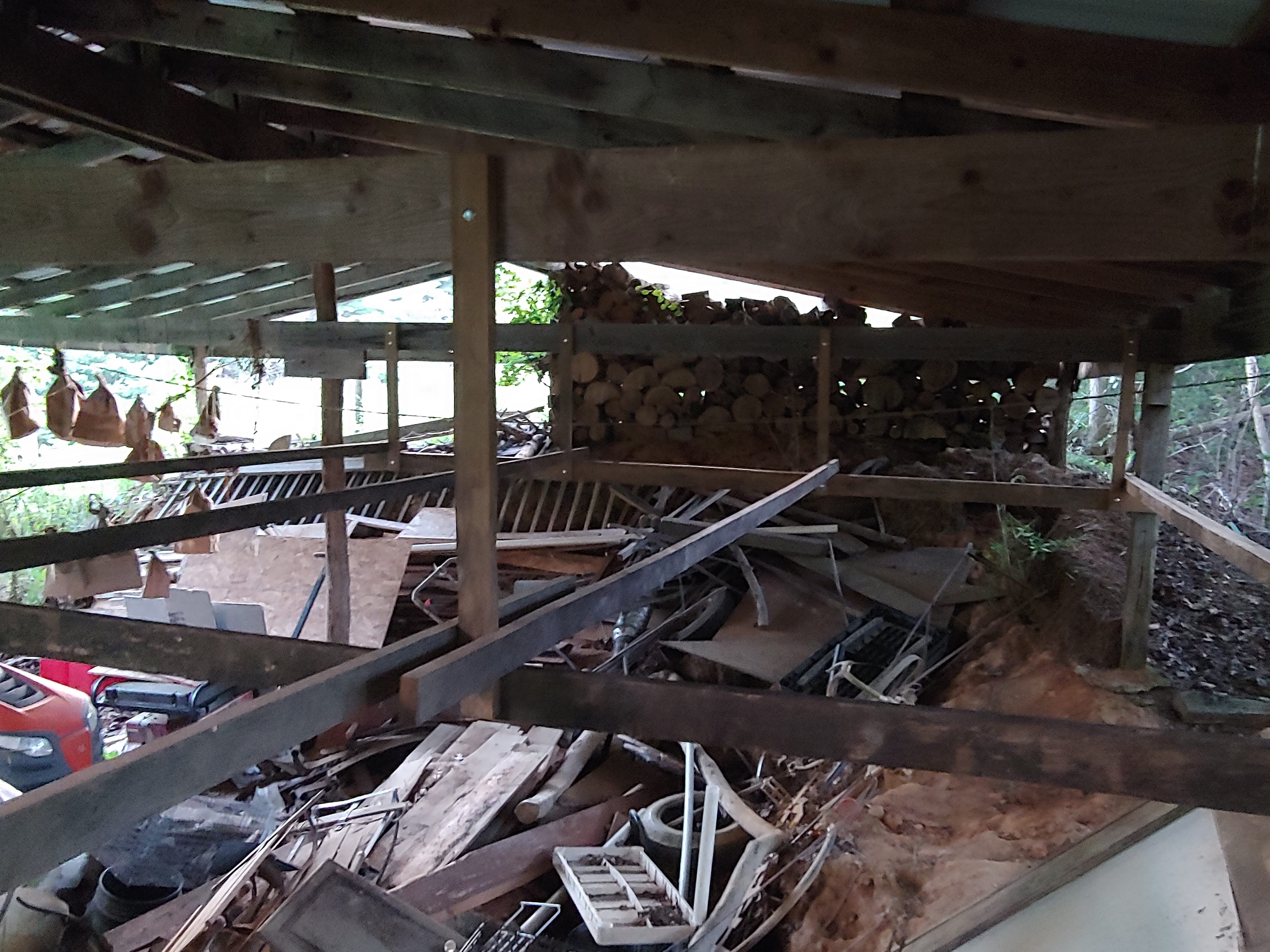
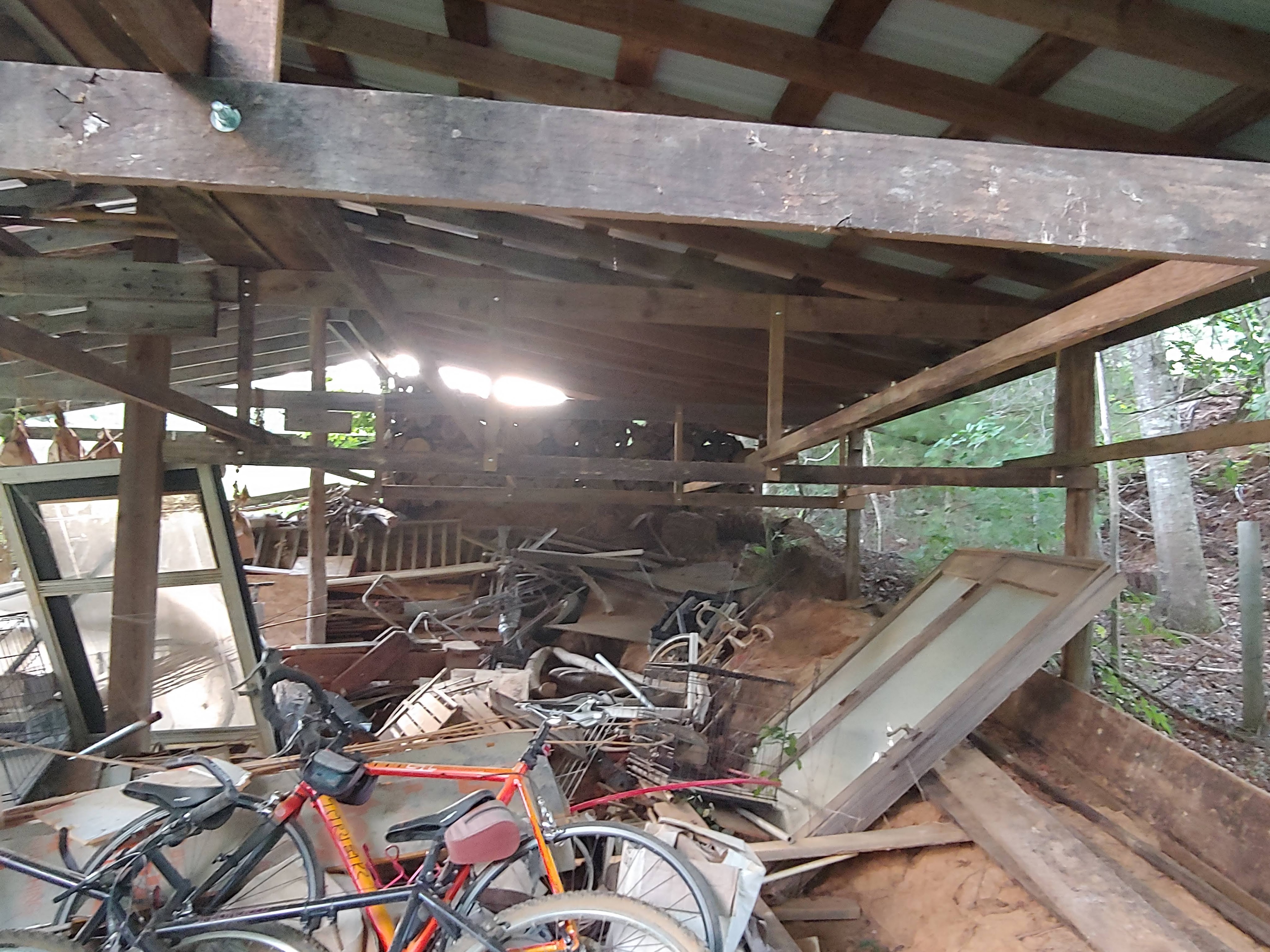
I built a shed on the back corner of the property long ago to have a place to work and keep a bunch of the accumulated stuff. Since we had added on to the house, it accumulated a lot of leftover building supplies. To this was added every odd and end, from old tires and broken-down equipment to any piece of wood or metal I thought would have a future use. Thinking back to all the old sheds, barns and houses I’ve seen full of old stuff, I realize I’m just carrying on a grand old tradition. It was a veritable goldmine. You had to dig and dig without knowing when, where or if you’d hit pay dirt. I’m much older now and my mind has a harder time retaining the location of objects laid down, along with any surety of their actual existence. This became a real issue when I started looking for materials for my various building projects. It is great when I find something I don’t remember having. Things go really bad when I know I have something and no trace can be found, especially when I remember casually seeing it in more recent times.

I decided to build a wood rack of sorts in the shed so I could put wood and other items up high off of the ground and be more organized. That way, I could find the materials I wanted far easier. The potential downside was that I was making more room to keep even more junk. Nothing tried, nothing gained, I guess. During my vacation I had started cutting oak boards into strips to bolt and screw into place. I didn’t want it to be so high that it was difficult to store or retrieve items, so I cut pieces to drop down from the framework of the building to attach my crosspieces to. I purchased the appropriate number of nuts, bolts and washers plus some extra to allow for unforeseen complications or losses. Dropping a small item in this environment was the epitome of the needle in the haystack. I used my carpentry magnetic nail retriever a couple of times in the process.

I work four ten-hour days per week, so I have a day off during the week to get some things done. My next day off after my summer staycation, I got busy installing my rack. I added a wood bit to bore holes for the bolts that would give my rack the strength it needed and used my impact driver to put in the screws to stabilize the pieces, and I was in business. The interesting part was perching on various items and piles to get up to the spots I was working on. I have a versatile articulating ladder. Combinations of ladder and random objects and piles allowed me to reach wherever it was needed.

Everything was going fast and smooth until the very end. I would bore the holes for the pieces to go together, bolt the piece in place and use three inch screws, strategically placed, to keep the whole thing from swinging and add a little more strength. Newton’s third law states that for every action, there is an equal and opposite reaction. This necessitated holding the frame from one direction while driving a drill bit and screw from another direction. Oak is hard stuff requiring a lot of force. Sometimes only body weight is needed to provide the appropriate resistance. Perched on random dubious items reaching up over my head required using some muscle to help force things where they needed to go. I’m always very aware of my hands and body in regards to all possible hazards in these situations. I’ve managed to keep all my fingers and toes through some extremely hazardous occupations and projects.

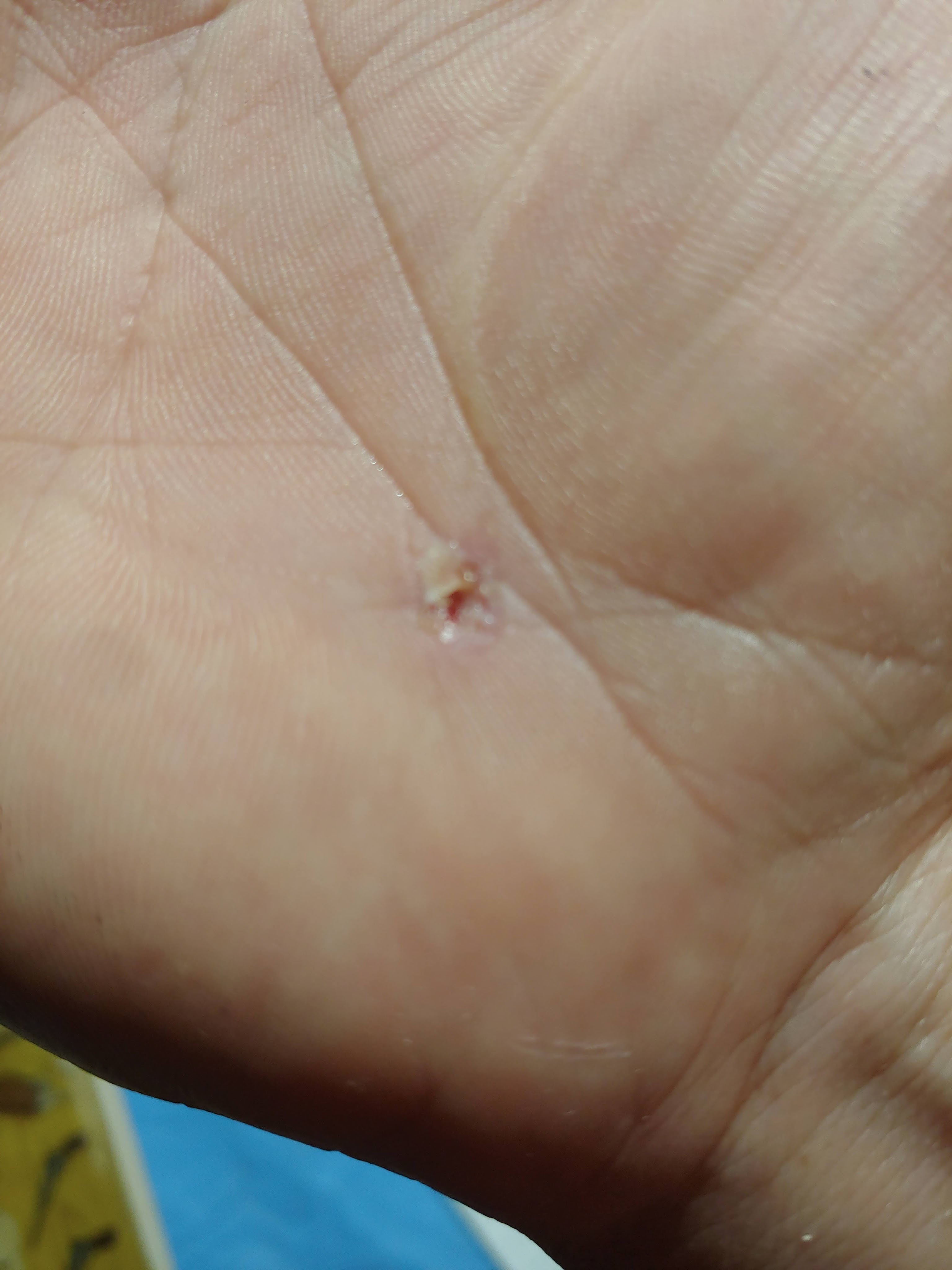
I was putting in the very last screw left-handed, while reaching high overhead at a weird angle with my other hand in what I thought was a safe spot to give me the force I needed to drive that screw into place. The impact driver slipped and I watched it in slow motion as it arched over the foot-and-a-half gap to sink into my palm. With all my strength committed, I was helpless to reverse it. It was probably good that the shed is far removed from human habitation. Any tender ears would have melted off after I finished a little outburst berating myself, the screw, the impact driver and several other things nearby.
There wasn’t any pain, at least not immediately. Shock in various forms protects us so we might get past the situation. Working in the operating room and being a nurse provides plenty of exposure to the sight of blood and wounds. I’ve seen what can appear to be major blood loss with no adverse effect on people. I’ve also seen major infection and what it does. I decided to let the blood flow and flush out particulates if possible to avoid infection. I had that one screw to finish driving so I repositioned myself with a different angle and drove it home while giving it a few names and words of encouragement.
One week after the incident

The spot where the impact driver hit me was close to a major nerve. The same nerve the nail was driven through when Jesus was crucified. My incident was either shallow enough or just off to the side enough to spare me that sort of torture. Some soreness and stiffness was the extent of my suffering. I did go to great effort to protect it from infection, especially at work. It would be a little while before I started digging stuff out and putting it on the rack. The shed was the ultimate place to get infected since mice and other critters had made it a virtual apartment complex.
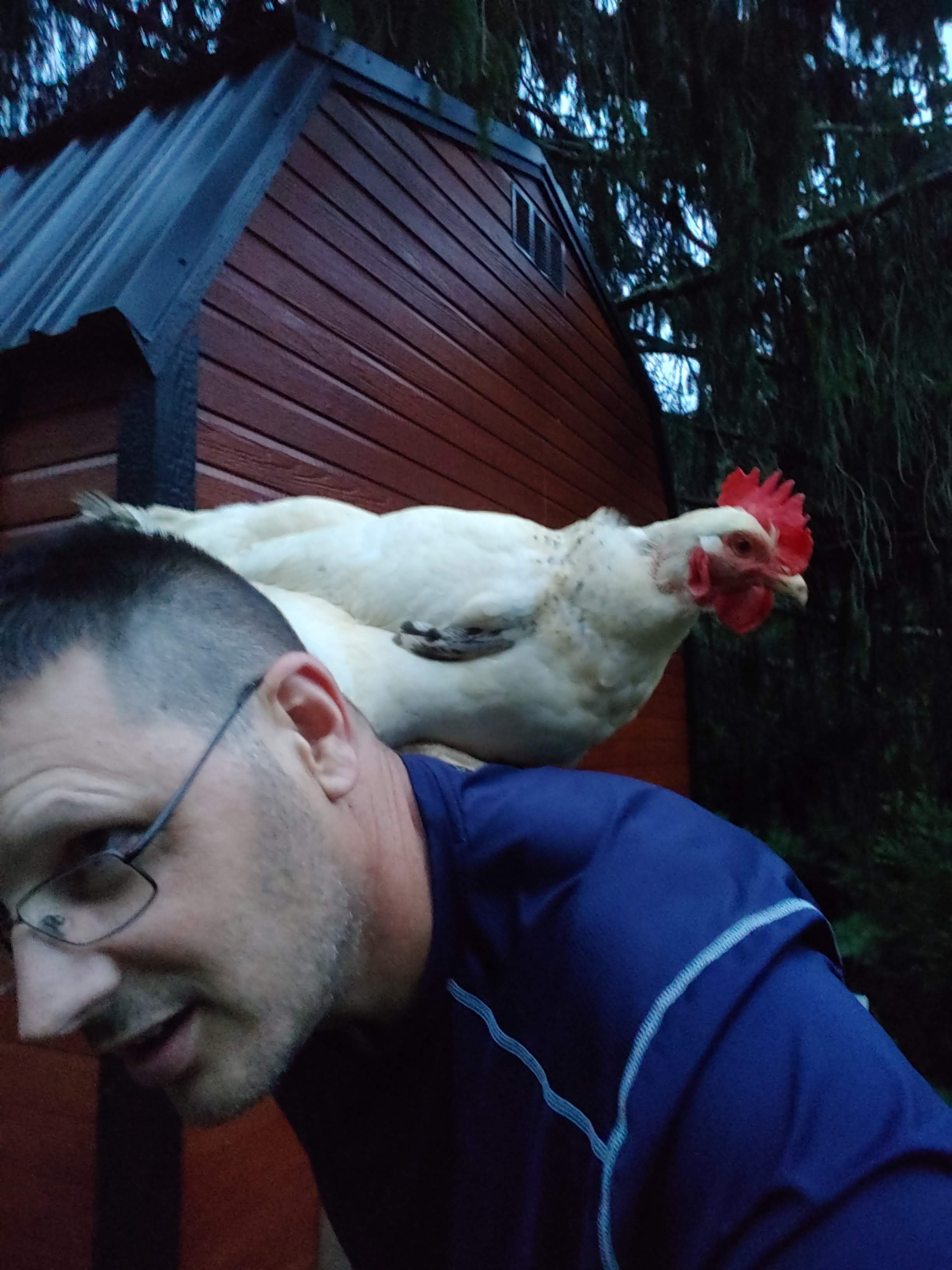
An odd thing happened a couple nights later that proved to me that animals have souls. I was taking care of the basic chores as twilight set in, being careful with my wrapped hand. Lucky, my chicken, came up to me acting somewhat agitated and with a fervor I’d never seen before or since. I squatted down to see what she wanted and she flew up onto my shoulders. She settled down there to stay as if that was where she belonged. I contend that animals have souls, because at a time I was dealing with the pain of my injury and the shame of my stupidity, I was being consoled by a chicken.

STAYCATION

With a week of vacation time this past summer came a rare opportunity. We always traveled in the past, never missing the chance to go see another place or revisit a favorite area. Along with most of the world that idea had to take a back seat. I hoped to get tested and be able to go inside for part of the time. The health department set up a time for Tuesday which would be at least four days after working and any possible exposure. There was no guarantee when the results would be back so I resolved to work on projects until then and hope they came back sooner than later.

The weekend passed building the gun cabinet one day and painting it and the tool cabinet the next. A funny thing happened when I was involved with these various building projects out in the driveway. The days were long and I would work until sundown or later. I would be so focused on what I was doing that time would seem to stand still. The summer sun would still be high in the sky when I would check the time and it would be around four or five o’clock. There was always several more hours left to start and possibly finish another major job before dark. The odd thing was, I hadn’t experienced anything like that in quite some time. As a kid there were days either working or playing that lasted forever. Time was irrelevant and there were few if any other engagements besides supper to occupy one’s thoughts.

It’s amazing what the lack of stress and worry can do for your perspective. I had a knack for getting into a project or job and focusing so intently to the exclusion of everything else that the world could have ended and I wouldn’t know it until I was done to my satisfaction. For example, as a teenager I had decided to make a knife out of an old file found in the old metal building we called the shop over through the woods from my parents’ house. All I had to work with was an old body grinder, vise and a coffee can full of water. I had learned a little about blade design and geometry from my brother and knew I had to keep the blade cool so as not to ruin the temper. A tedious process of clamping the blade, grinding, unclamping and cooling began early in the morning. Working by a dim light overhead in the back of that dark shop and no concept of time since I had no watch and couldn’t see the sun, a good eighteen hours passed. I think finishing the knife and the urge to pee was the straw that broke the camel’s back. I walked outside into the dark and decided that was enough. Making my way in the dark through the woods I went in the house and found they had saved some supper for me. I asked why they didn’t come get me and Dad said it sounded like I was busy. He gave me a proud grin when I showed him the knife I had produced. It was a piece of crap but I felt like had really accomplished something.

The same feeling came back to me building this stuff in the driveway. It was hot as Hades in the sun standing on black pavement. The sun didn’t seem to move much and time slowed to a crawl. Without the expectation of having to go to work and being totally quarantined before my test meant I had nothing else to do. With my mind totally focused and absolutely nothing to worry about I believe it started out as one of the best vacations ever.

Being the middle of summer I did have to contend with heat in the building. The old Igloo cooler I was using had a hard time keeping up. I traded out jugs of ice from the freezer in the basement on a regular basis. Even with an AC unit in the building the ice didn’t last long. Rather than pay big money for a name brand that may or may not work, I chose the cheapskate make-do method. I had purchased a two inch thick piece of foam insulation board to make a box for the cooler. I had also picked up some liquid nails to glue it together. When insulating the building, I had used insulation board and learned a couple tricks for cutting it. A cheap narrow putty knife with an edge ground on one side along with my straight edge and carpenter’s square allowed me to cut it cleanly. Blade geometry and design on cutting tools is everything. Foam board needs something thin to reduce friction or it just gets stuck and starts tearing out chunks.

Glueing was not going to provide enough strength and support to hold the box together. I had some wire flags for marking stuff on the ground that were repurposed as reinforcement. I cut the wire into 10 inch lengths and bent over the last inch past ninety degrees. Trying to push the wire into the foam was futile due to friction. Heating the tip of the wire with a propane torch allowed it to burn into place like it was butter. Inserting wires along all sides at the joints at different angles gave me the structural support to hold it together. With the cooler inside this box it would keep cold three times as long. Two problems with the system were it’s bulk and the fact that the cooler would sweat inside the box creating some mold issues in the future. In the meantime my food and drink stayed cold.

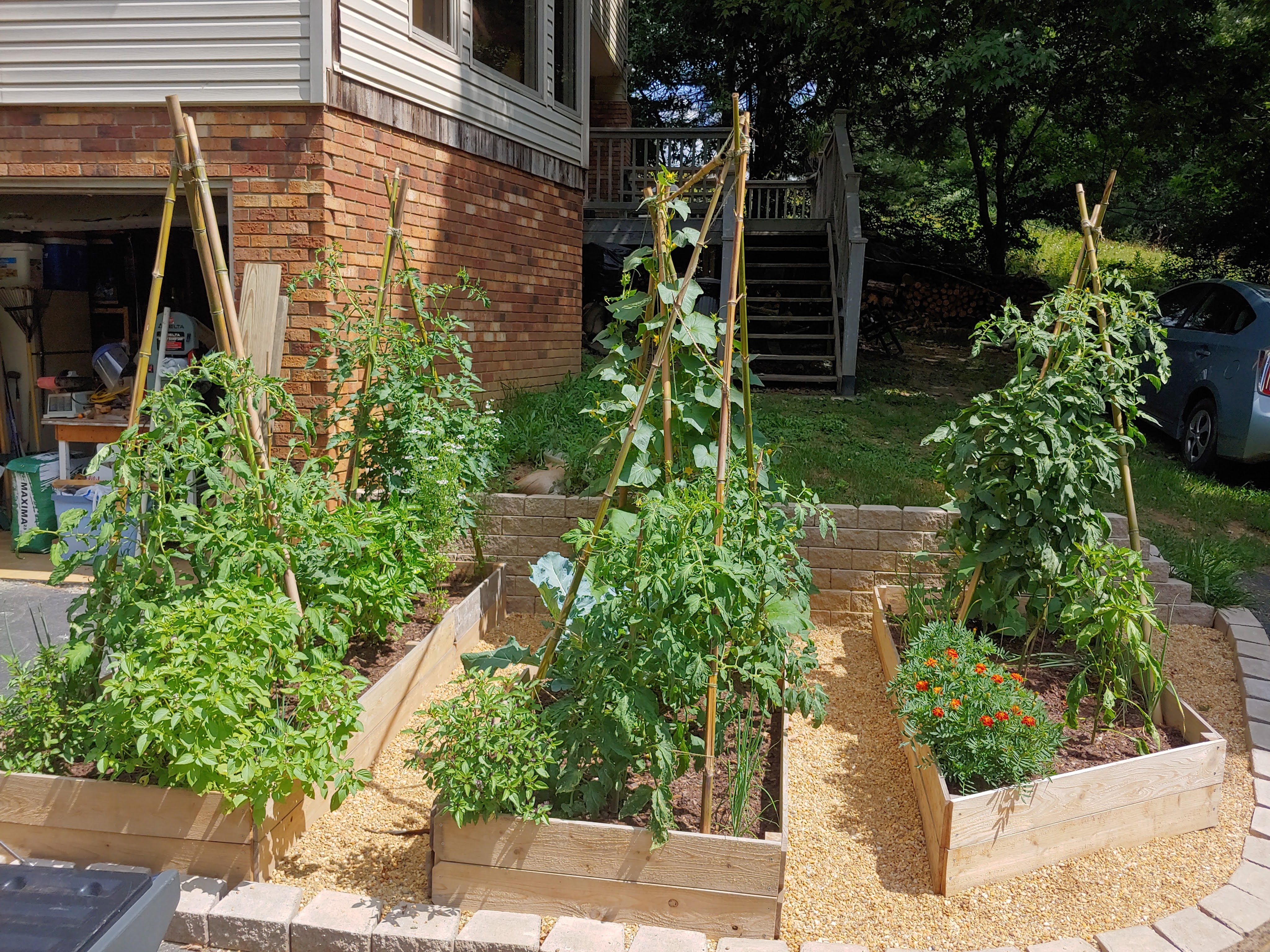
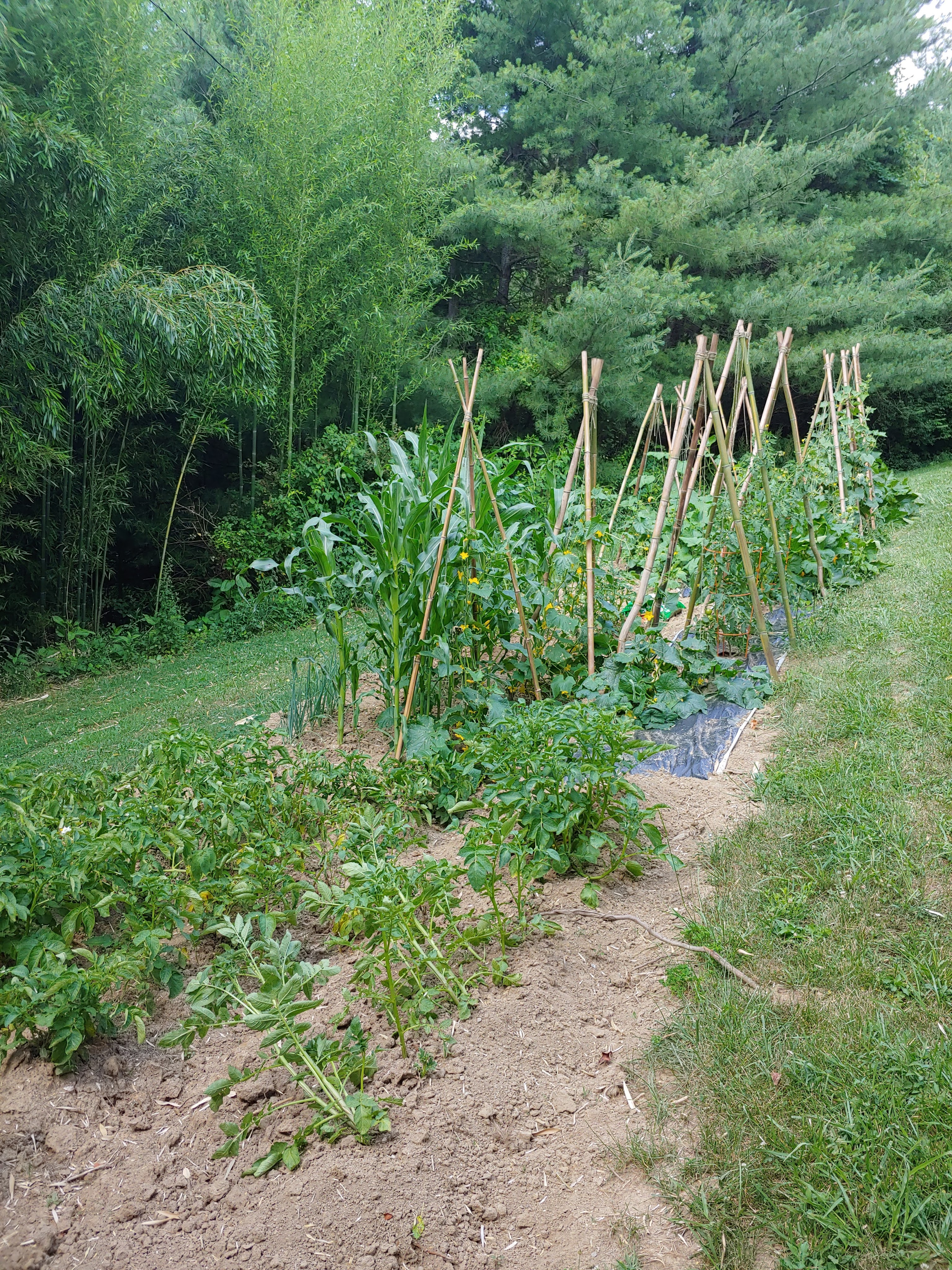
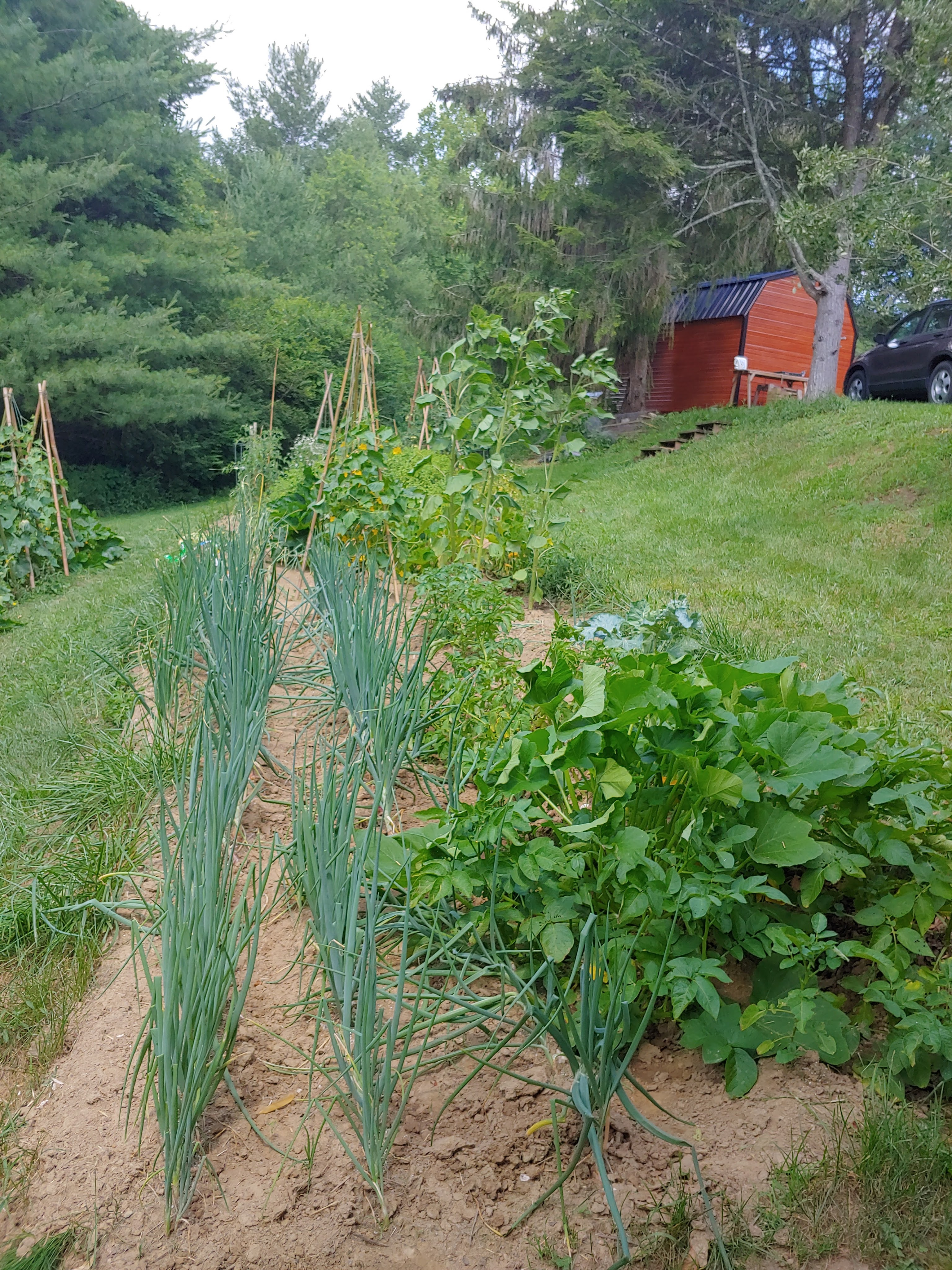
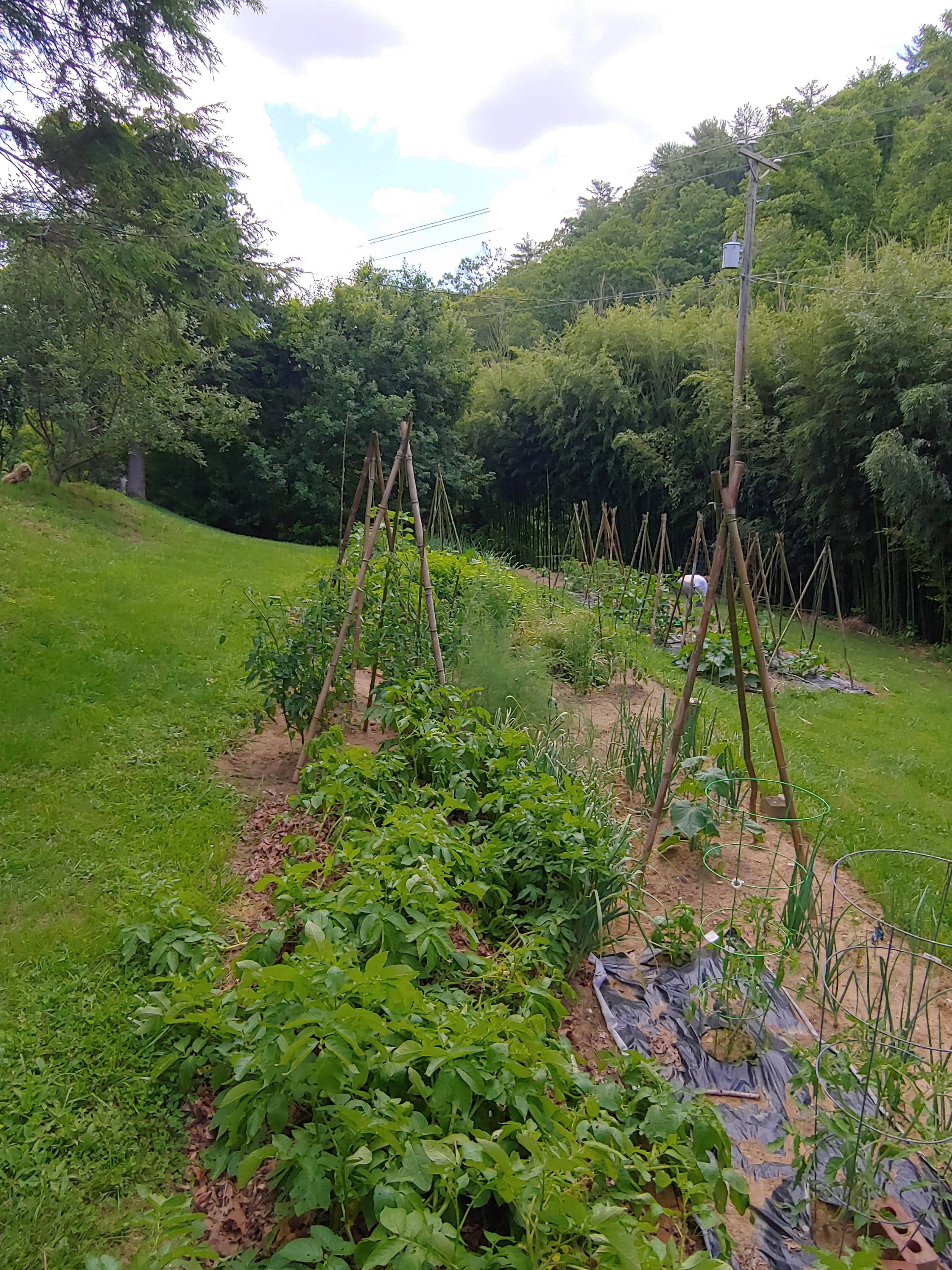
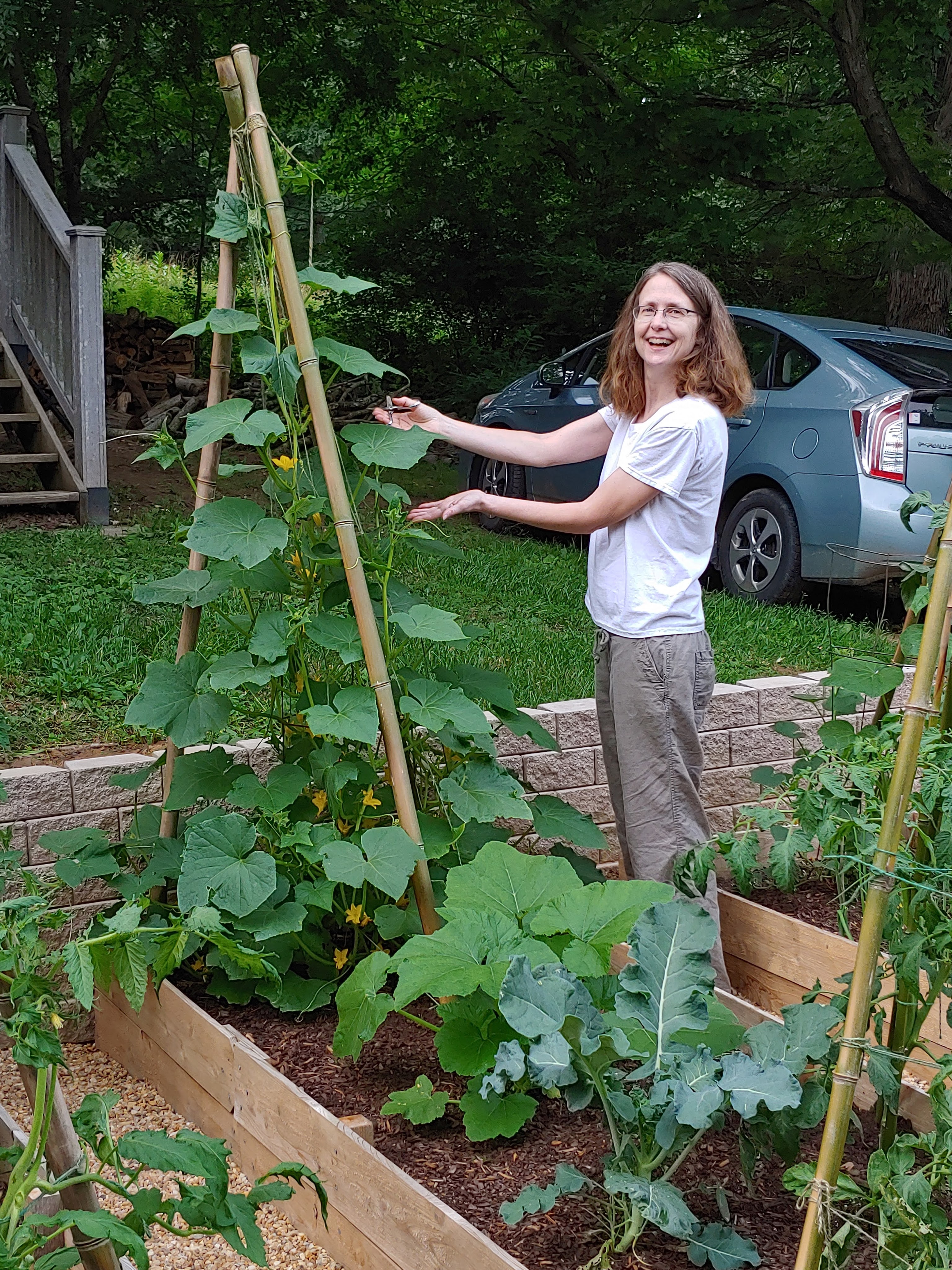
Our gardens were growing rather well this year since Lydeana was working from home and could walk out to work in them in the evenings on a regular basis while Shayley fixed supper. A lot of stuff needed something to run on for vertical support of some kind. After a pow-wow of sorts we decided bamboo tripods were the way to go. I had some laying dead after cutting it some months before so it wouldn’t want to spontaneously take root and create a rift in our marriage. Ironically, a Japanese-style pull saw was the best tool to cut it to length. The pieces were sorted to match in diameter and node location for lashing together. I found the hard way that you can’t carry an arm load of bamboo poles unless they are already tied together. More than four or five bamboo poles carried loose are like the proverbial greased pig. They are going to get away from you. After some expletives and several trips up the hill, I settled down to lash the tripods together with some Jute twine. Once I got my technique down it only took a little over an hour to make over thirty tripods, enough to take care of everything. We put them in place and I tied long bamboo poles across the tops of rows to help solidify the setup. Tying down the tripods with string and stakes would keep them from toppling in the wind under the weight of the various vines.

I went to get tested at the recreation fields at Floyd on that Tuesday morning. Leaving my quarantine bliss momentarily behind, having to think about the outside world and be reminded of work was the worst part of the week. Working in the operating room around sterile technique makes you highly critical of folks who don’t have that degree of training or exposure. It’s both funny and exasperating watching what people do and don’t do that are ridiculous because they don’t know how to think through the chain of contact. Gathering my wits together after the brain probe, I sped home to get away from it all again.

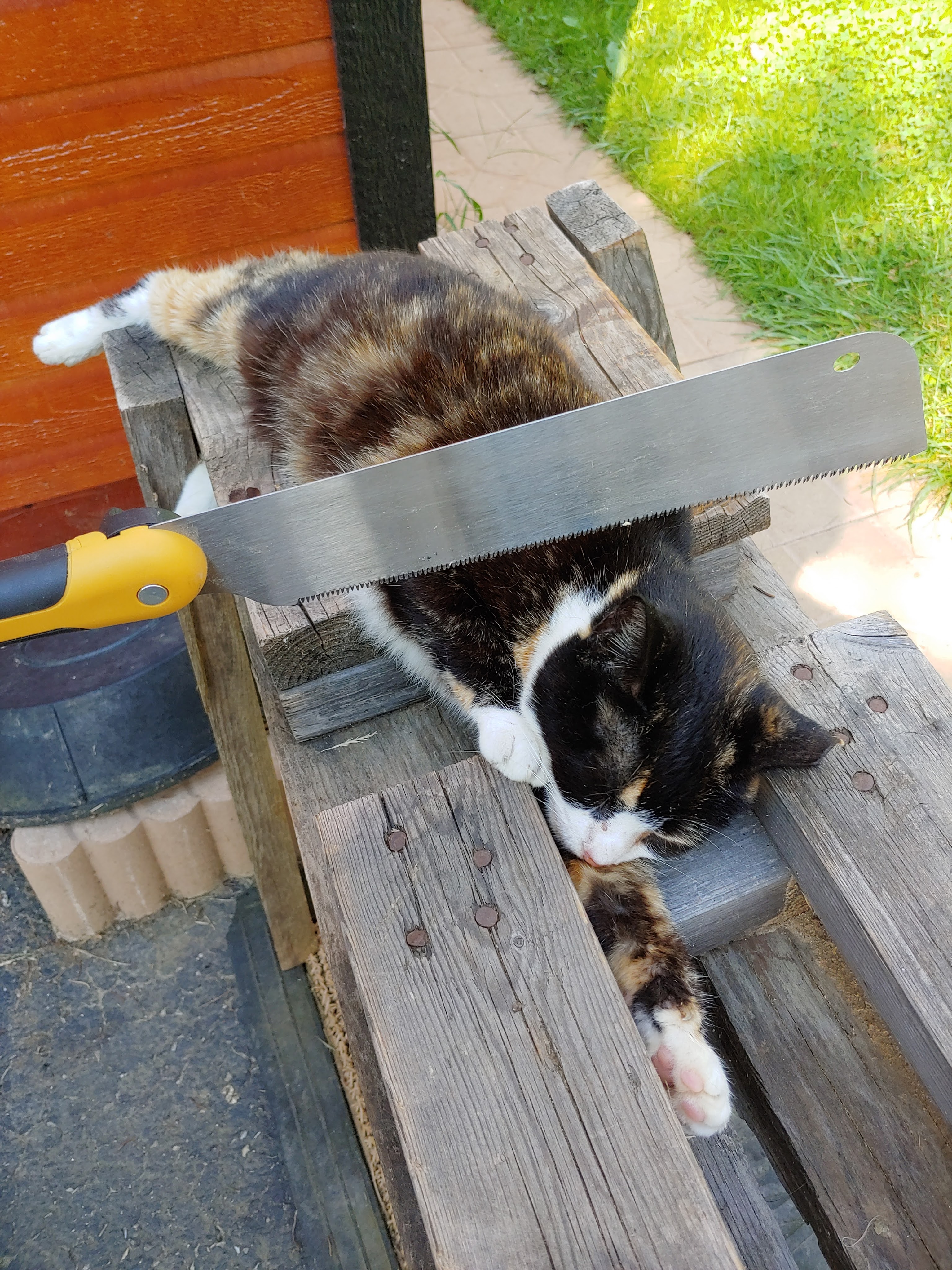
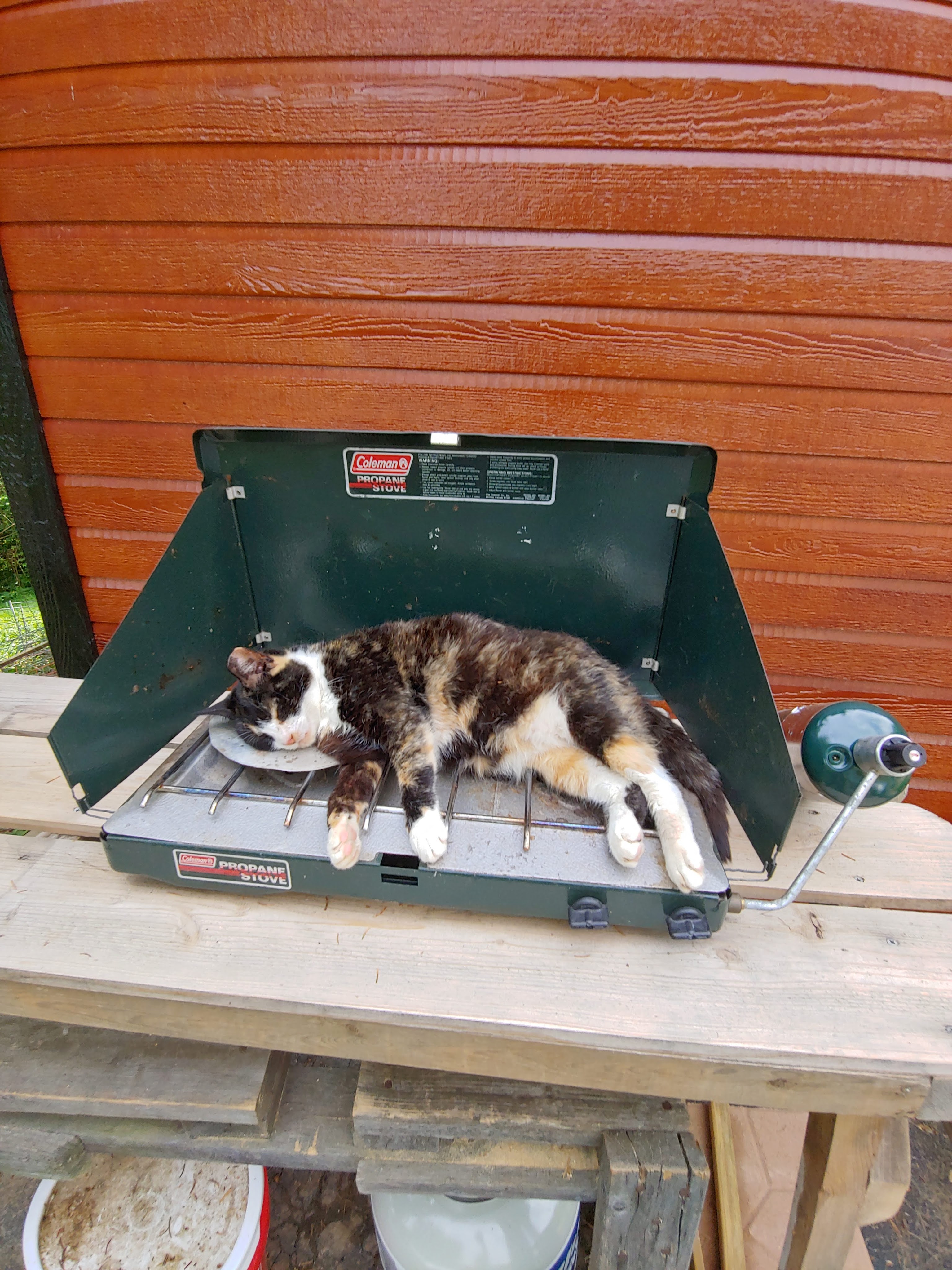
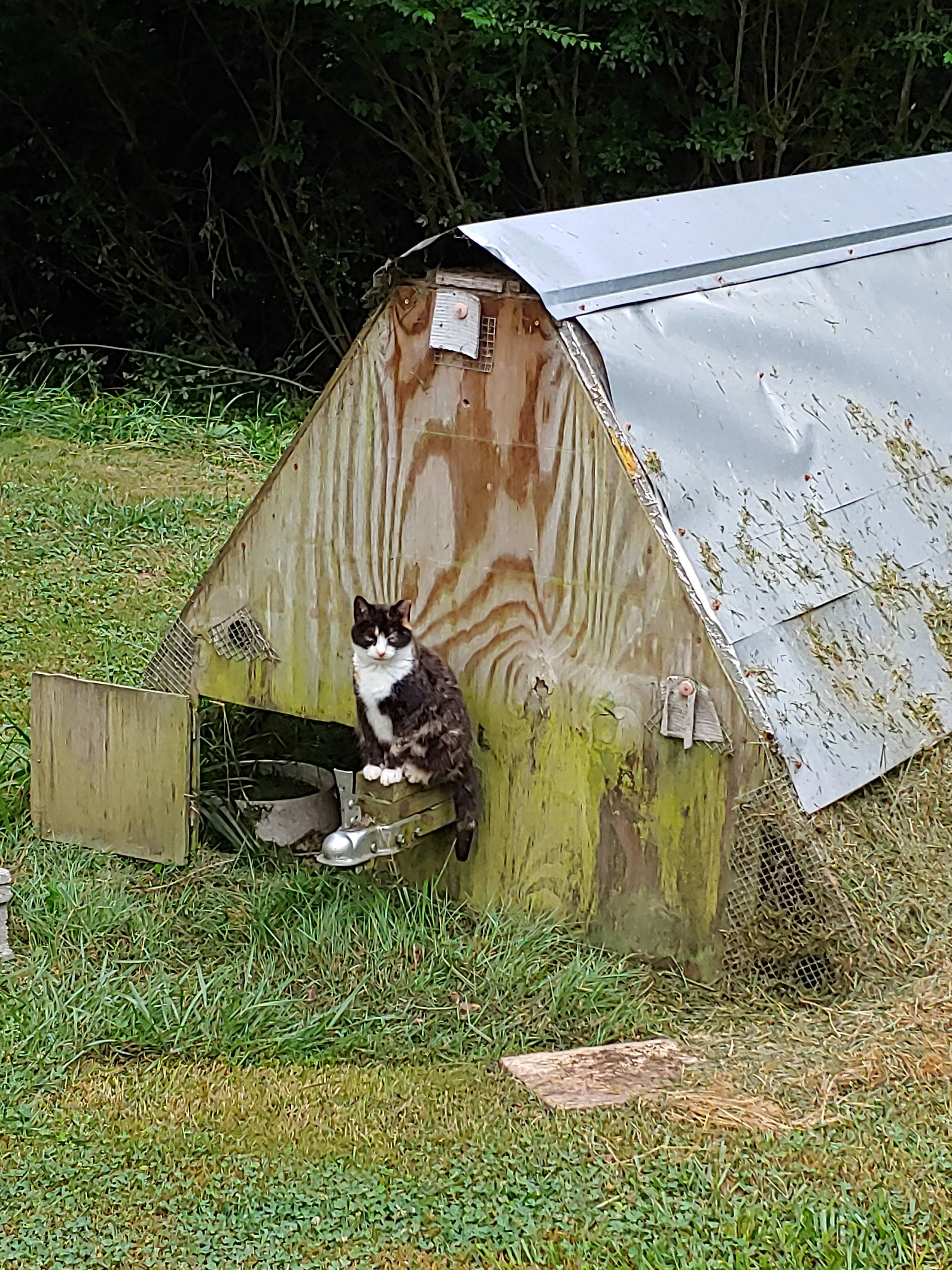
I had plans to build a rack of sorts in my shed to store some items overhead and off the ground. The boards I used around the base of my tent were oak and would be strong enough for the job. They were widths of six to fourteen inches and I began to cut them into three-inch strips. That poor old skill saw I had got the work out of its life that day. It would be later in the month before I would get around to installing the pieces. Flitz, my fat stray cat must be partially deaf since she would hang around to keep tabs on the strange activities of her favorite food supplier. She has no fear of saws.

Some time spent mowing the yard helped fill the days before my test results came back negative. Thursday afternoon I got the call and I busted into the house to announce the news. The combined look of shock and excitement on Lydeana and Shayley’s faces was precious. Manny hardly knew what to do either. The strangest part was that I found myself wondering how to adjust. I felt out of place like I was invading someone else’s world and home. I eventually found my way to my regular spot on the lazy boy love seat we have and stayed there as much as I could the rest of the week. The projects and work were put on the back burner so as not to waste the chance to be with family.

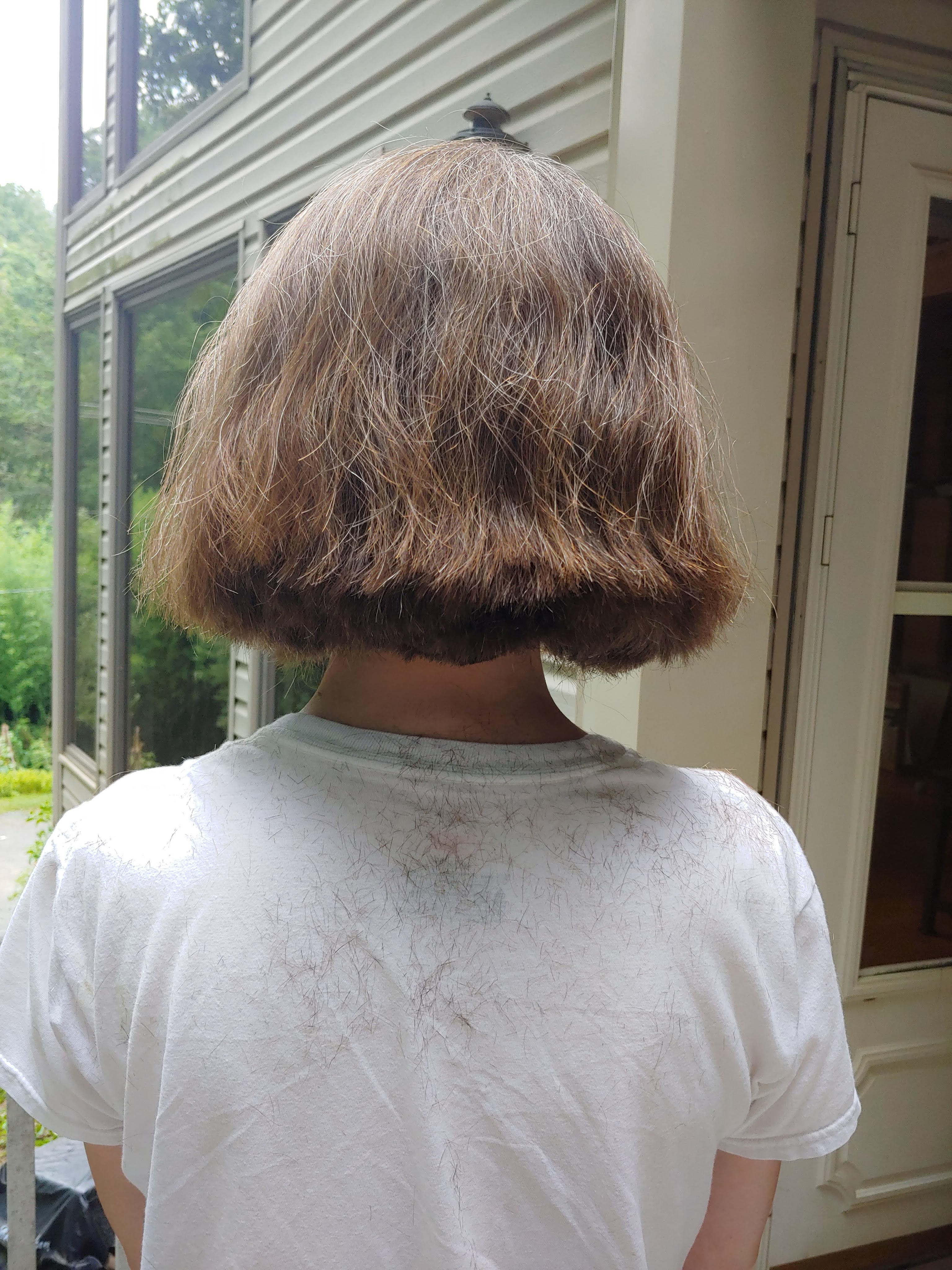
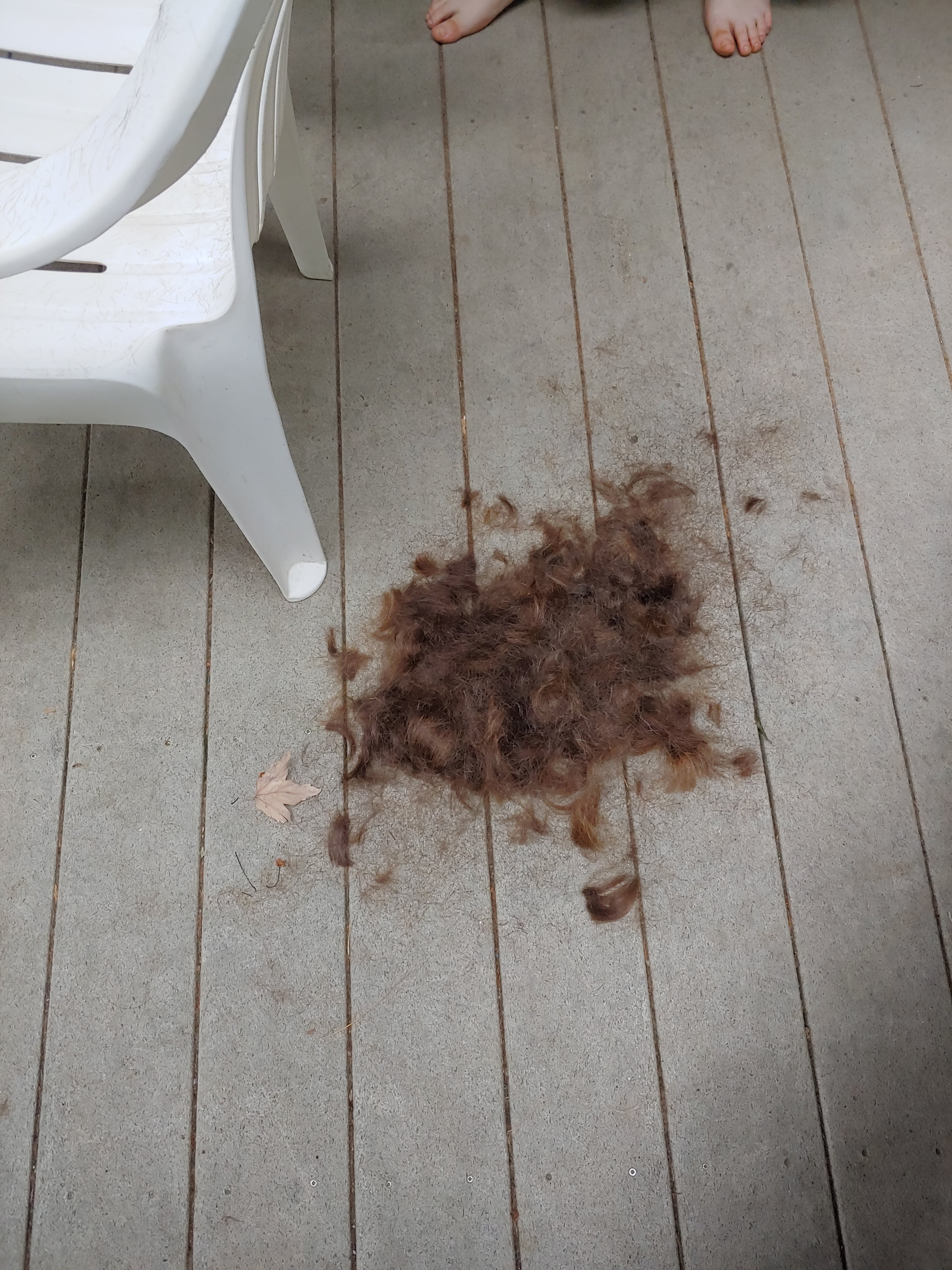
Two projects popped up anyway. Lydeana hadn’t been anywhere since this whole thing started and needed her hair cut. I’ve always cut Manny’s hair and he was too shaggy for the heat. With a good set of electric shears and wrestling techniques I managed to give Manny a tolerable cut. With a dull pair of scissors, several prayers to God and some well-timed lies to Lydeana, I managed to give her a tolerable cut too. To top it off, I had two piles of hair to spread around the garden to dissuade marauding critters from making off with our crops.

Out of the nine days I had off I was able to get three and a half days and four nights inside. We spent all the time together we could, doing things inside for once. Every once in a while I would catch Shayley jerking her head to look at me in surprise as I entered a room. She wasn’t used to this extra person in the house and we all barely had time to get used to the idea before I had to move back out after going back to work. I hoped and tried to make these days stretch on like those spent working outside. Unfortunately trying makes time go faster. The real kicker was that Manny had assumed my old seat on the lazy boy was his and he resented me displacing him. As Charlie Brown would say, “Man’s best friend! Good grief!”

The Gun Cabinet

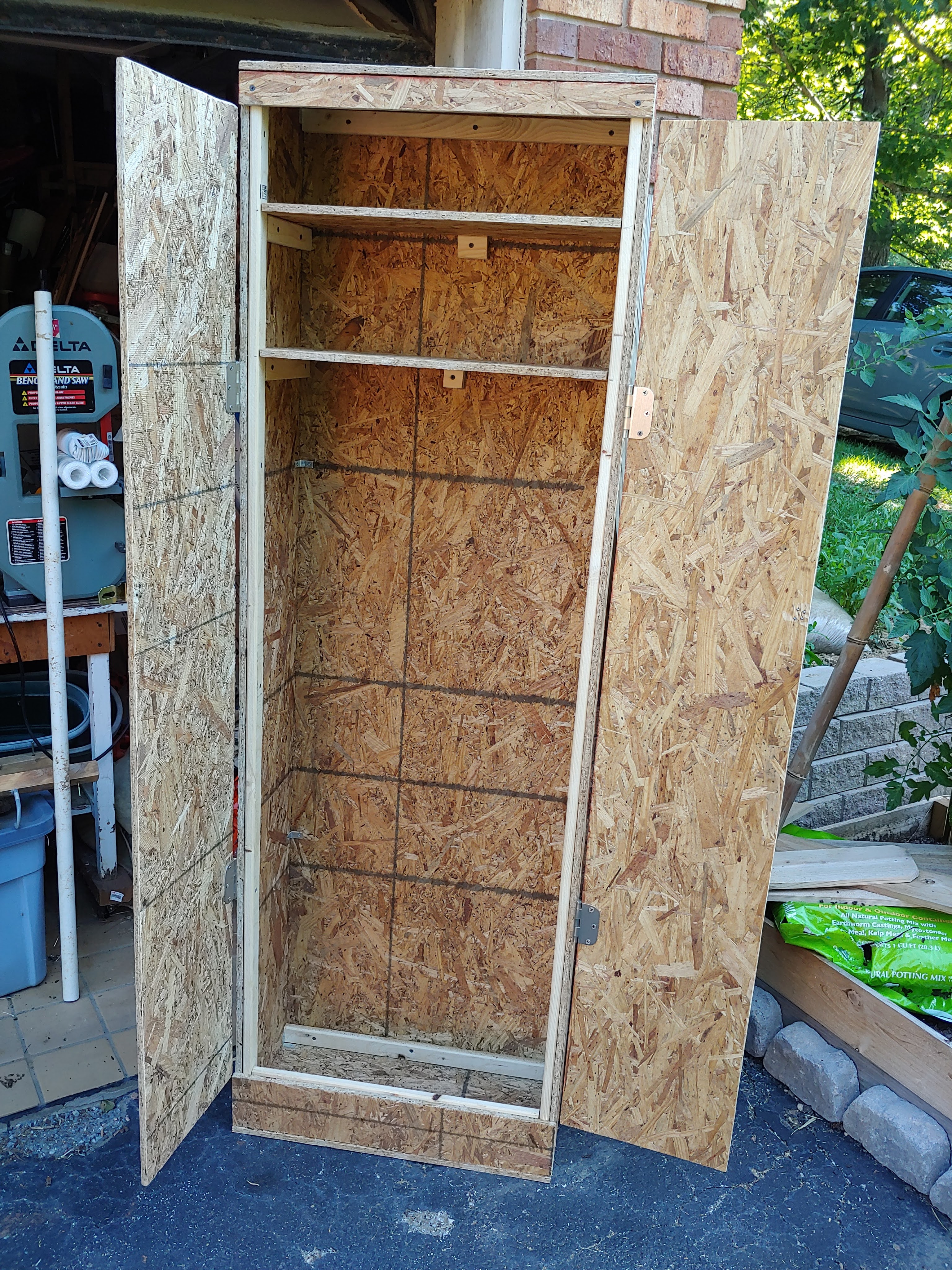
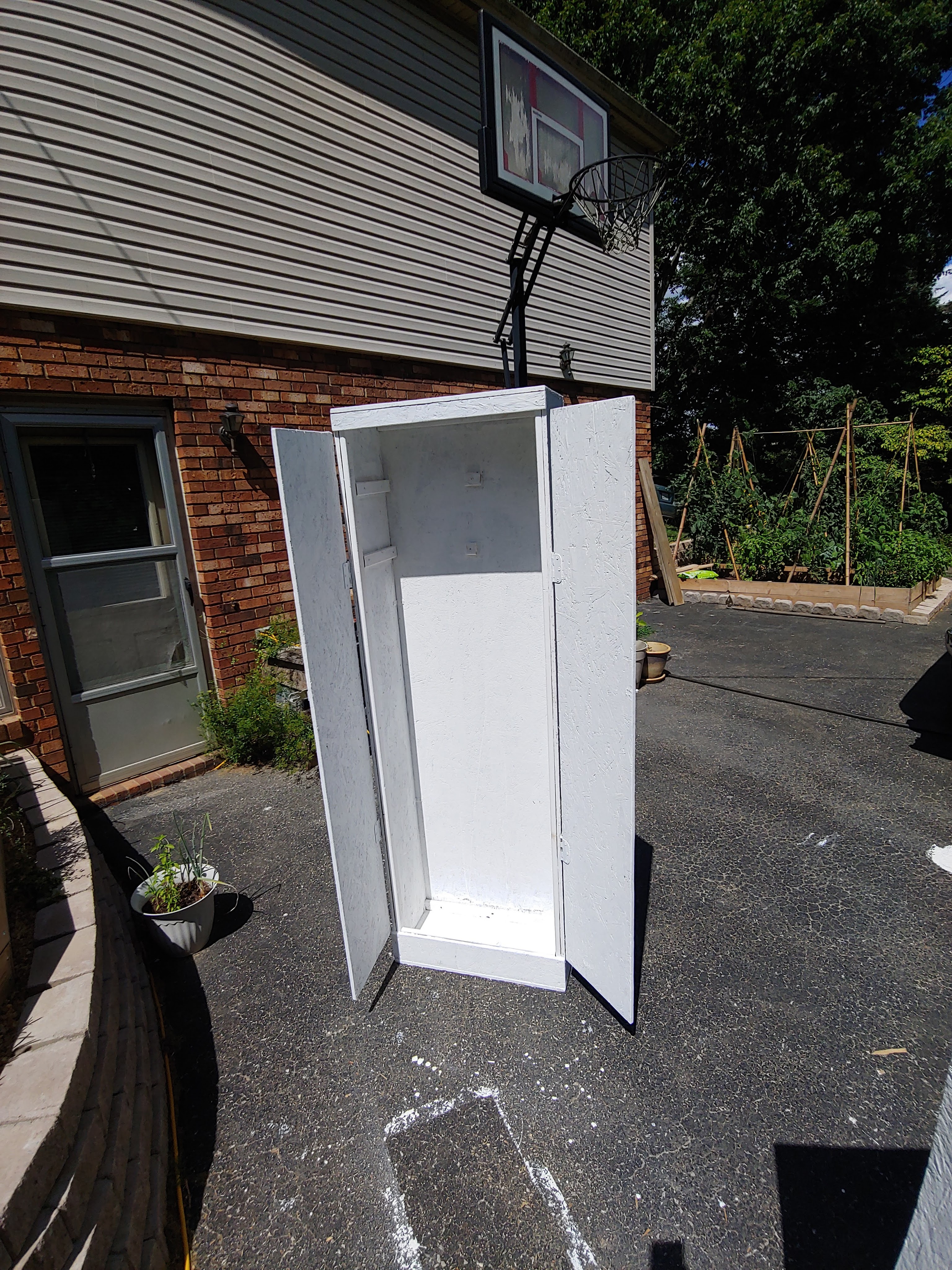
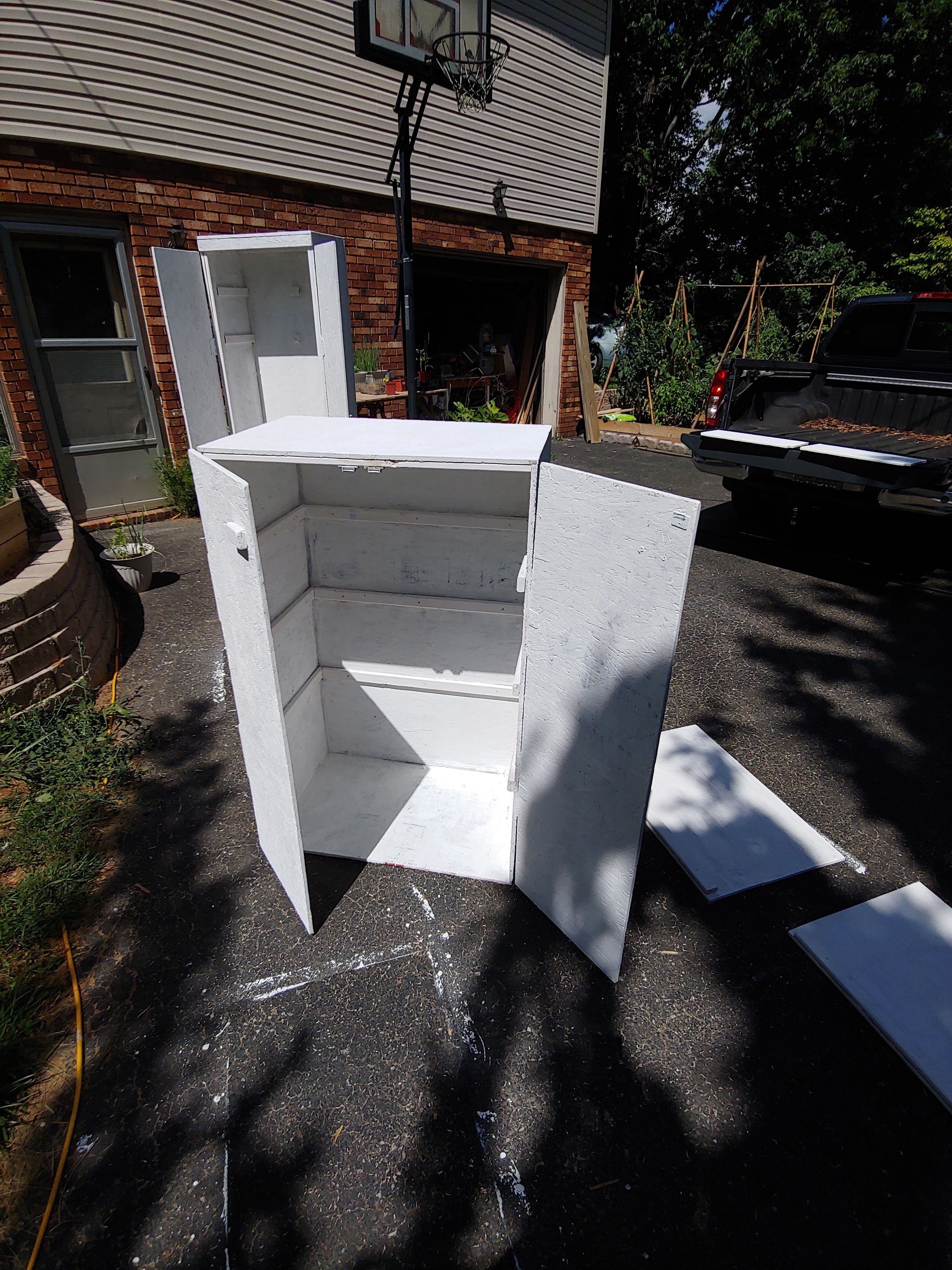
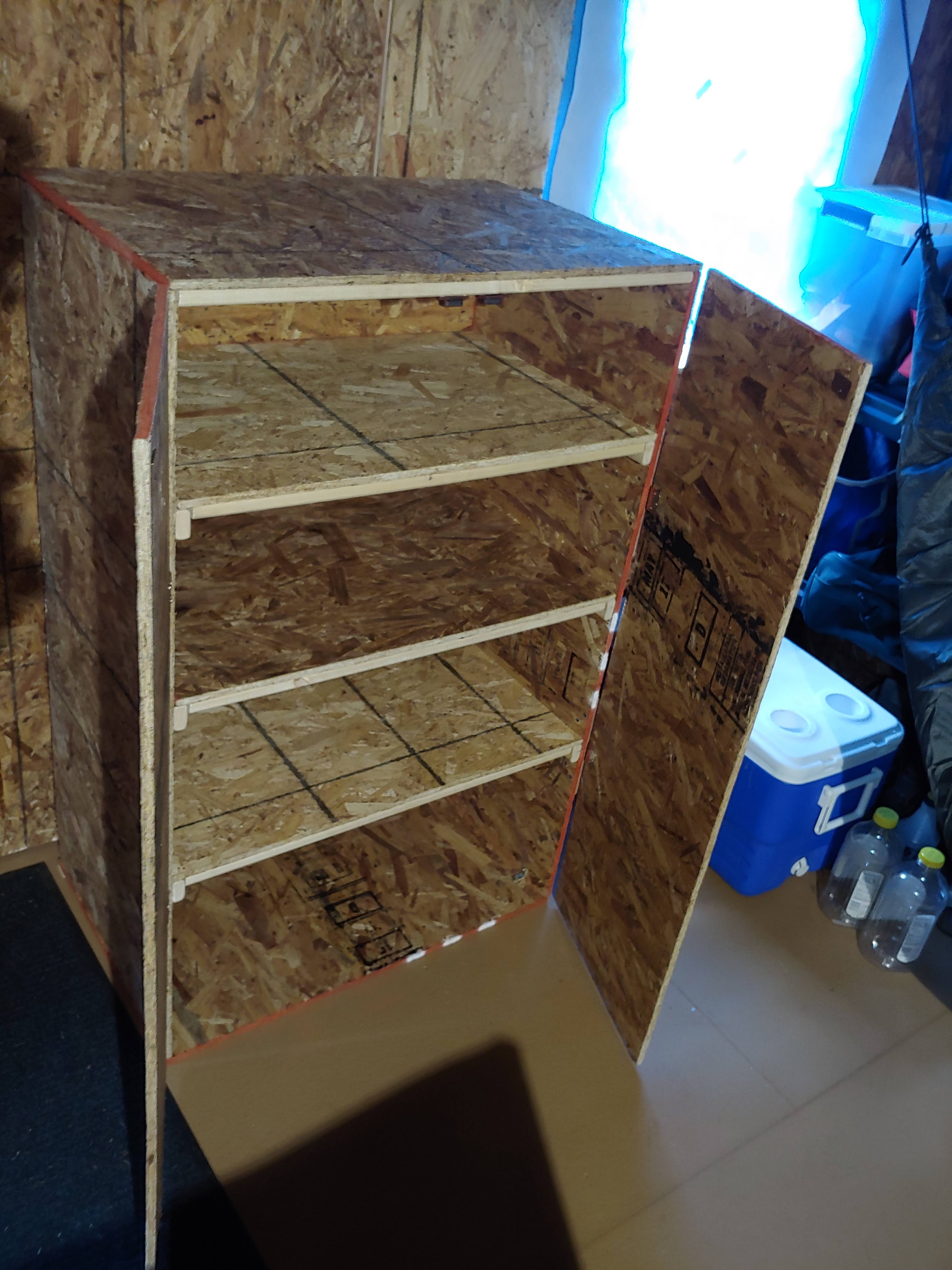
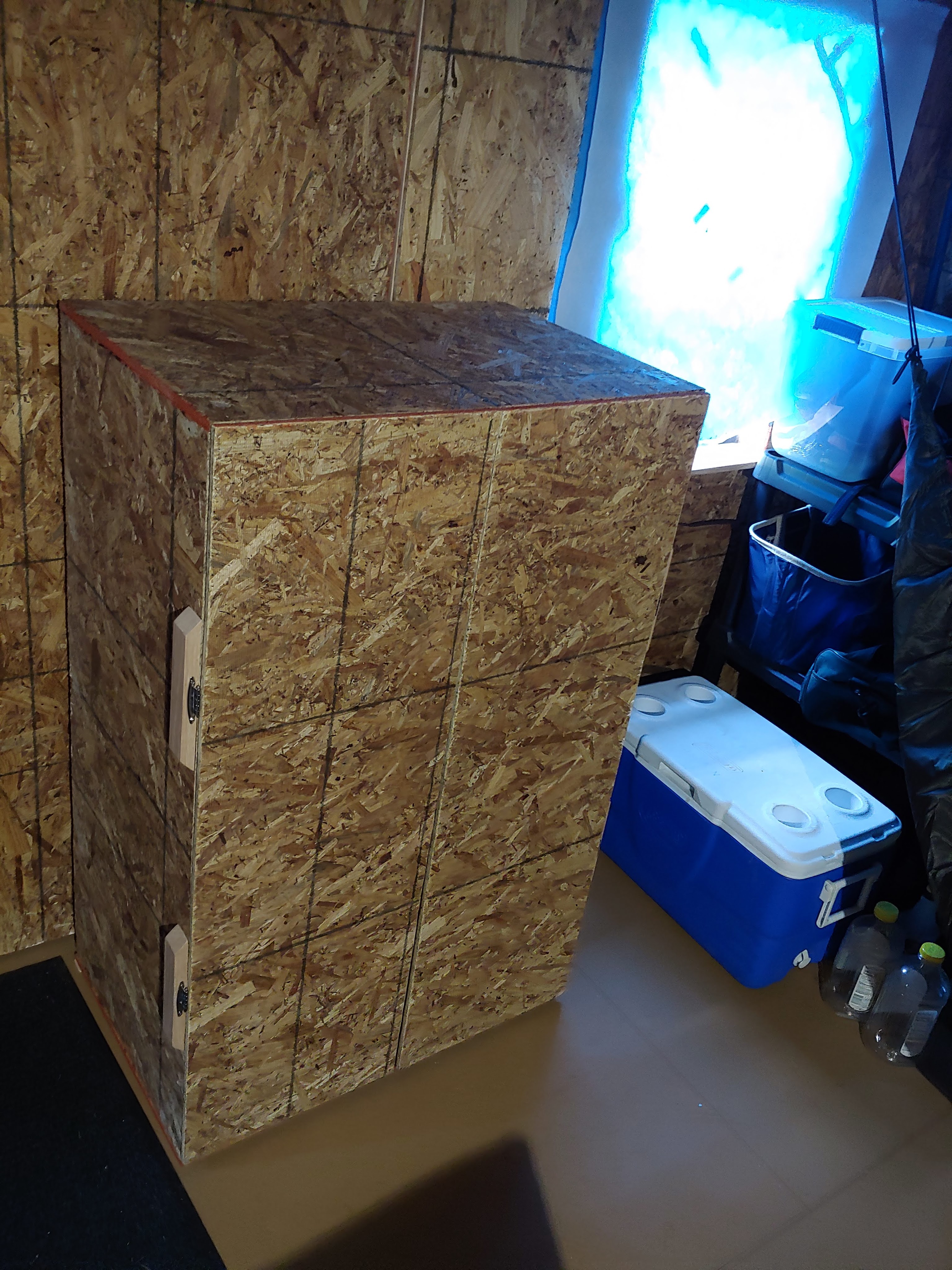
Vacation started the second weekend of July. The next project to finish with the OSB was a gun cabinet. I spent one day constructing the gun cabinet and the next painting it and the tool cabinet. A couple coats of Kilz helped to seal the fumes that would otherwise become exponentially worse. A little bit of white would help brighten up the inside so it wouldn’t totally resemble a groundhog burrow.

I’m a hunter and a shooter, primarily a shooter. Early in life Dad started us out with strict training in use and safety of guns. I recall, as early as I could stand and use my arms and hands with any dexterity, operating a skeet thrower so he could shoot skeet over the garden behind the house. Other times were spent sitting beside him at a reloading bench wiping lubricant off resized brass, then trimming it to length. I was always mesmerized by the consistent and steady thwack, thwack of the knocker on the powder measure, ensuring every little granule of powder made its way into the case. He stressed consistency and exactness so that each round was the same for the best accuracy.

Dad was adamant that if you were going to hunt, it should be quick and humane. This was reinforced one day when I had a little bow and arrow shooting at a can in the back yard. Dad walked out and I asked him if he knew how to shoot it. He took the bow and arrow from my hand and with perfect form drilled the can dead center. I asked if he had ever killed anything with one. He told me one time he shot a cow they were going to butcher. It took so long for it to die that he vowed he would never do that again.
Growing up on a farm you’re not separated from your food by a grocery store and the processes that get it to the table. Whether farming or hunting, that process can still be humane. As a kid I raised chickens and ducks, each one of them a unique personality from the time they broke out of the shell. When the time came to kill them for the table or freezer, it was my responsibility. I learned the hard way not to take that meal for granted when I had to look it in the eye.

Accuracy of the gun and ammo combined with accuracy of the shooter made for a quick, humane kill. I learned to be a good shot and be responsible with each one. These days I’m most likely to shoot holes in targets. I’ll pass on more shots than not while hunting if I have a doubt about getting around to eating it. I still love guns and shooting because I was never really any good at other sports. I couldn’t run fast, couldn’t throw a ball for squat and didn’t really enjoy playing games too much. I could, however, bring all my mental and physical abilities together to focus on a spot and hit my mark. Like Kyudo, the Japanese art of archery, it is a form of zen.

I know this subject is controversial and sensitive for many people and I don’t discuss it here to argue any case or make any statements other than why it is a part of my life. A tragedy with a gun occurred in our family when I was small that completely altered the course of our lives. Suffering from bipolar depression, my mother took her own life. After a lifetime of contemplating the what, how and why, it has struck me how it correlates to my actions and present state of mind.

I have never personified objects. Likewise, I have never objectified people. My perspective on the current state of things in our world is simple but not simplistic. A virus is not a life form, though like a loaded gun and mental disorders, it deserves caution and respect for its potential. Regardless of its origins, it carries on in its progression without any regard for the personifications often attributed to it. Similarly, mental illness has been misunderstood and often mistreated throughout history. The person suffering from it may not be aware of what is happening to them, or may be in denial, or when aware, may be helpless to control it. People observing it from the outside are almost a mirror image by not seeing it, misunderstanding it, denying it and simply not knowing what to do about it. Over the years understanding mental illness has changed significantly through advances in psychology, medicine and education. Despite those advances it still exists with all the coinciding stigmas, risks and sometimes fatal results.
All this wasn’t in my mind as I built this gun cabinet. I needed a safe place to keep and manage the guns I would be using. There are inherent risks when the guns are removed from the case if not handled with due diligence. This virus, now out of the case, requires the same diligence. It has no agenda, goal or purpose in and of itself. We all have opinions about it. It has no opinion about us. It is what it is and does what it does only when it interacts with the one dynamic that activates it, us. We have been going through the natural progression of not seeing it, misunderstanding it, denying it and not knowing what to do about it. We’re hopefully on the path of fully unraveling its secrets for everyone to see and understand so it can be put back in the case.

Could something have been done differently to save my mother’s life? I’m sure it could have. All my parents are gone now, along with a lot of people who may have had those answers. The only thing left that really matters is what would I learn from it. Life is precious, and we are the dynamic factor that can have a positive, negative and sometimes fatal impact on it. People often assume I’m doing this for my wife, which is only half true. I’m doing it for my daughter too. I never want her to have to lose her mother too early in life like I did. Due diligence, understanding the risks and choosing to manage them responsibly given our current knowledge, will hopefully prevent that.

Working in medicine with a higher likelihood of contracting the virus makes me the possible loaded gun. My building is my gun case to help manage the risks. Wearing a mask and being respectful as I interact with other people makes all the difference too. I just imagine Dad looking down at me like he did years ago, telling me to check the chamber, keep the muzzle pointed in a safe direction and my finger off the trigger. If not, I wouldn’t have any feeling in my butt for the next three months.

HEARTH AND HOME

July 4th came on a Saturday and I was on call with a couple buddies from work. We had decided to find a fishing spot close enough to be back in time for whatever came in. Fortunately our services were not required and we successfully wiled the day away teasing the fish. We did a good job because I could hear them laughing at us the whole time. In my mind, it was a successful trip. I succeeded in not worrying or doing anything responsible or important and never cleaned a single fish.

My biggest catch of the day

I was off Wednesday July 1st and began work on my hearth. Fire in a small space can be a wonderful thing, but it deserves respect. I had been measuring and considering where my stove pipe would exit the window and for my plan to work, I needed to build a raised hearth for the stove to sit on. The hearth would be built with heat shields to protect all the wood surfaces around it from overheating. Later I would be building a window to integrate with what existed. It would be somewhat insulated and allow the pipe to go out and up beside the building. The layout, considering the lofts, didn’t lend itself to putting the pipe through the roof. I wasn’t about to put a hole in the roof since I considered this to be a temporary situation. If I couldn’t reverse it, I wasn’t going to do it.

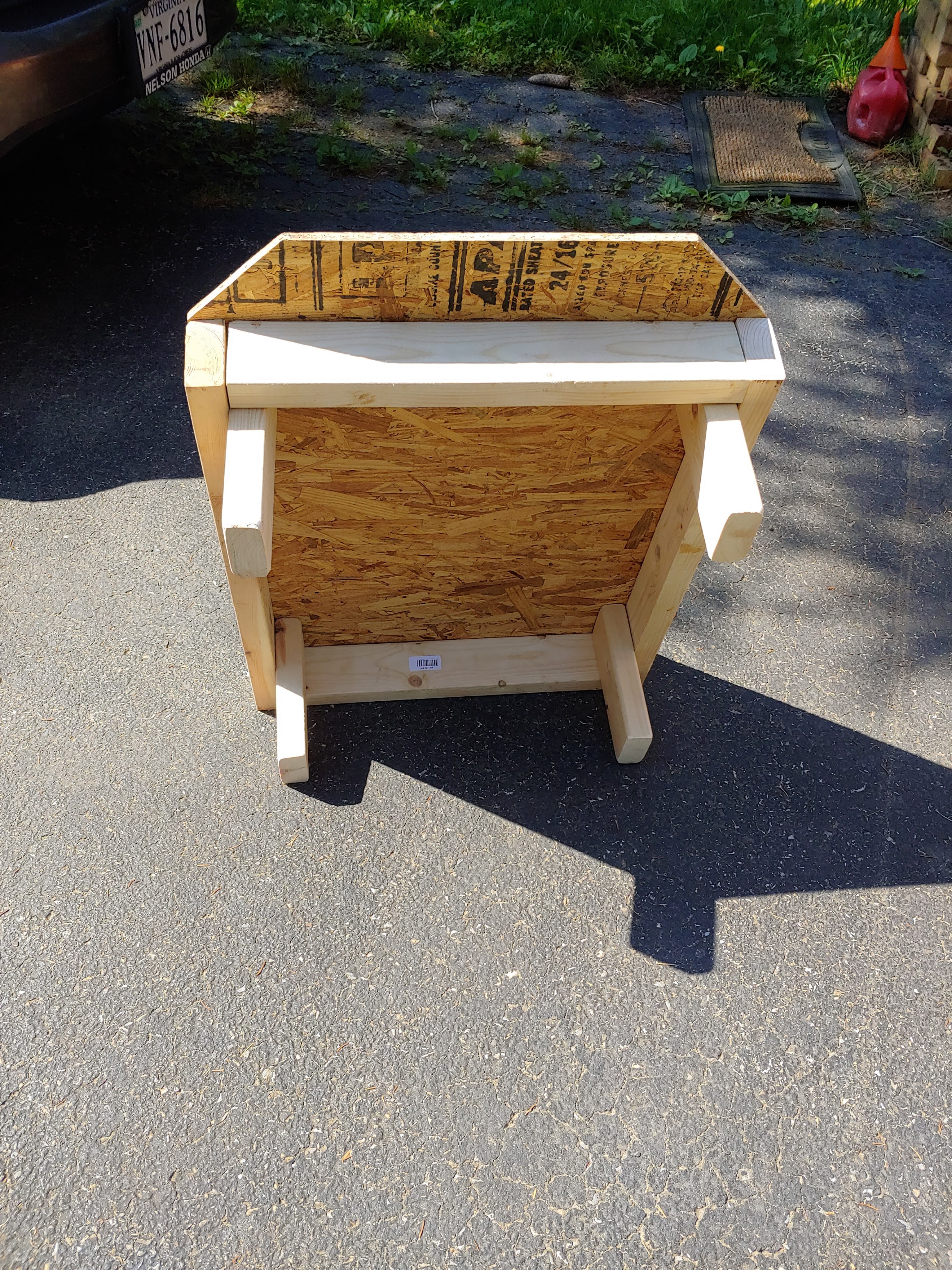
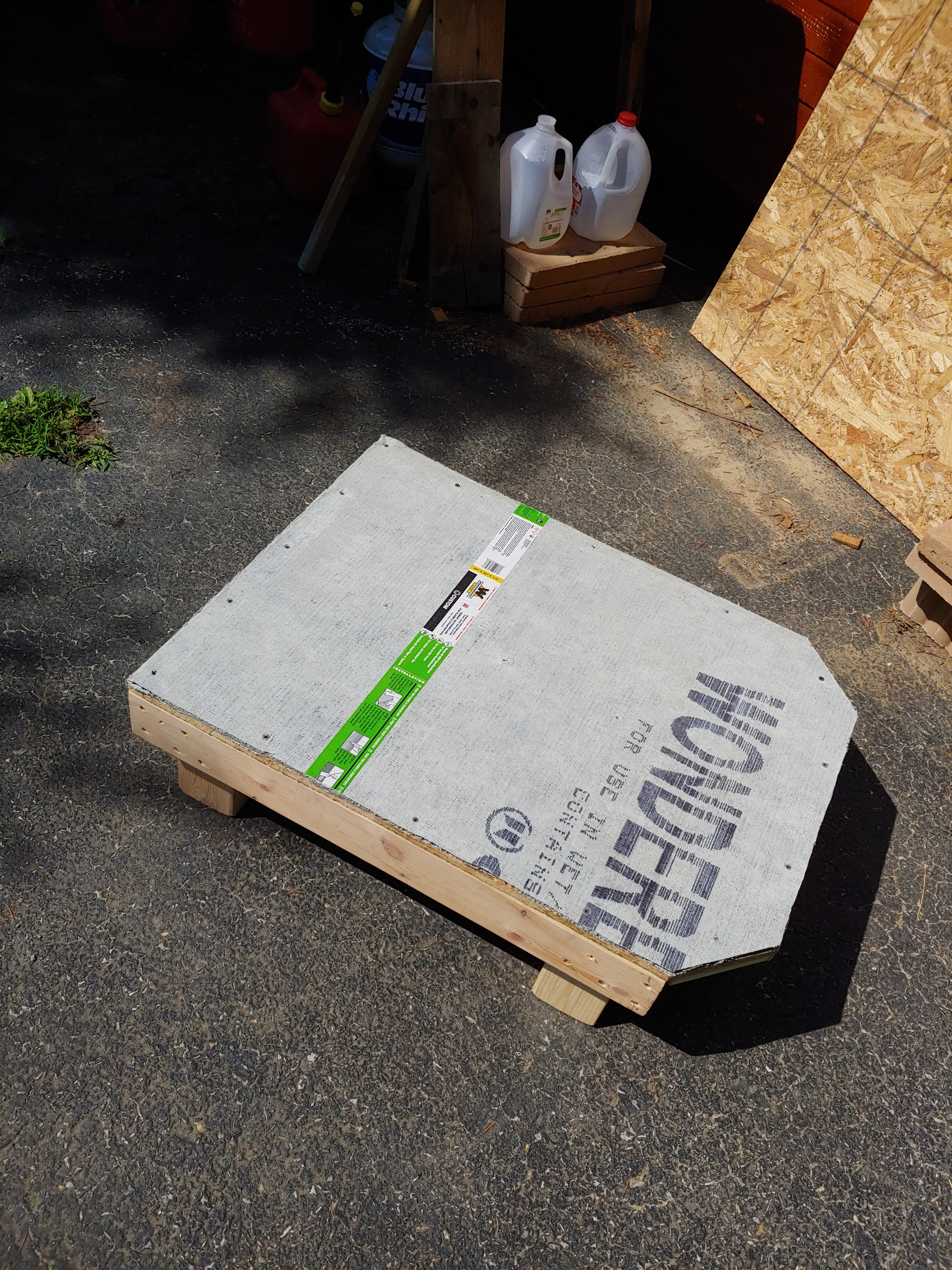
Measuring and imagining the pipe exit dictated the hearth needed to be 10 1/4″ tall. Using the thickness and dimensions of my materials, I designed it from the top down. I used OSB, 2 x 4’s, oak trim boards, tile and tile underlayment. Angling the front corners kept down the bulk and made it less likely I would bash my shins constantly. Corrugated metal roofing would be attached as heat shields that would allow hot air to create an updraft by pulling cool air from below, keeping the surrounding walls cool and distributing the heat more efficiently.

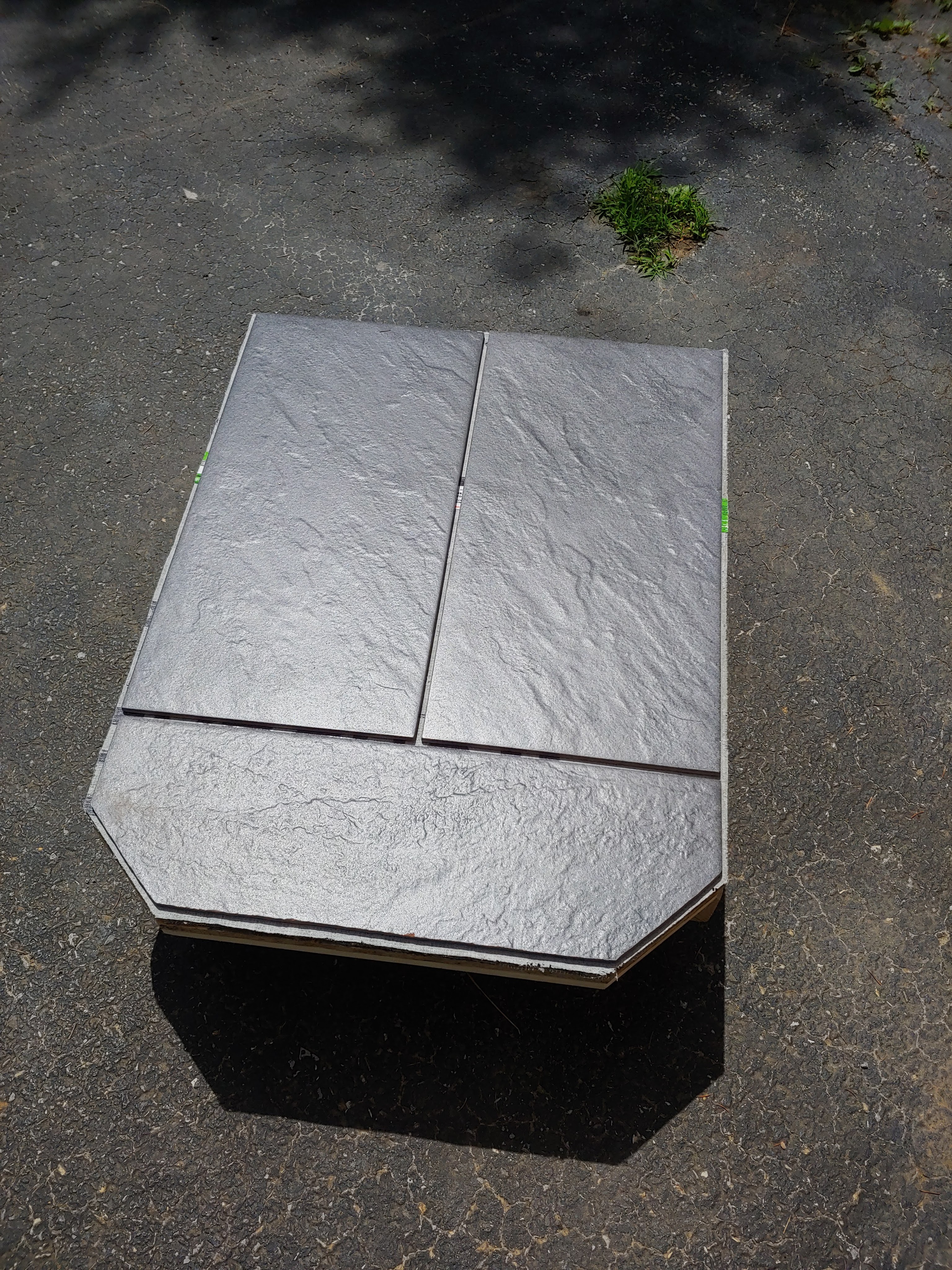
I had bought a package of 1 x 2′ tile for the kitchen counter that would leave me enough to tile the hearth. The biggest challenge would be custom-cutting a tile to fit the front end, which would be over 7″ deep with angled corners. Masonry demands particular tools that I don’t have. The exception was my angle grinder, which I had a couple of masonry wheels for. It took a little bit, grinding a groove the length of the tile, until I could snap it cleanly. I tried a couple of thinner wheels I had that didn’t last long at all. The corners were a much shorter groove and came off nicely.

Thin oak boards were used to create borders for the grout and dress the whole thing up some. Legs were added and checked for length. The driveway isn’t perfectly level, so I did have to use a thin shim under one leg when I took it in the building. I lost my board stretcher, in my garage somewhere I think, and couldn’t make it longer again.

Finished hearth with metal shields and extra shield on nearby wall

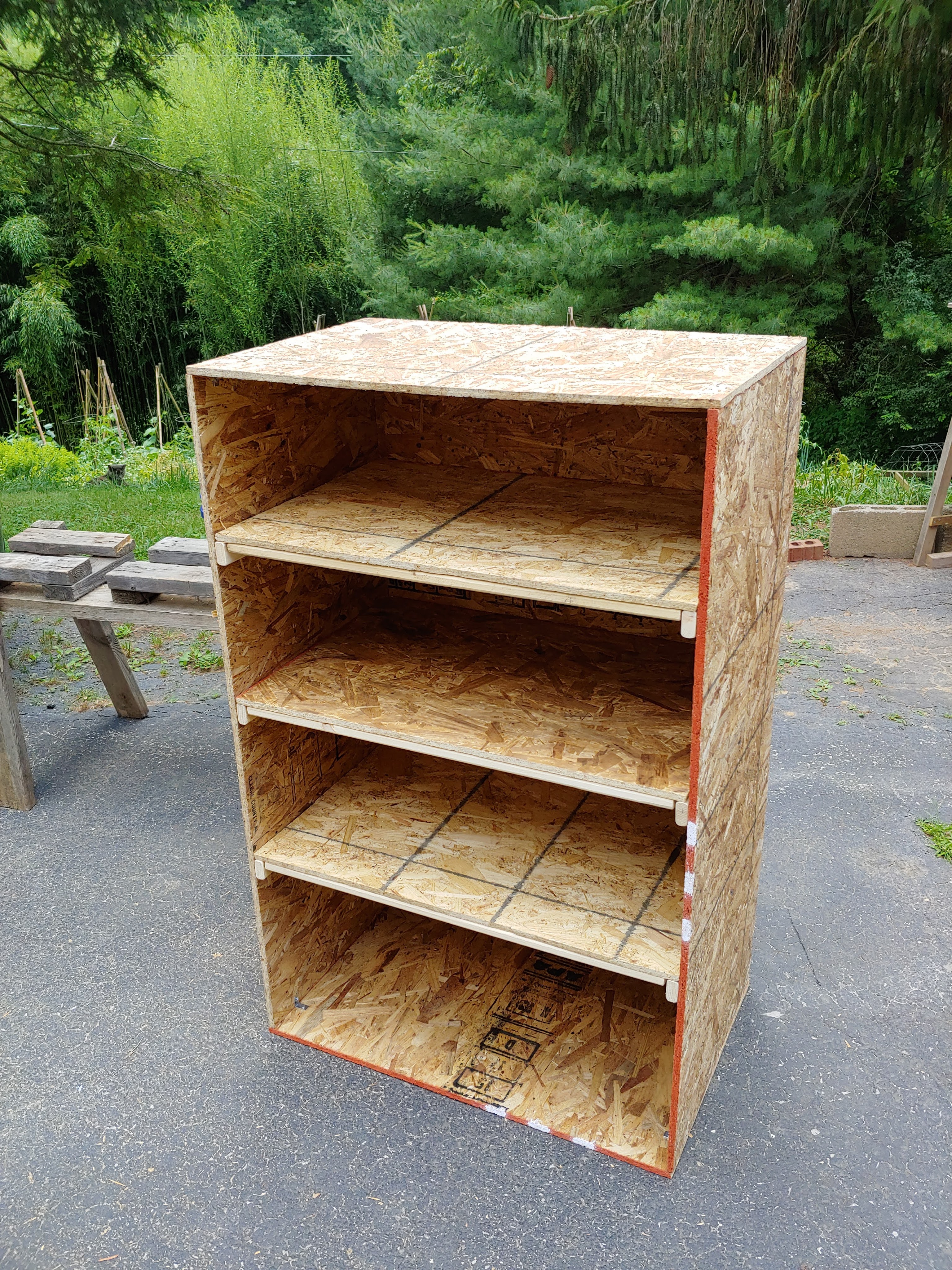
I had a couple days for a big project after taking time to fish. The tool cabinet was next. With some experience under my belt from the kitchen cabinet, it went much faster. L-brackets were used to attach the top and bottom pieces to the back and sides. Some 1 x 2″ framing was used for the shelves and the body was finished. I’ve said before that OSB isn’t the strongest stuff around the edges. The doors on the kitchen cabinet were attached to the framework. They were functional though nothing to look at. The tool cabinet didn’t have the same structure, so I made some oak pieces to screw onto the outside edge that I could mount hinges on. I used some actual cabinet hinges instead of plain galvanized utility hinges like I had before. I moved the cabinet inside before attaching the doors so I wouldn’t have to lift as much.

I mentioned before that the OSB was still drying and was rather harsh on the nose and lungs. Every time I opened a door on the kitchen cabinet I was heartily reminded of it. With this new piece of furniture installed, the air got still heavier. I called my brother and discussed it. He told me to paint it to seal it. The smell of water-based paint wasn’t toxic and was far less obnoxious. Some KILZ was acquired for the tool cabinet and the gun cabinet I was soon to construct. I could have painted the inside of the building for the same reason. I didn’t want to have to be careful not to mess up the paint job. As it is, I can make a hole in the wall with screws and what-not, and you’d never notice. Having things on the rough side and easy to maintain suits me just fine. In the meantime, it was warm enough to leave windows up with a fan running all day and night. I would open the doors when at home, and the building would eventually dry out and the smell would settle down. That or my olfactory senses are on strike.

In the midst of all this was July 3rd, the day that marked why I was doing it all. Lydeana and I tied the knot that day in 1993 after having been together four years. When you have something like that, and have been given the second chances we have, you don’t waste it. We’ve lost some time together in the meantime. I’ve said over and over to people, it’s better to lose a little time now to have more time in the future. Death is more permanent than a little camping trip. I’m not a gambler, so knowing the potential consequences of exposure makes living out here a no-brainer.

We actually aren’t completely apart. Social distancing and accounting for wind direction allows us to to eat and visit outside together. Shayley fixed us a nice anniversary dinner and we celebrated a good 27 years of marriage on the front porch. I was about to have a week’s vacation and planned on getting tested after the appropriate quarantine time. That would give us four nights together after getting my results back. I had a lot of work to do until then, though, because I didn’t plan on wasting the time I’d have inside with Lydeana and Shayley. This vacation was going to be a time to complete some big stuff. We’ve always traveled as much as we could, but I never came back to work with thicker calluses than I left with until now.

New Furnishings and Mr. Murphy

The weather was warm and the rains had gone away after finishing the garden prep and raised beds. I could now use my shop (a.k.a. the driveway) to start putting together some cabinets for the shack. With the leftover scraps of OSB from covering the walls and ceiling, plus two more 4 x 8″ sheets, I carefully planned the sizes of cabinets I could build with the least waste possible. Inventory of pieces in one hand and measuring tape in the other, my imagination had to work double time to see what was needed to store what I wanted, and how it could be integrated for the most efficient use of the space. I guess you could call it Charlie’s feng shui.

The building is 10 x 16′. The main obstacles I had to work around were the windows, two wide double doors and my hammock setup. One door would be kept shut and considered the same as a wall unless I needed to move something large in. My old table took up too much room and I had plans to replace it. I used a cooler, for which I built a makeshift foam insulation board box to help it out during the hotter weather. It ended up being rather bulky and had sweating issues that could lead to mold problems so it was a temporary fix. There were tools and items that I wanted available at all times to take care of the random issues and the endless projects that I seemed to have before me. Lydeana was still opening and closing the garage at the time and I didn’t want to constantly bug her, so keeping the most used tools and materials in the shack seemed like the thing to do.

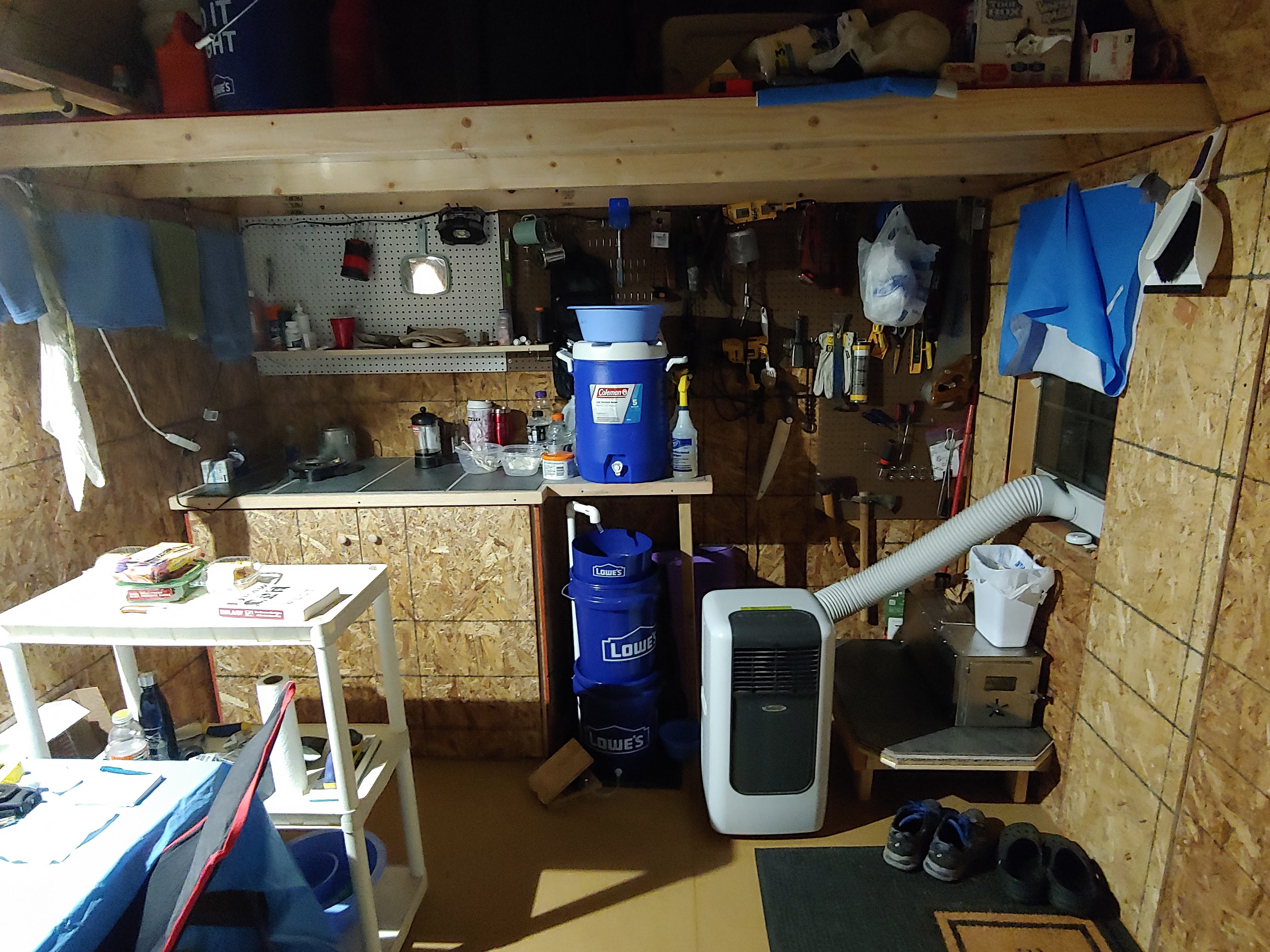
I determined I could build a kitchen cabinet, a tool cabinet, a gun cabinet and a hearth for a wood stove with what I had. Plans were drawn up with detailed measurements so I could avoid as many stupid mistakes as possible. OSB isn’t as conducive to building cabinets as plywood because it lacks the equivalent structural integrity, especially along the edges. The easiest and cheapest solution was to frame it with 1 x 2’s as supporting structure. I did use a 3/4-inch piece of plywood for my kitchen cabinet since I was considering laying tile on top. Thinking back about the extra materials used such as various hardware pieces, screws, some oak for trim, tile and grout with accompanying tools and an extra piece of galvanized steel roofing for the hearth, I had less than $100 invested in everything.

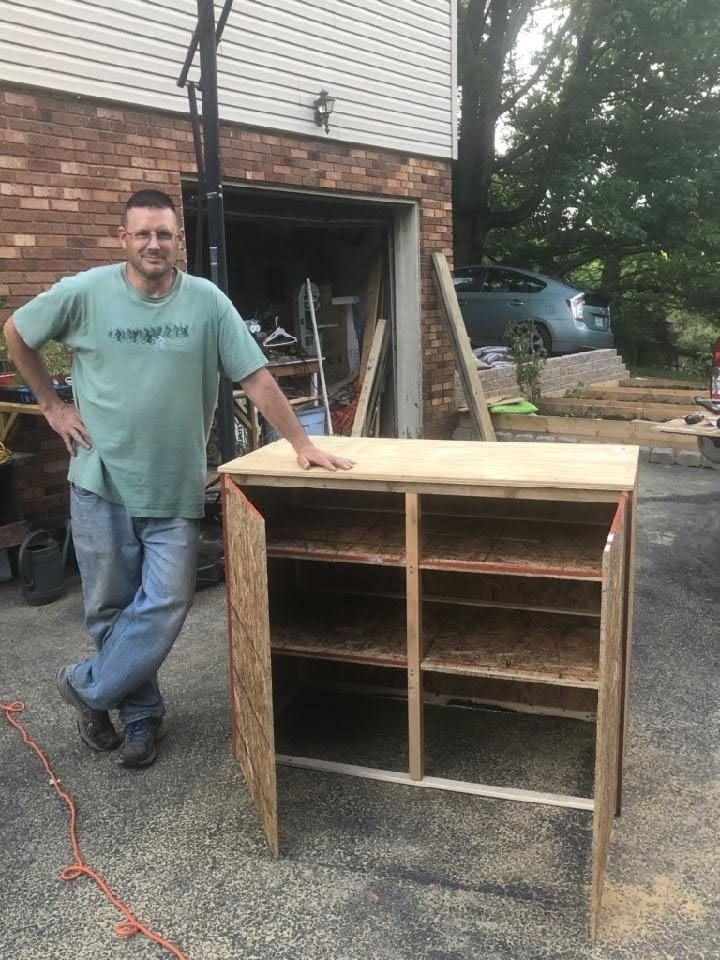
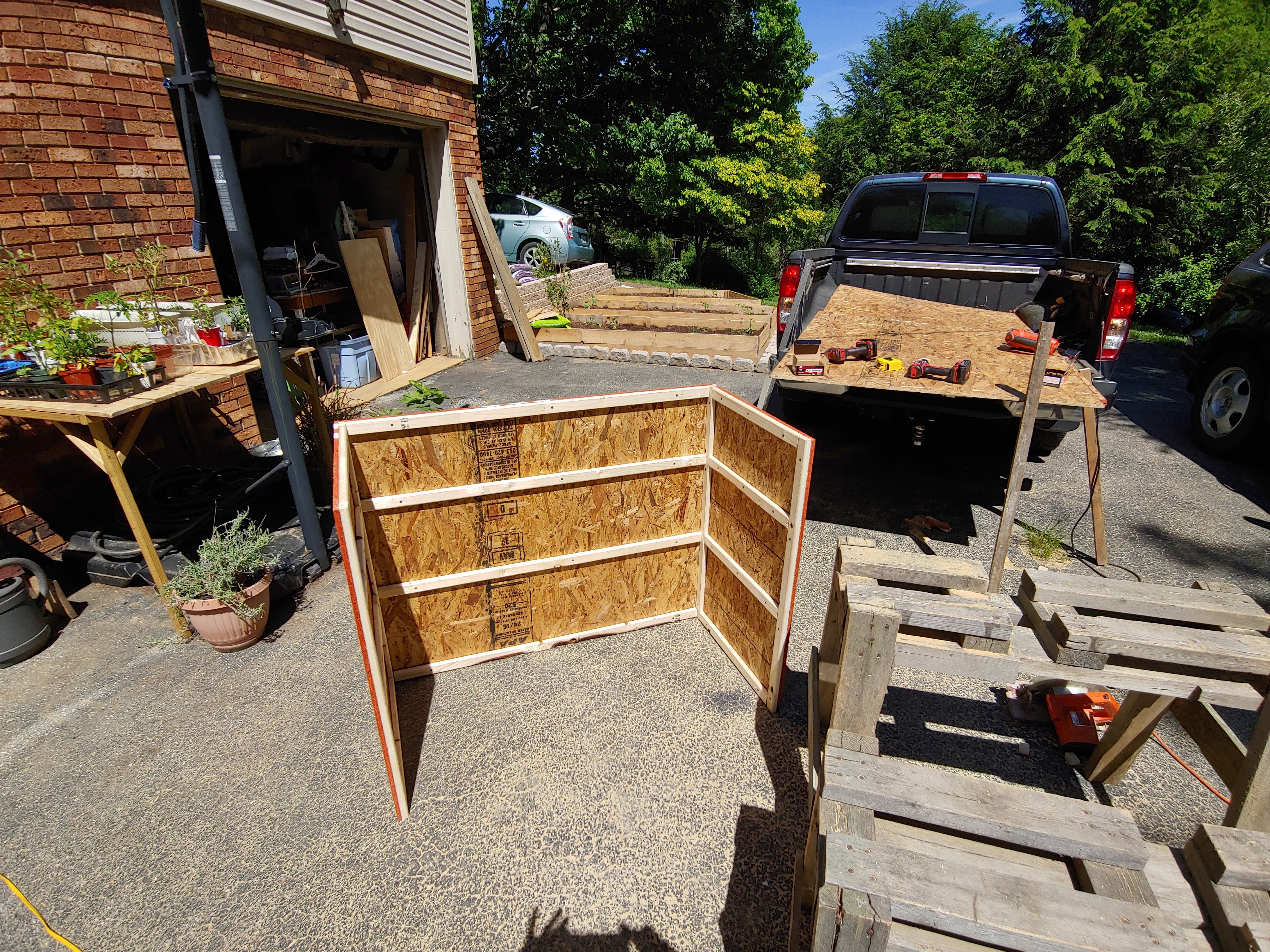
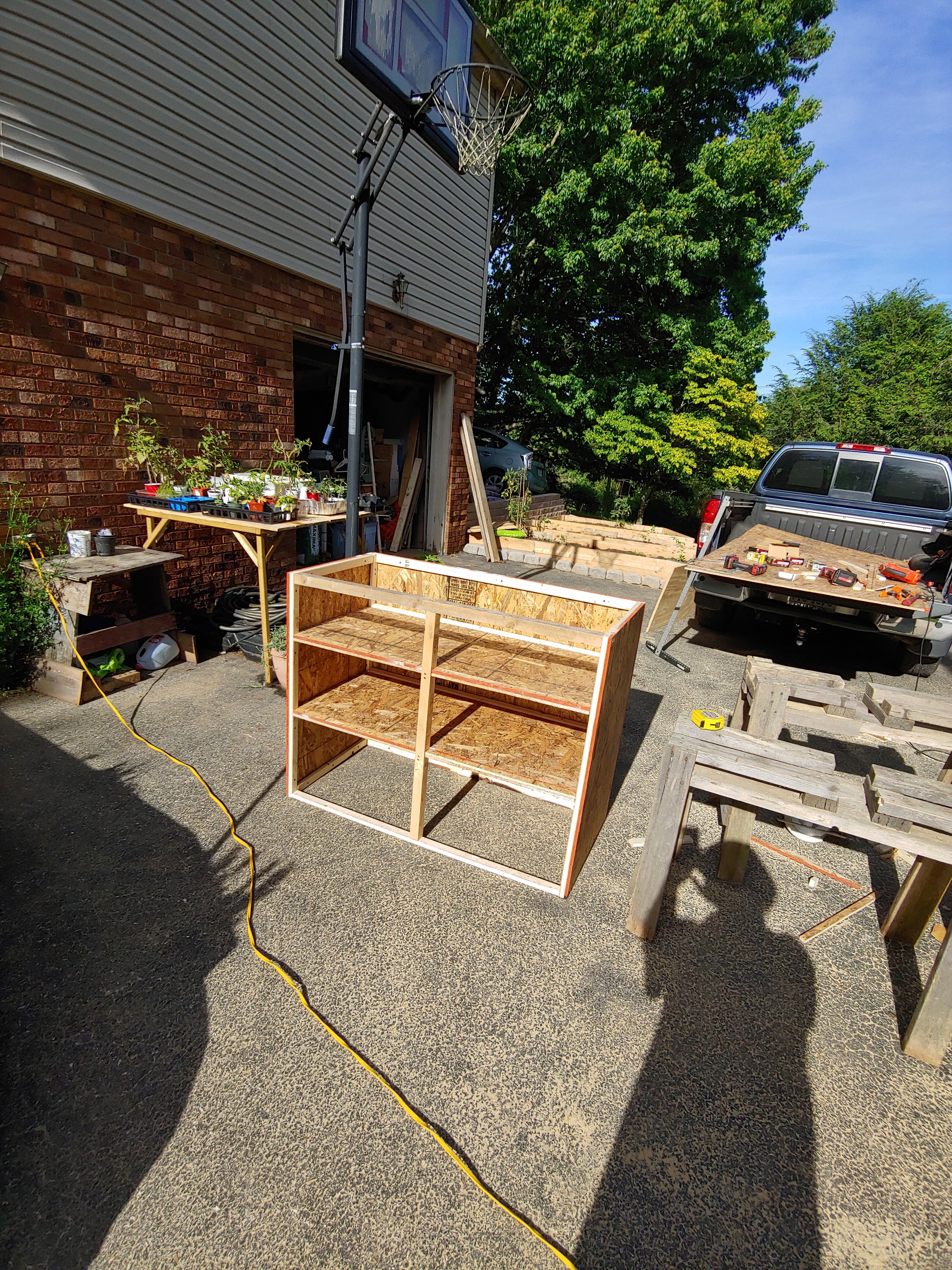
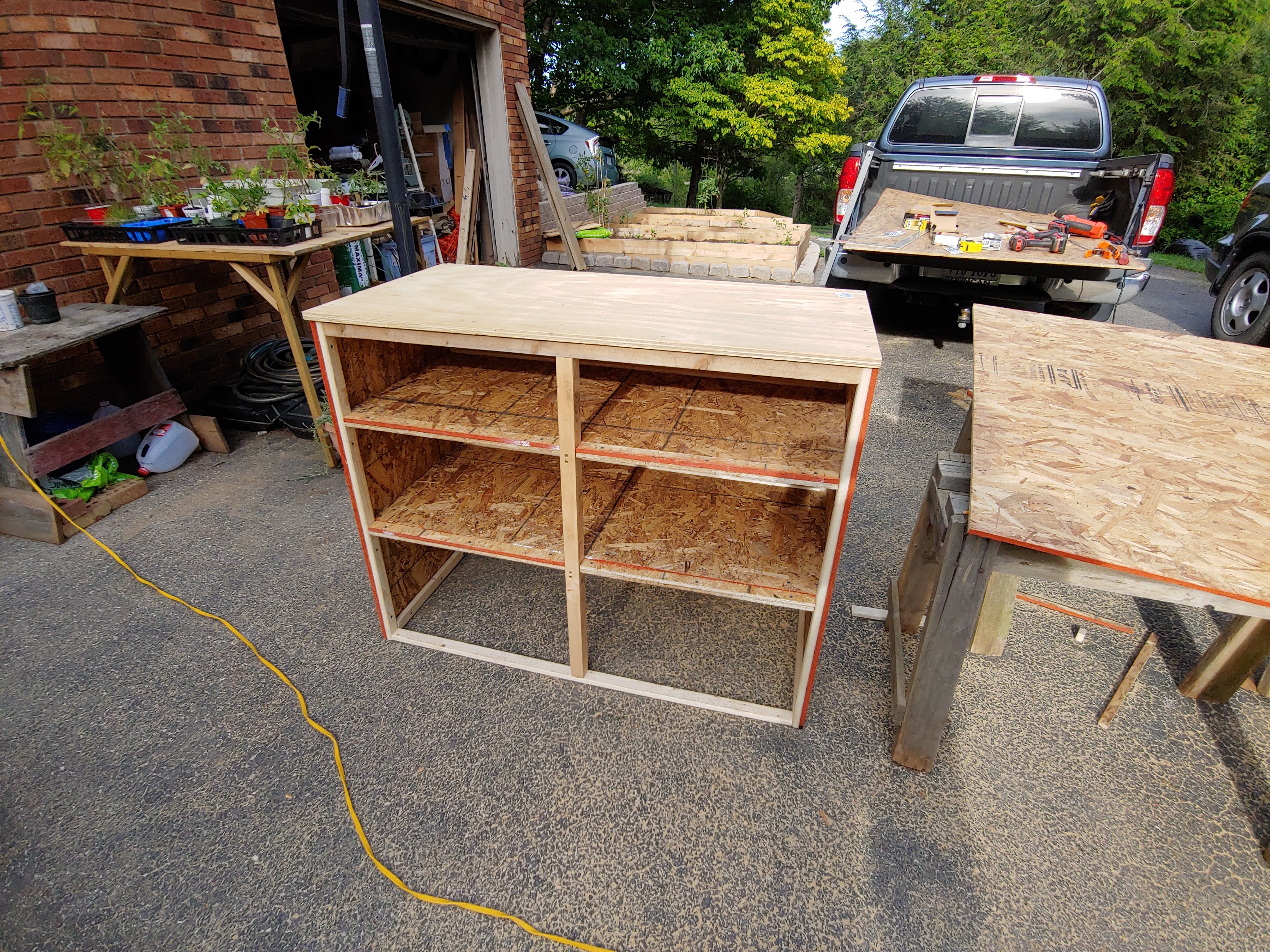
The kitchen cabinet took the longest because I’m not a cabinet or furniture maker. The OSB was teaching me what was possible, along with what was necessary to use it for a solid cabinet that was light enough to move into place by myself. A 40-year-old skill saw, handheld jig saw, impact driver and drill were the only power tools used. A two-foot square, four-foot sheet rock square, miter box with hand saw, tape measure and two old sawhorses Dad cobbled up over 35 years ago rounded out the hand tool selection. The saw horses were different heights, which made for some interesting tensions on the saw blade when making long cuts. They were designed to hold 2 x 4’s in different positions without clamps, and also allowed materials to be cut with saws without cutting into the sawhorse if you used them correctly.

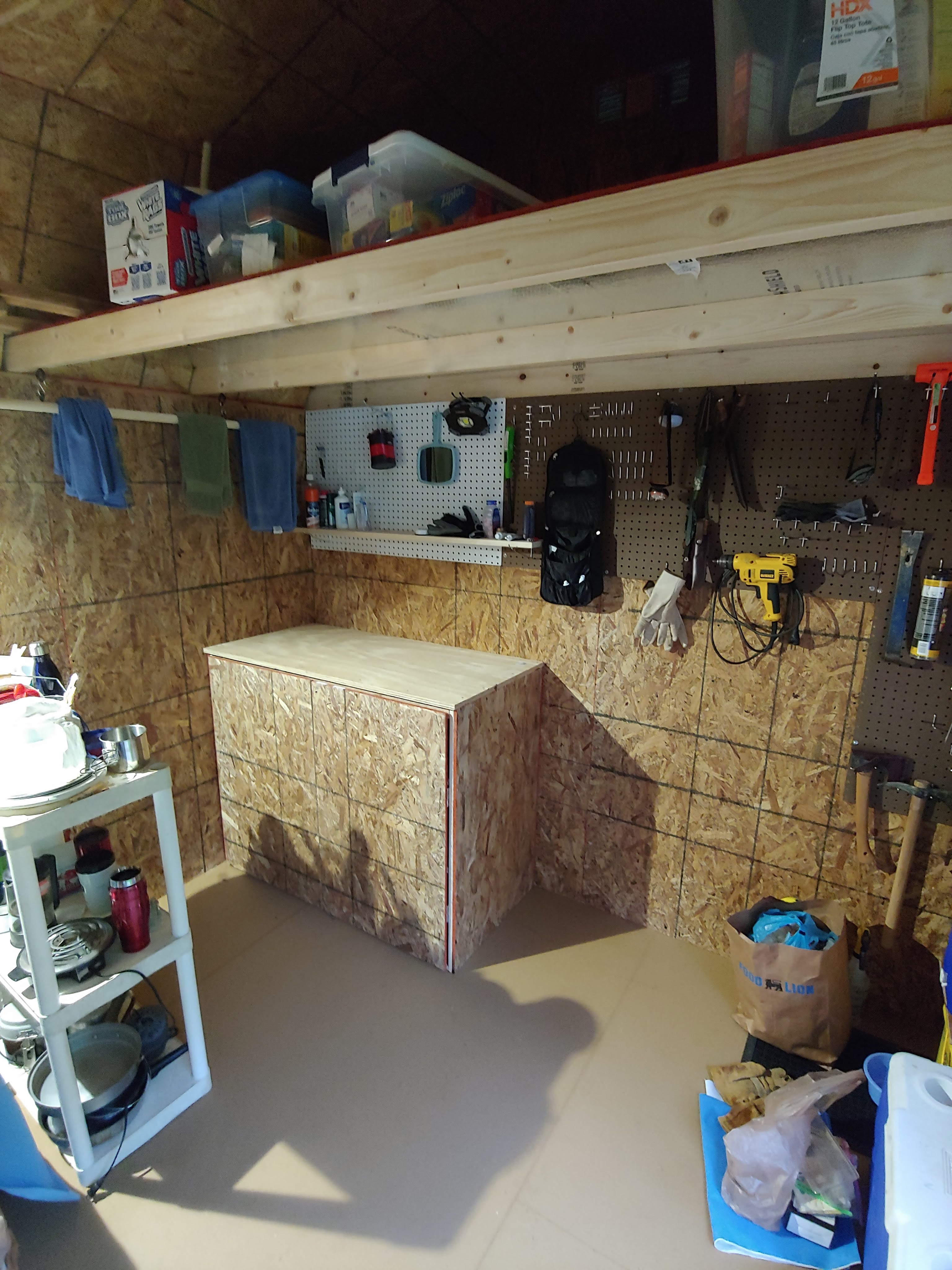
At the end of a long hot day I stood proud, not because it was nice or perfect, but because I was able to create a good solid cabinet out of crap. It was light enough that I could slide and swivel it across the driveway and up some boards into its final resting place. A little later I would add an extra countertop piece for my water cooler and makeshift sink and ultimately lay tile on the top.

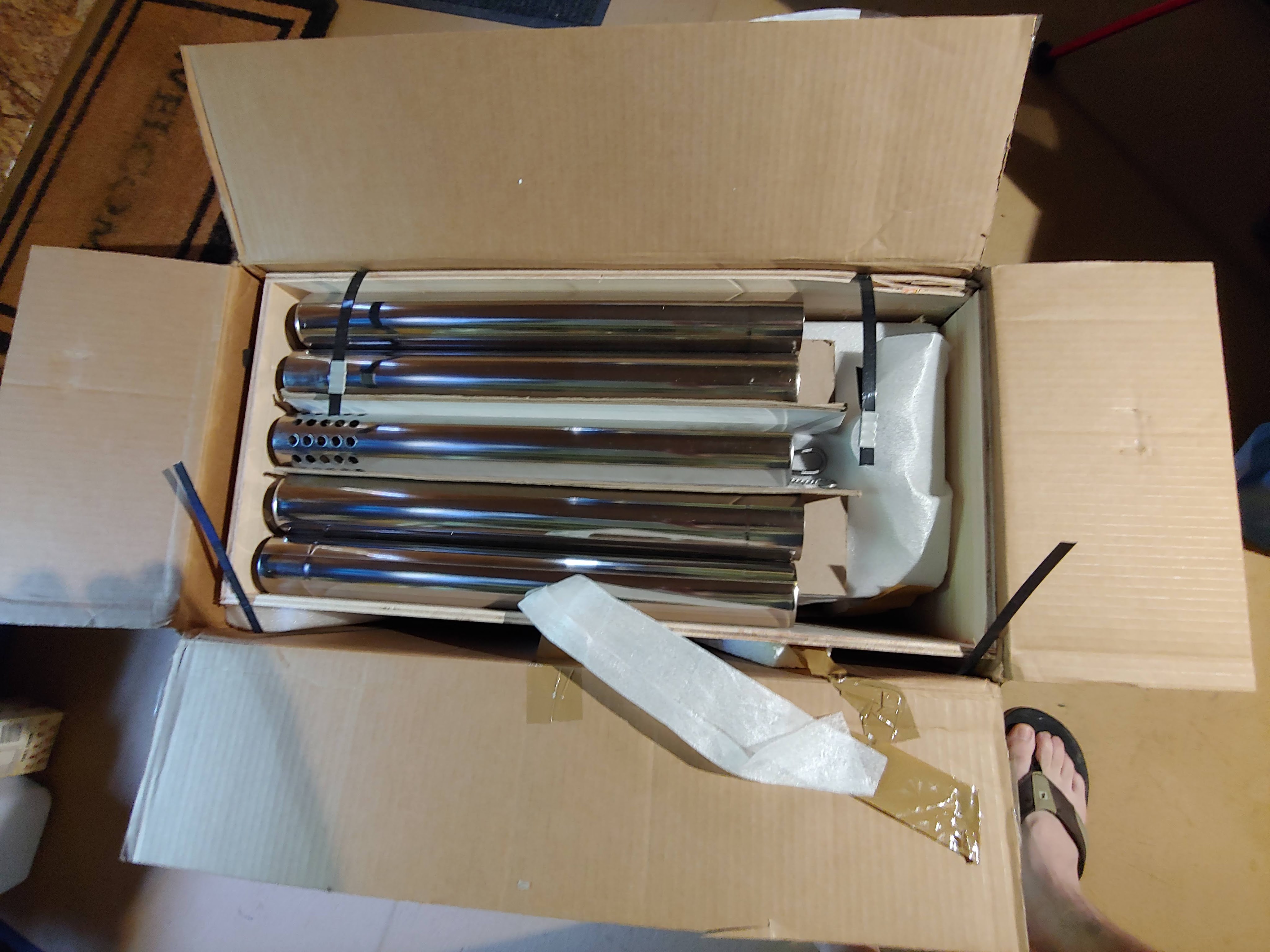
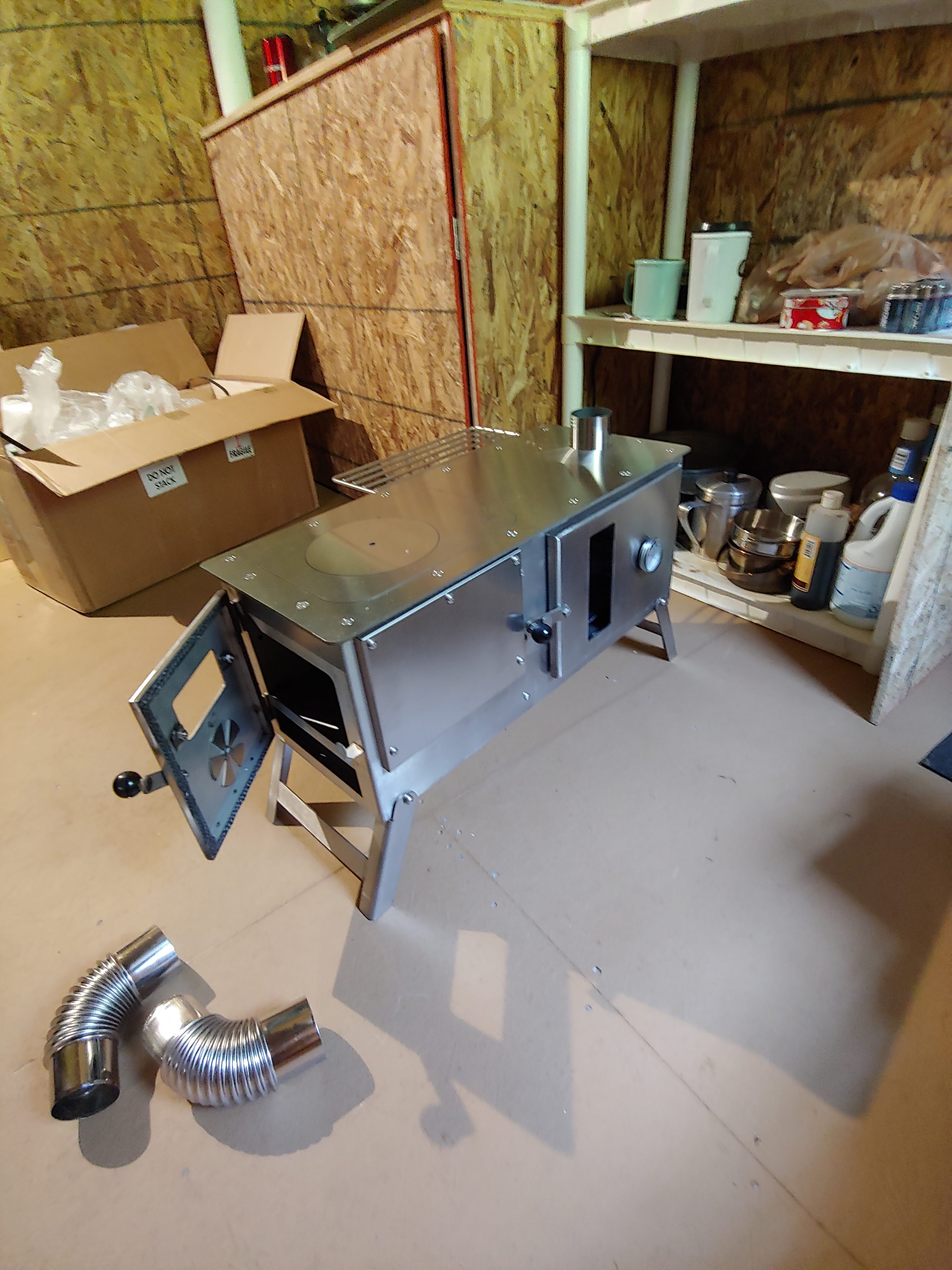
The next day was a day of rest of sorts. I received my stove in the mail. Back when it was still cold I began researching stoves that could be used for tent camping or tiny house living. I was somewhat familiar with the light tin sheep herder stoves used out west. There was one in an old prospector’s A-frame shelter out in the desert in Wyoming. I camped there with my brother and one of his old high school buddies. It was built in the early 1900s as far as I could tell, with old lumber and using cardboard boxes for insulation. I imagined whoever built it to be a tough, crusty old character expecting to get rich finding gold or silver. That area was mostly rich in oil and fossils. We fired up the herder stove with dead sagebrush at night for heat and fried some stuff on it. The next day we had a coffee can of stew cooking on a bed of coals. The fire ring was made of flat shale stones that, to my surprise, started burning. That’s when I learned about oil shale.

I debated the pros and cons of several stoves. Each time I narrowed it down to a choice, they were not available due to pandemic reasons. I was looking for something to possibly cook on while safely heating a small space. I settled on the Tent Dragon made by a company called Silver Fire in Oregon.

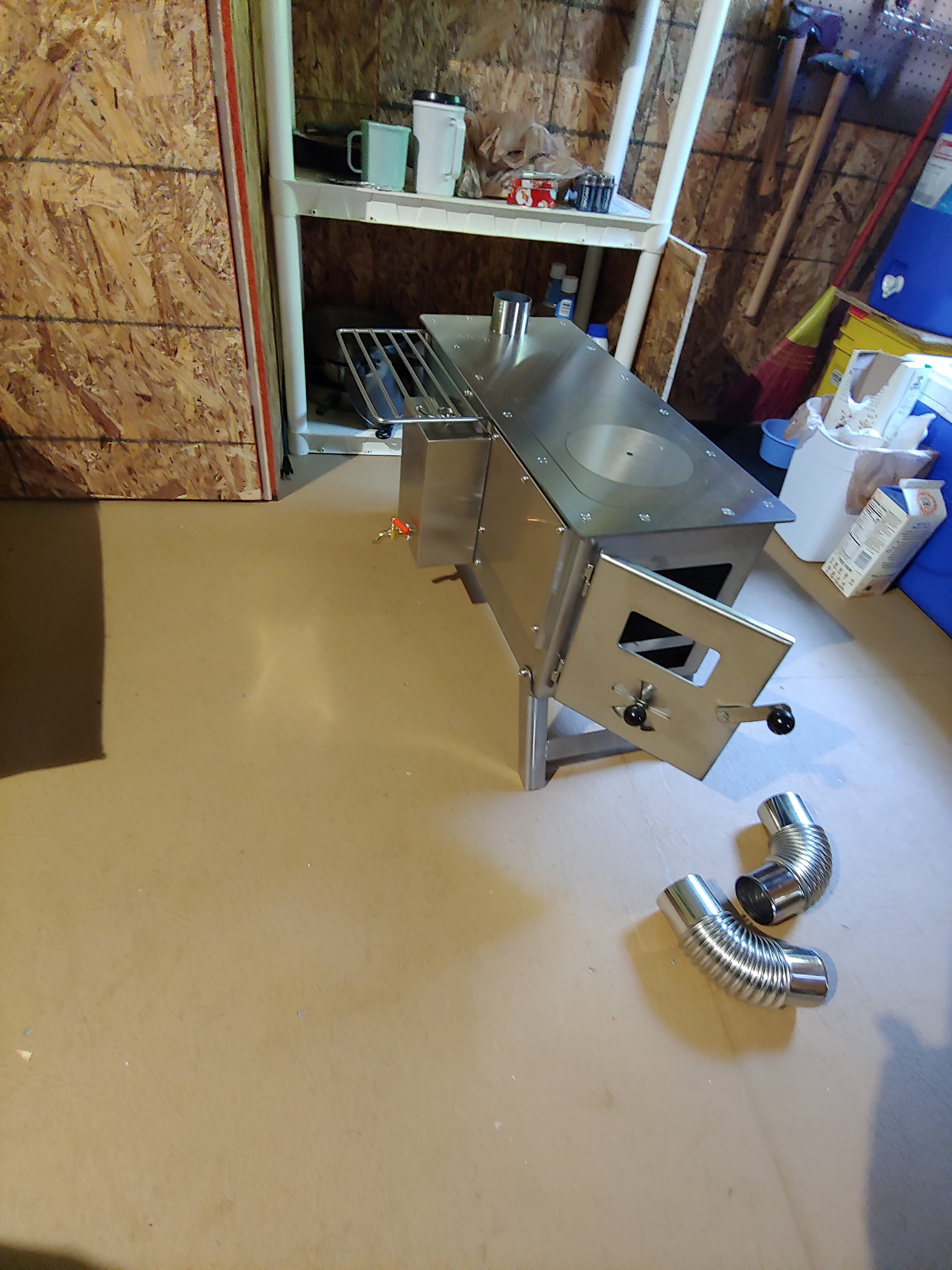
It was a stainless steel gasifier. A gasifier stove is designed to feed air into the firebox in such a way as to ignite the smoke for a secondary burn. This allows the stove to burn hotter and cleaner with less fuel. This stove had a removable top that was adjustable for different heat, a two liter hot water tank, wire warming rack and an oven with a temperature gauge. The stove pipe was stainless steel 2 1/2 inches in diameter. The way the pipe fit together along with the small diameter has caused me a few issues along the way. I may need more time and experience with it to find some solutions I may not be considering. As I write this, it’s below freezing with snow on, and I can’t use the stove because the pipes are clogged with creosote despite a recent cleaning. Circumstances after a surgery dictate I can’t move the stove to work on it for a while, so an oil-filled electric radiant heater and extra clothes are doing the job for now. I’ll discuss the pros and cons of the stove in much more detail later on.

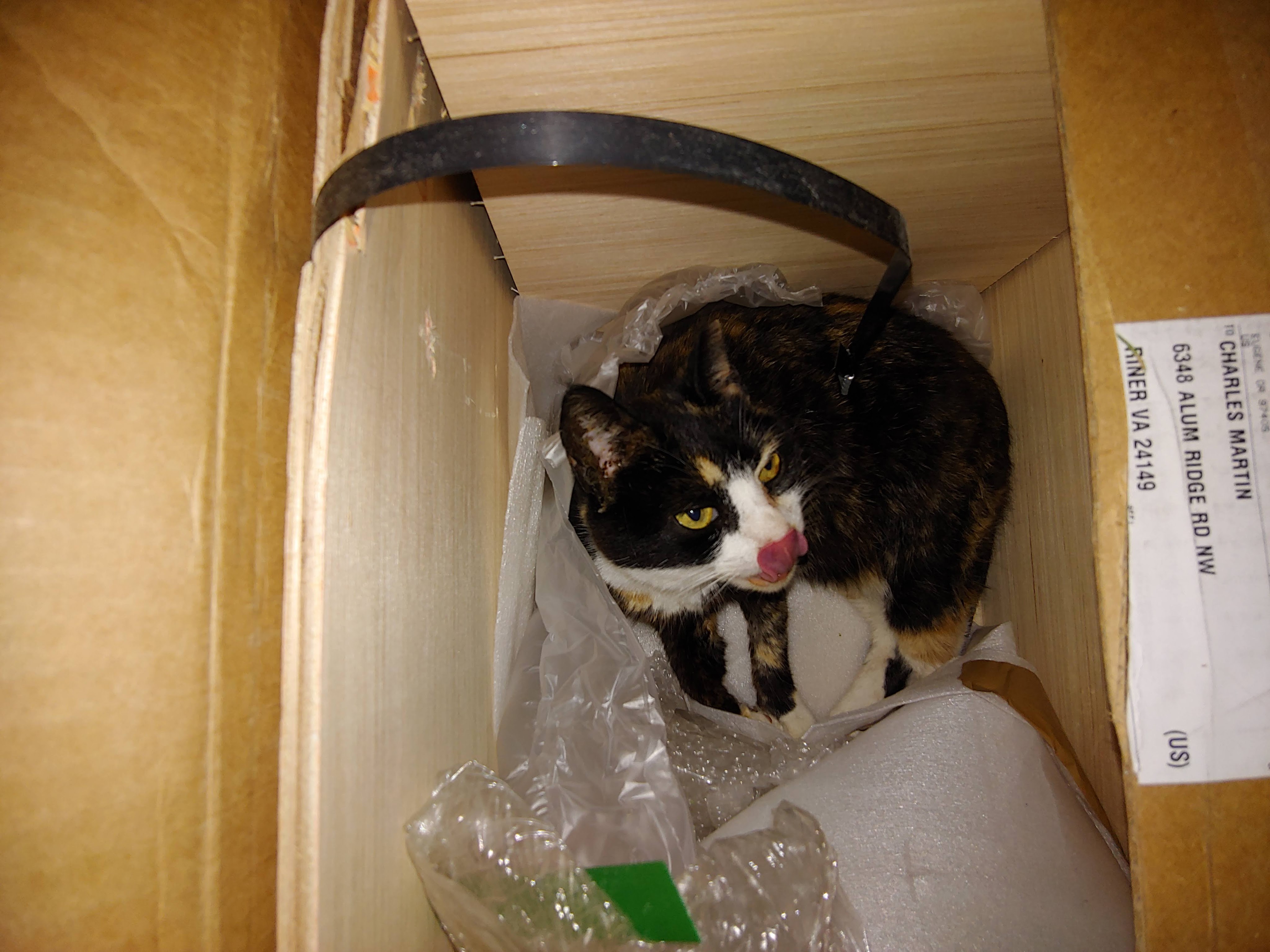
In the meantime I was like a kid in a candy store. I guess shiny things still catch my eye, though not all shiny things are what they seem. I spent part of the day setting it up and attaching the pipe to see how it might exit the window. Flitz found the box and assumed she had landed a sweet little kitty apartment. For some, the box is better than the contents.

Every intention was to be working on a new project, or finishing an old one, every evening before dark and knocking out the big ones on weekends and days off. Things like the tool and gun cabinets I would build needed longer dedicated chunks of time with no chance of rain. Since my shop was the driveway, the roof leaked pretty bad. My garage was too full to be used for anything but storage. Mr. Murphy was sure to rear his ugly head in attempt to trip me up.

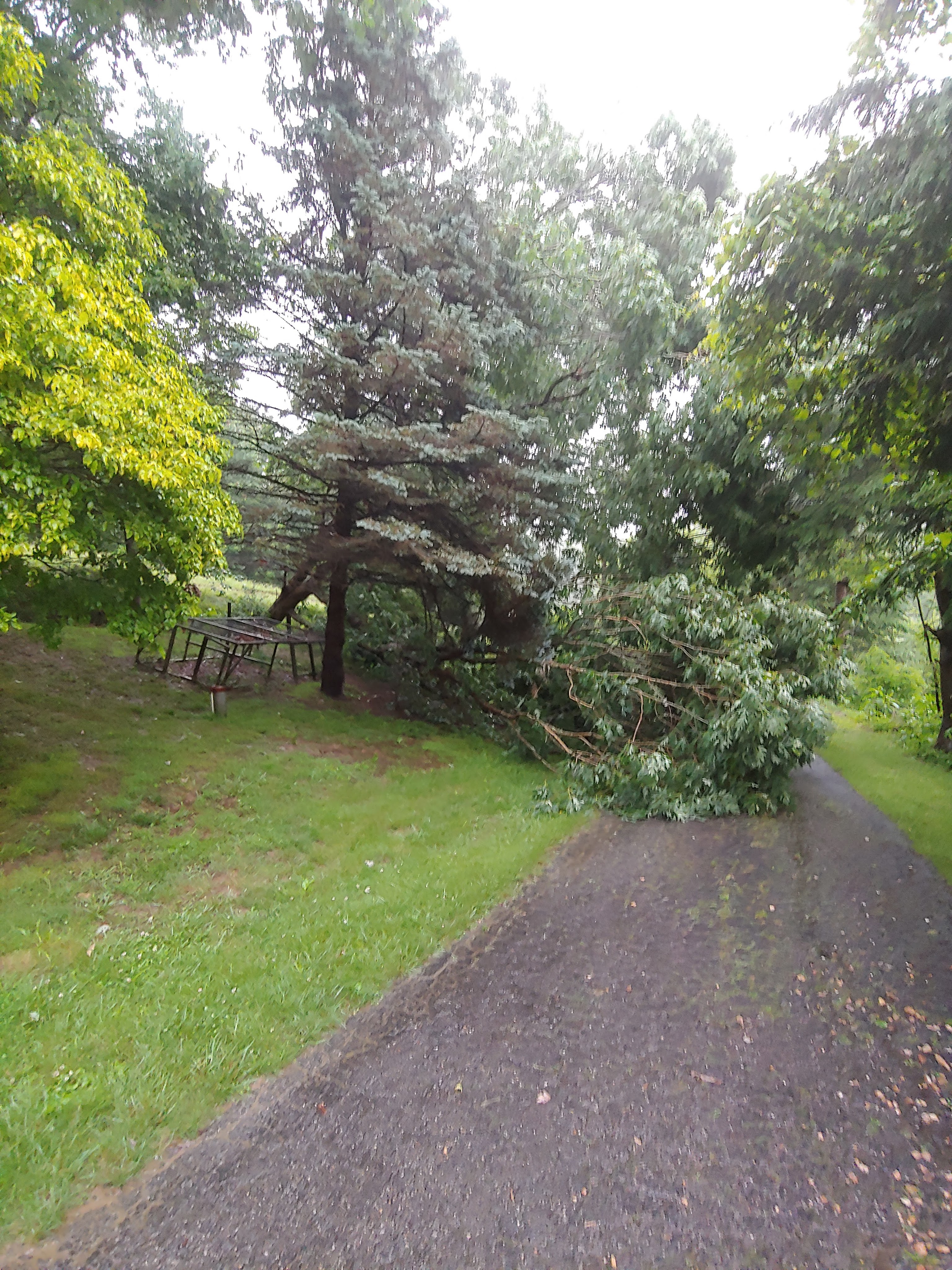
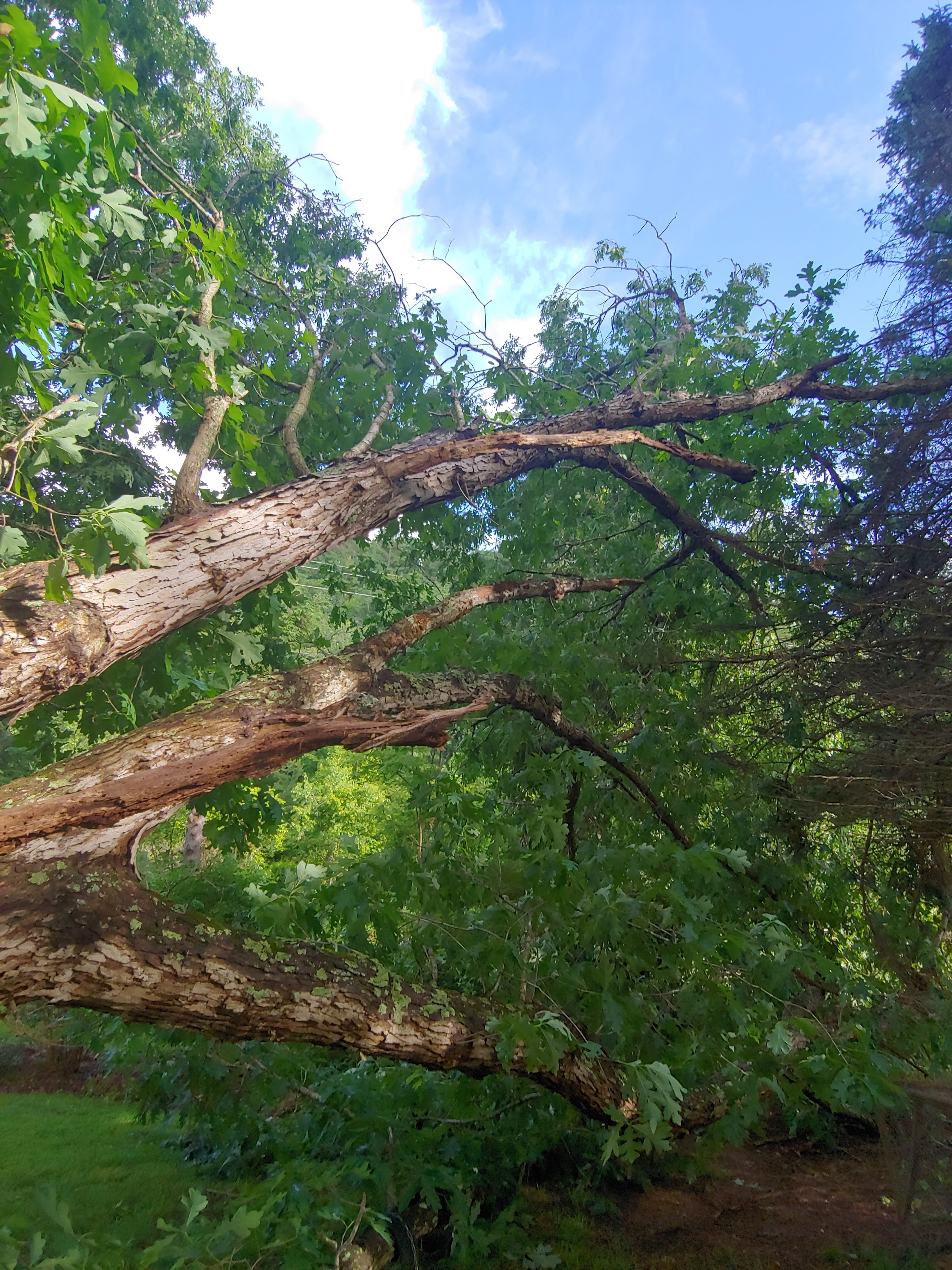
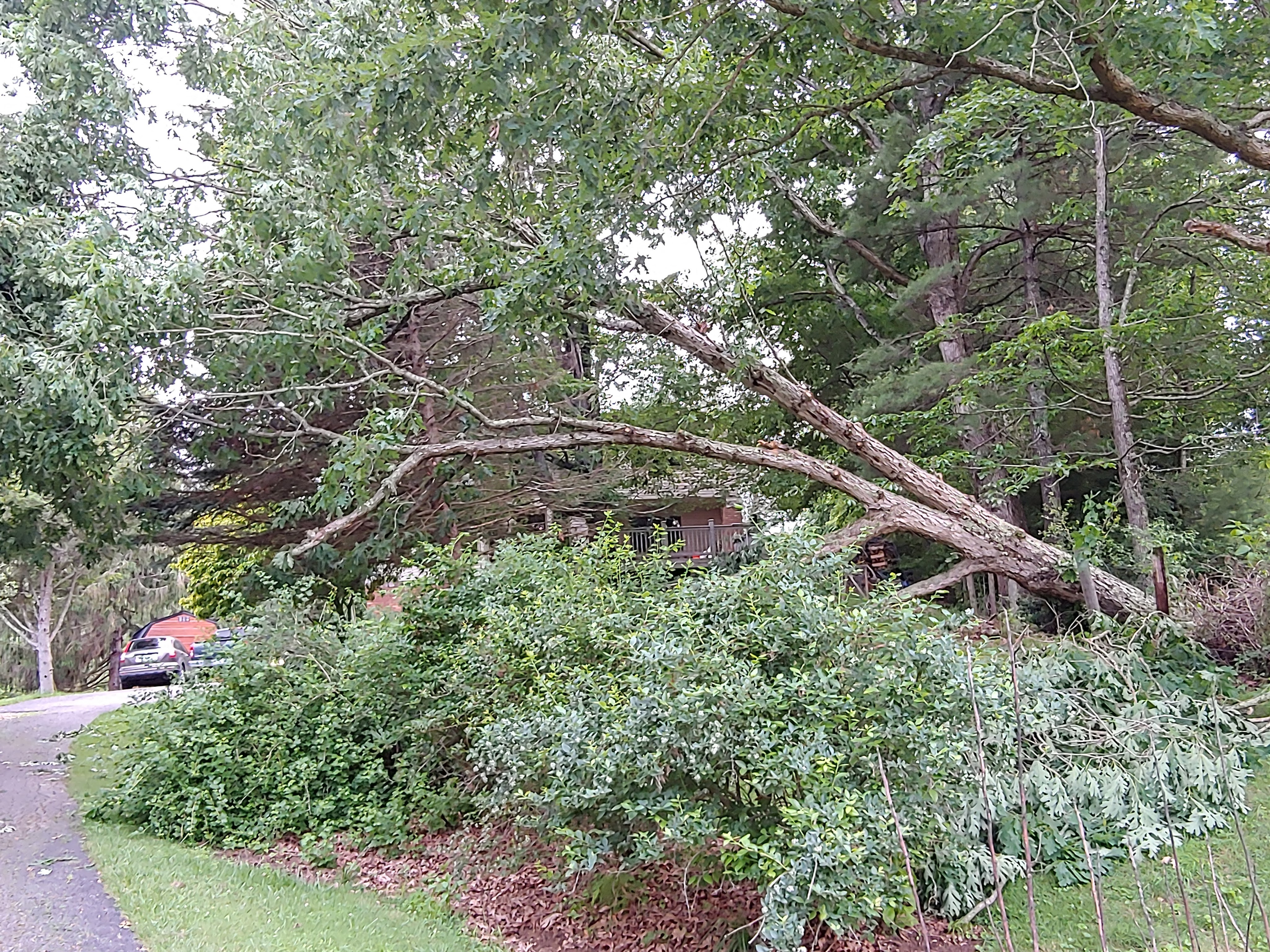
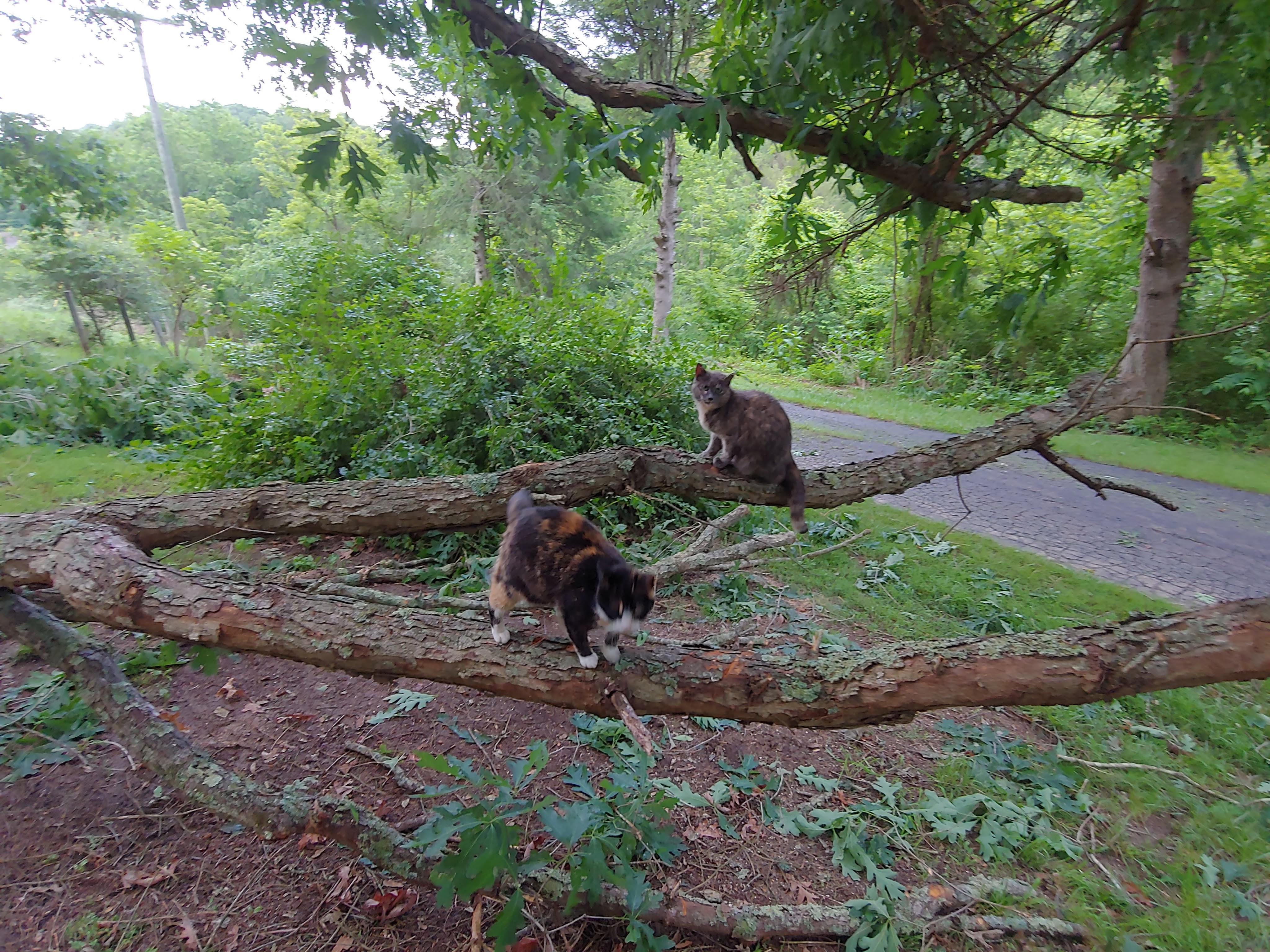
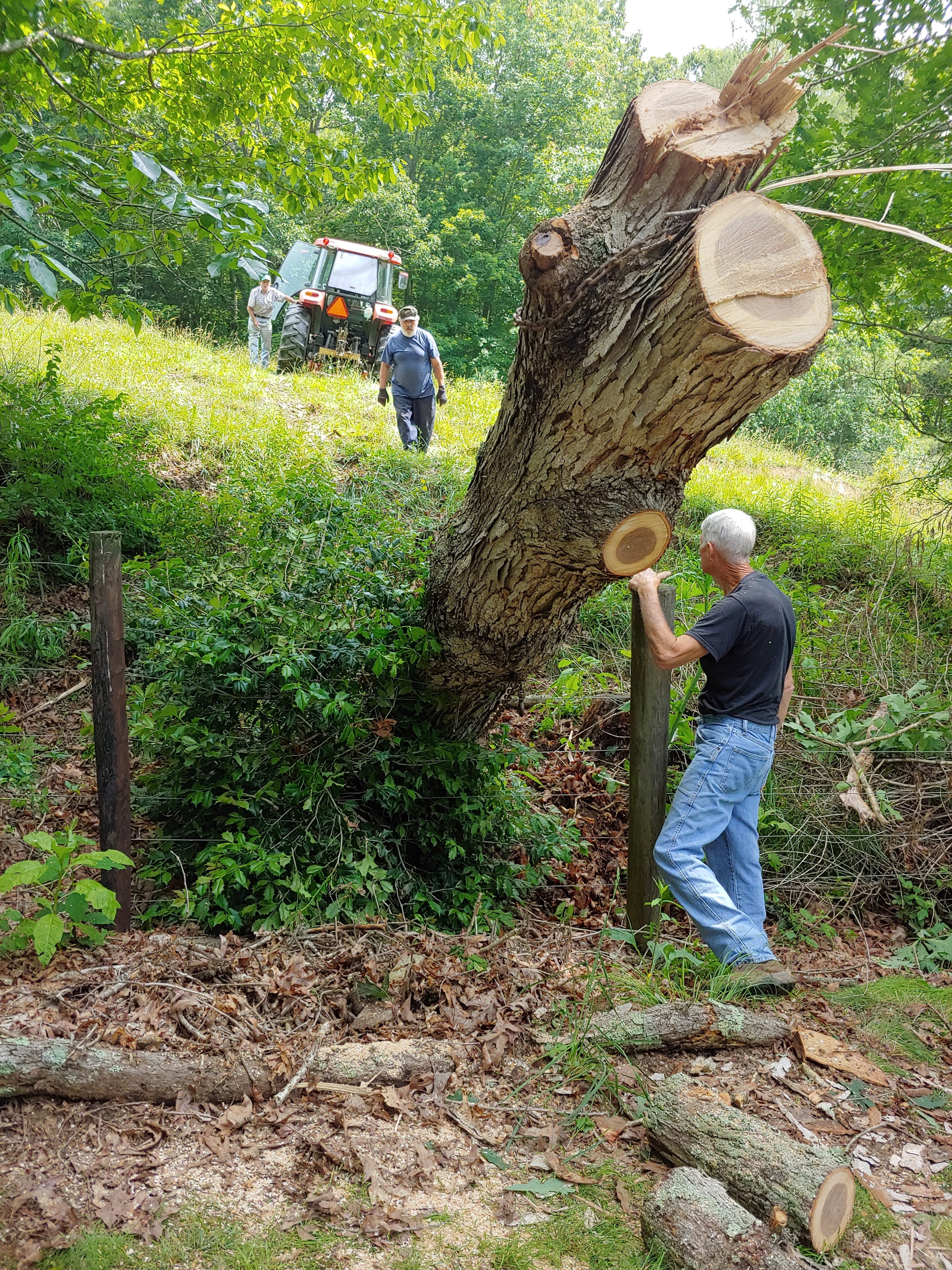
We started having some heavy rains, and with the ground having been supersaturated over the last year, my forward momentum was about to stall. I jumped in the truck one morning, turned on the headlights and saw the driveway disappear into a mass of limbs and leaves that weren’t there before. Barely able to snake around it I went on to work. There are several huge oak trees on the neighbors land along the fence by the yard. Last year we had cut a giant down that threatened to crush the house. It was rotted halfway through, so cutting it down was truly a disaster averted. The tree that had come down now looked healthy, but had a rotten root on one side. It was already leaning heavily and gave way in the rain-softened soil.

I discussed it with the neighbor and offered to cut it down myself. He insisted on getting a crew together to take care of it. The crew was his son and another friend who does a lot of wood cutting and other work for him. I cut over half the top out that I could reach from the ground with a chainsaw and a pole saw. Any widow maker (dead limb ready to fall off) I could reach got trimmed, and anything to drop excess weight and torque was cut before they came. My neighbor is in his 90s and the other two in their 70s. Having cut the big tree with their help the previous year, I knew there would be some communication and organizational issues. I hoped to avoid as many opportunities for any of us to die as possible. The neighbor drove the tractor while the rest of us did the cutting and dragging. He wanted the biggest wood to burn and was happy to let me have the smaller stuff. I had to stack it up for him to come get it later. The stump slammed back into place when the last large chunk of the trunk was cut off.

If a tree falls in the woods and there’s nobody there to hear it, does it make a sound? I don’t think so. A tree fell in the driveway while we were there and none of us heard a thing. Maybe it was a quiet-natured tree?

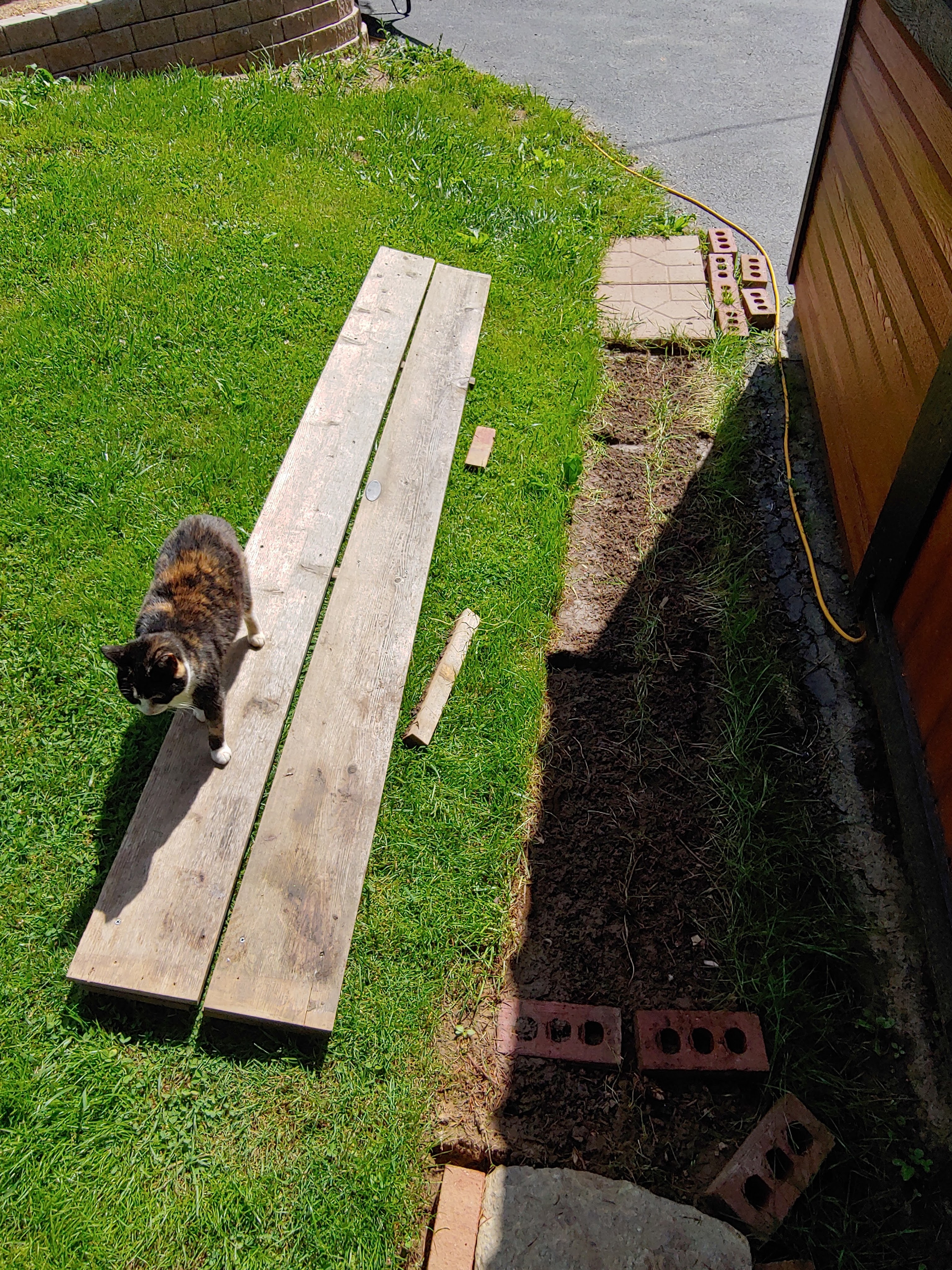
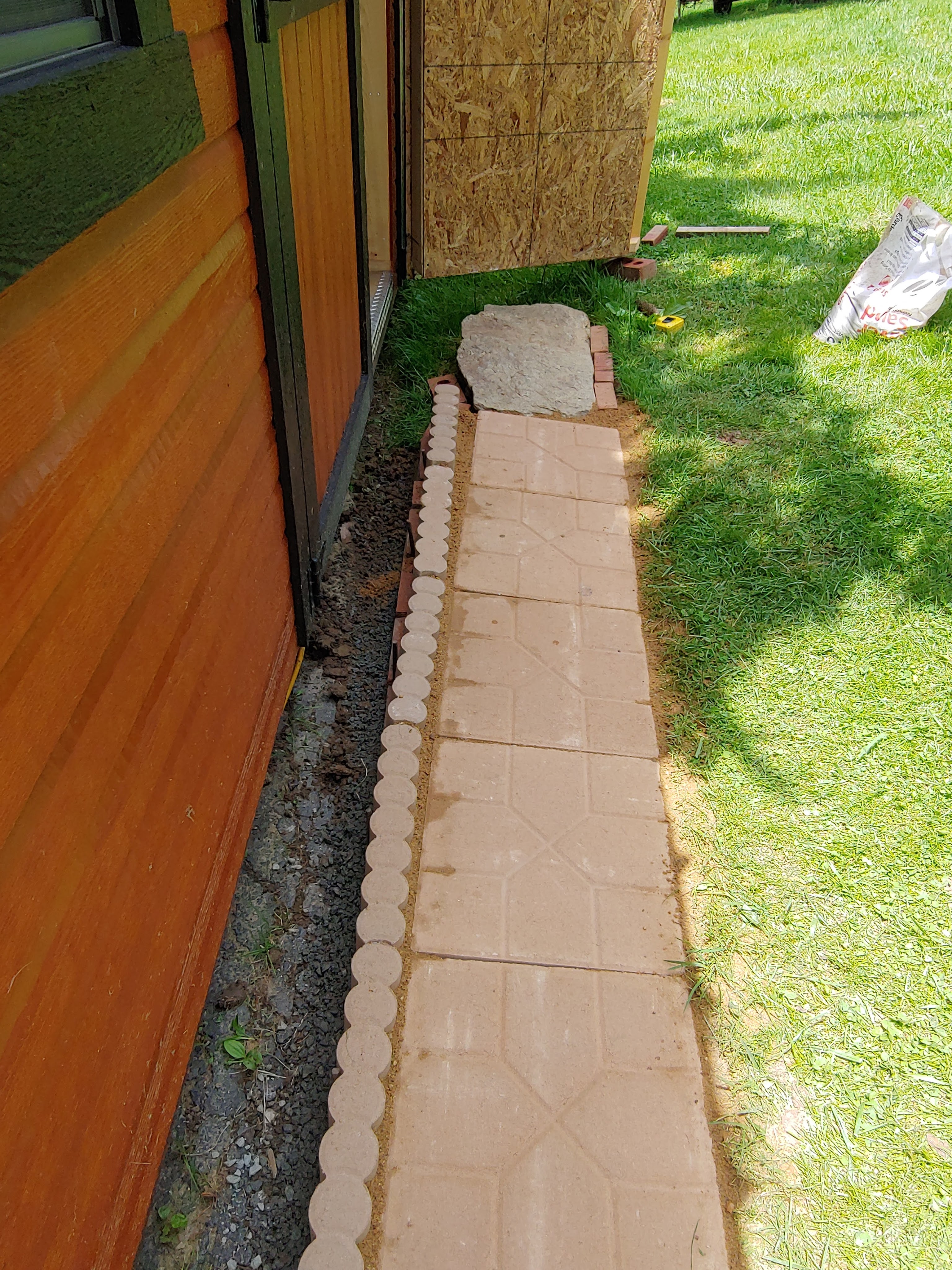
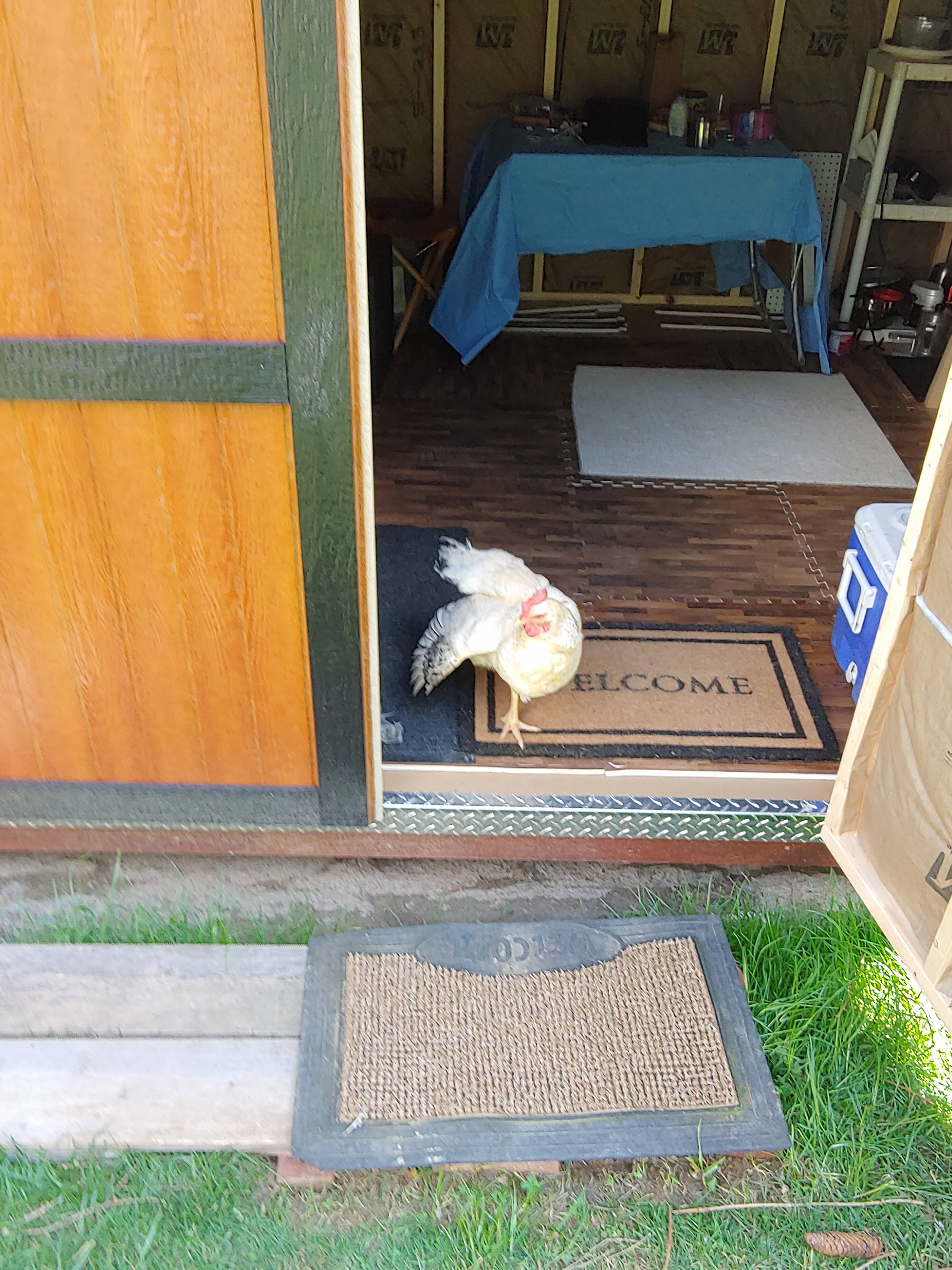
The next project I managed would be to put in a more solid walkway to the door of the shack. Two cedar boards propped on bricks had kept me from making a muddy trail up to that point. Some square concrete stepping stones were set in gravel and sand for a walkway, and a big rectangular stone from the back of the property was set in place for a solid porch. The cedar boards were reallocated to the walk for the outhouse.

An afternoon spent cutting bamboo poles and lashing them into tripods for the garden and raised beds helped top off the weekend. The gardens were going gangbusters with Lydeana working from home. With Shayley cooking all the time, that left Lydeana free to walk out and do little stuff here and there whenever she had time. Being stuck in the house doing her job and on long Zoom calls made the the garden work a much-needed stress relief. Both she and the gardens thrived, and I was happy to help promote it. I avoid garden work as much as possible. I can do all sorts of hard labor all day long without a problem, but let me bend over in a garden for half an hour and my back is in sheer agony. While she would be taking a break from sitting as a prisoner of the desk, I would take a break and sit down in the grass nearby so we could talk. That and meals on the porch were the times to be together. As long as the weather was warm, if she didn’t have meetings into the night, the longer daylight of summer allowed us have those moments.

Less than month later, I would have a week of vacation to accomplish as much as possible. Murphy’s law has a way of spitting in my face, and time passes all too quickly. I had an internal clock counting down the days till winter even if it was still early in the summer. Some people seem to have an impression that living simply, primitively and independently will be some sort of nirvana that will free them from all their worries and problems. There’s a movie called Into the Wild about a young college student who attempted to leave everything and make it completely alone. He wasn’t fully prepared and ended up dying while attempting to live in an abandoned bus he found in the Alaskan Wilderness. It’s based on a true story. Modern people often can’t spot a black cloud on the horizon and successfully prepare for the fallout when it reaches them, much less do it completely alone. A black cloud came along and caught us all with our pants down. I’m far from being alone, but it was time to pull up my pants and cinch up my belt and be ready for those little puffy clouds in the distance with their faux silver linings.

DIRT AND LIFE

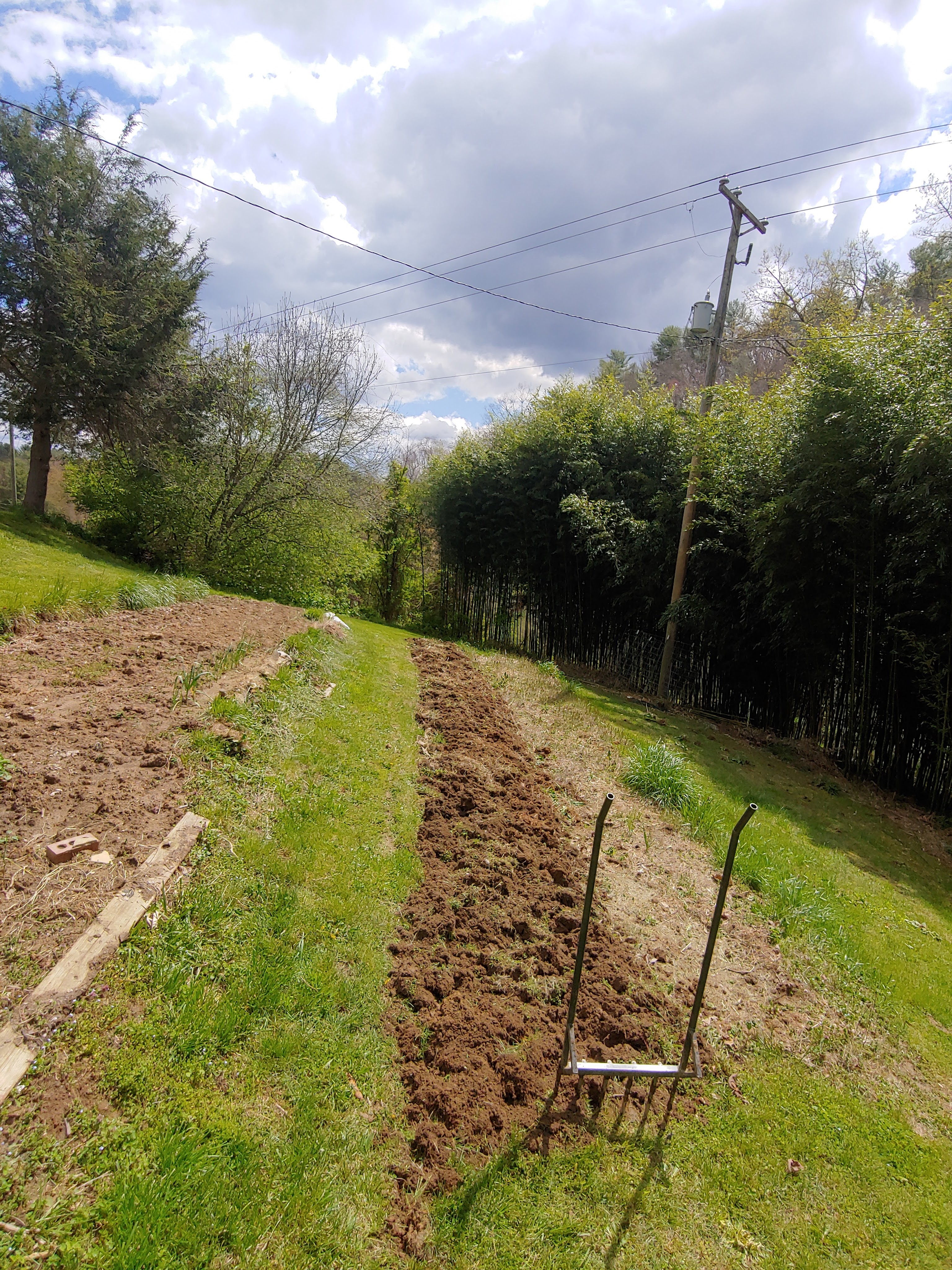
We’ve always had a garden. In the natural world, timing is everything, so I needed to shift my focus from the roof over my head to the ground under my feet. We have four garden spots since they have to be somewhat terraced on our hillside. Our little Mantis tiller can be slow, hard work to break them up from scratch after winter. We ordered a broadfork to do the initial deep break up of the dirt. It works better for me since it doesn’t require gas, oil and annual mechanical repairs and maintenance. Small engines are one of the banes of my existence. I had initially double dug all the sections with a pick and shovel as I created them. Each spring I would spend a couple weeks turning them with a shovel. Even I don’t like shoveling that much. The heavy broadfork worked much better, giving me a work out with less back pain.

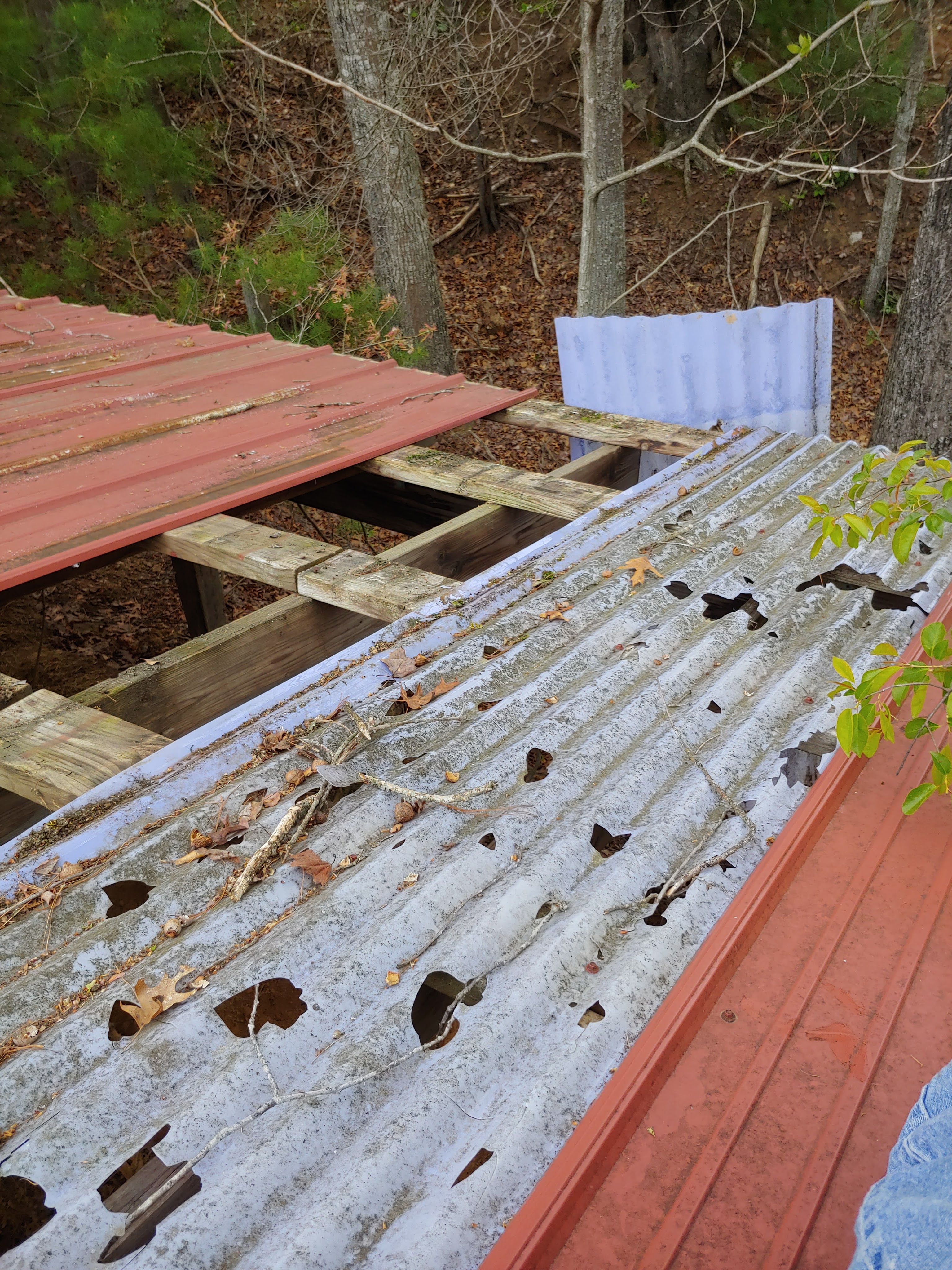
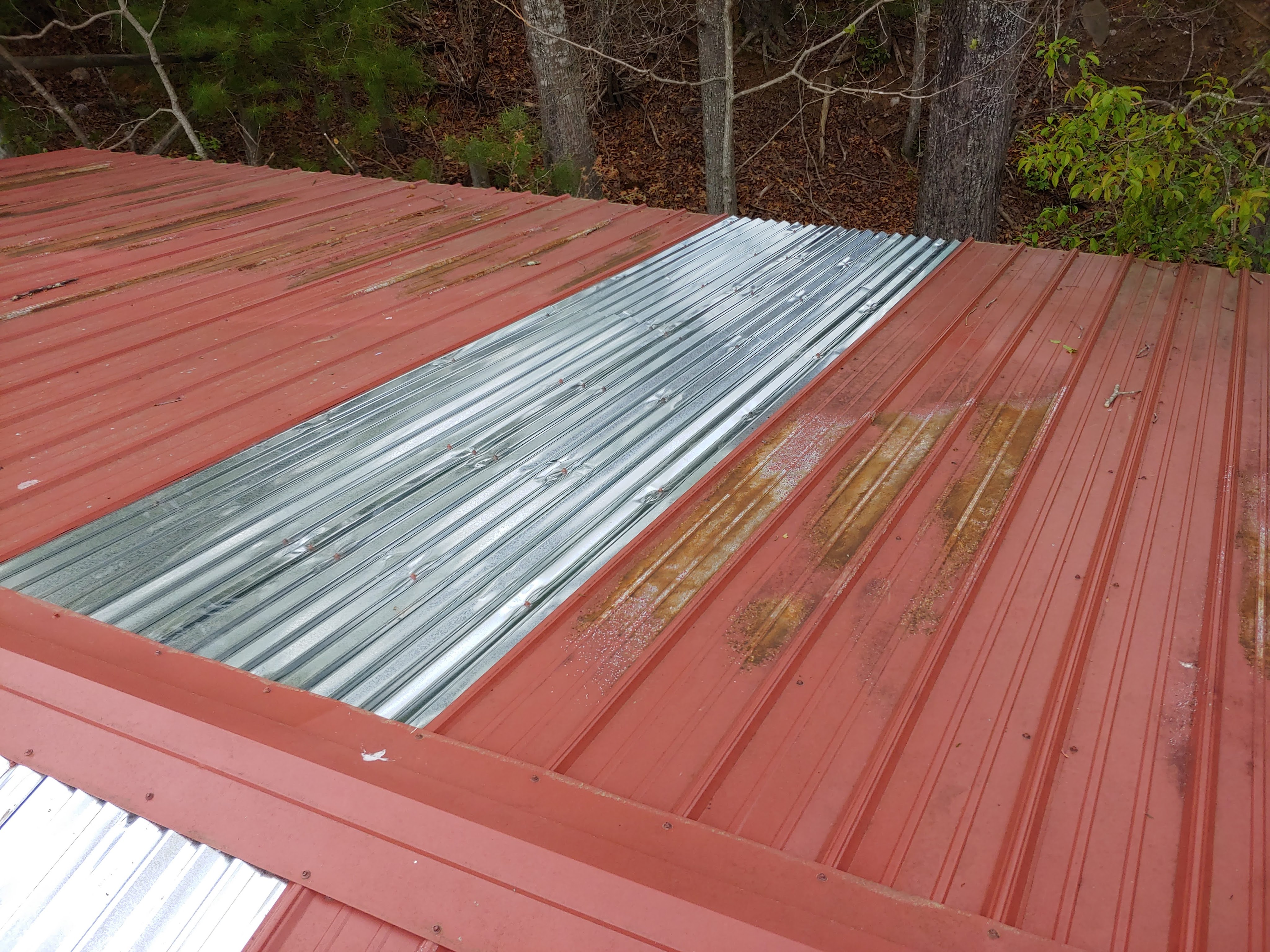
Another small job I needed to take care of was replacing some roofing on my shed. Years ago I had the bright idea of using some translucent plastic roofing over a section to allow some extra light in. Skylights never work out. The stuff rotted from UV exposure and developed gaping holes from acorns, limbs and hail damage. Extra roofing had been purchased along with the insulation for the shack to remedy the issue. The poor shed’s kind of rough and and anything but nice, but it deserved a little attention to keep my stuff dry.

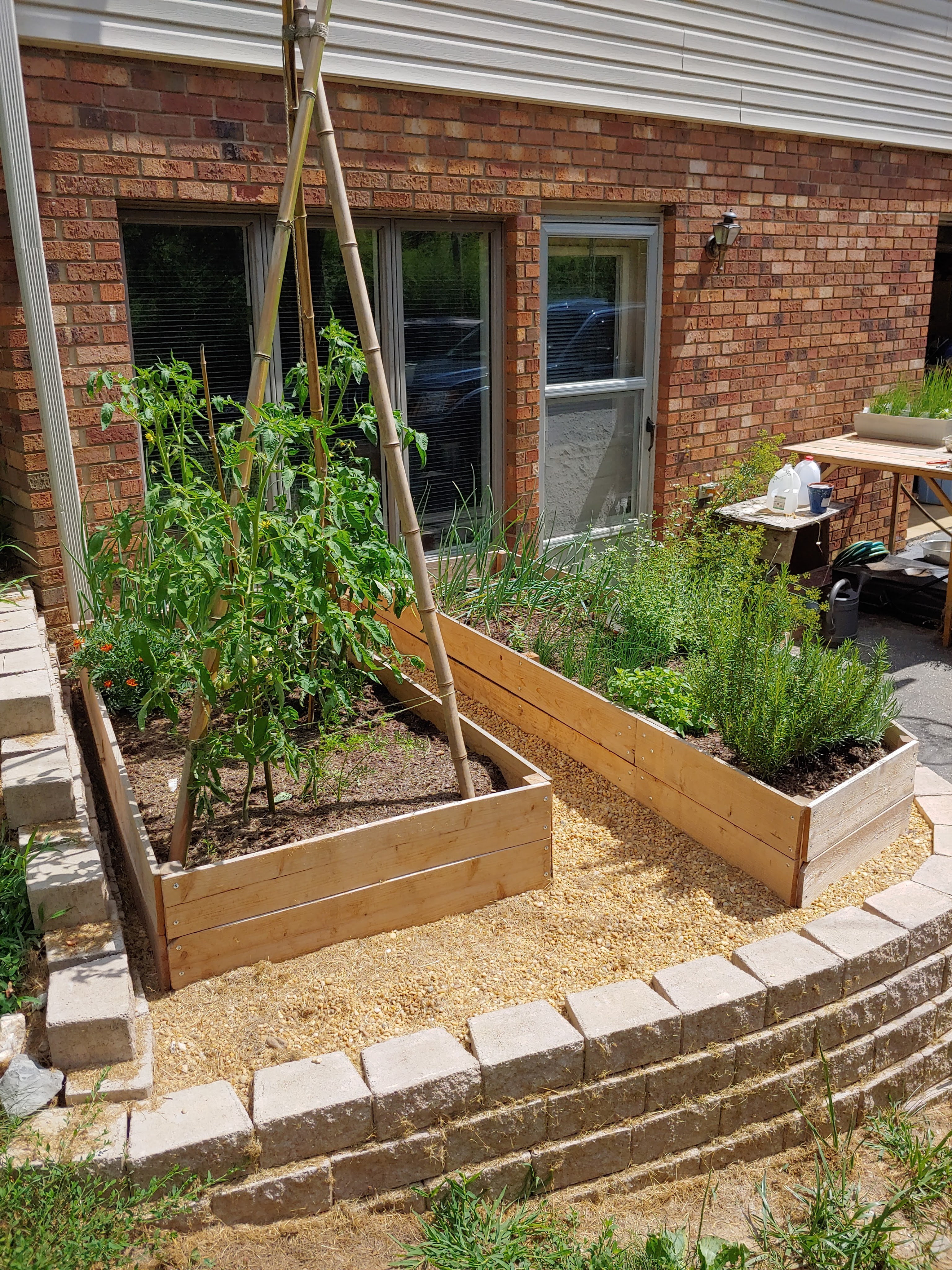
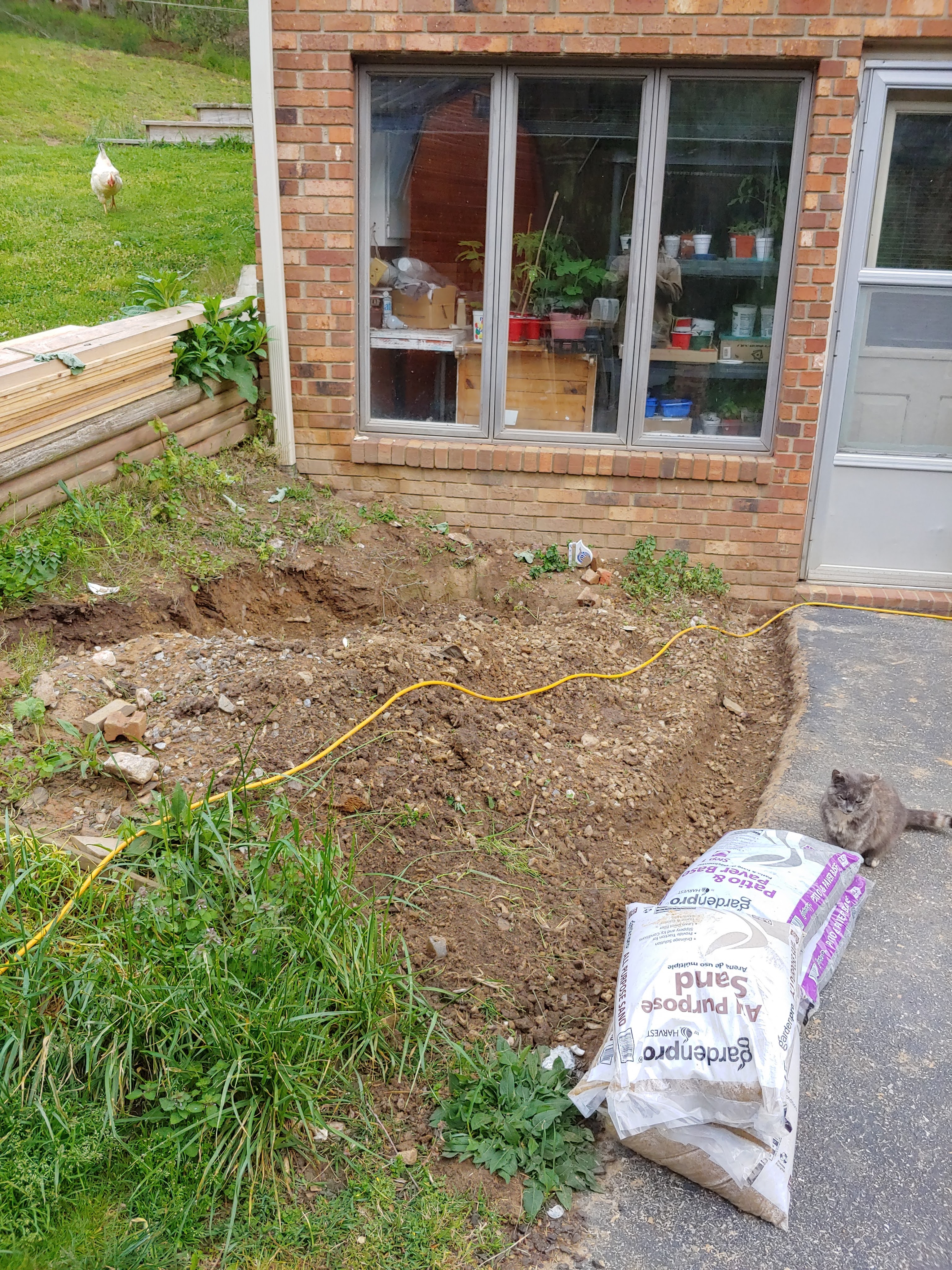
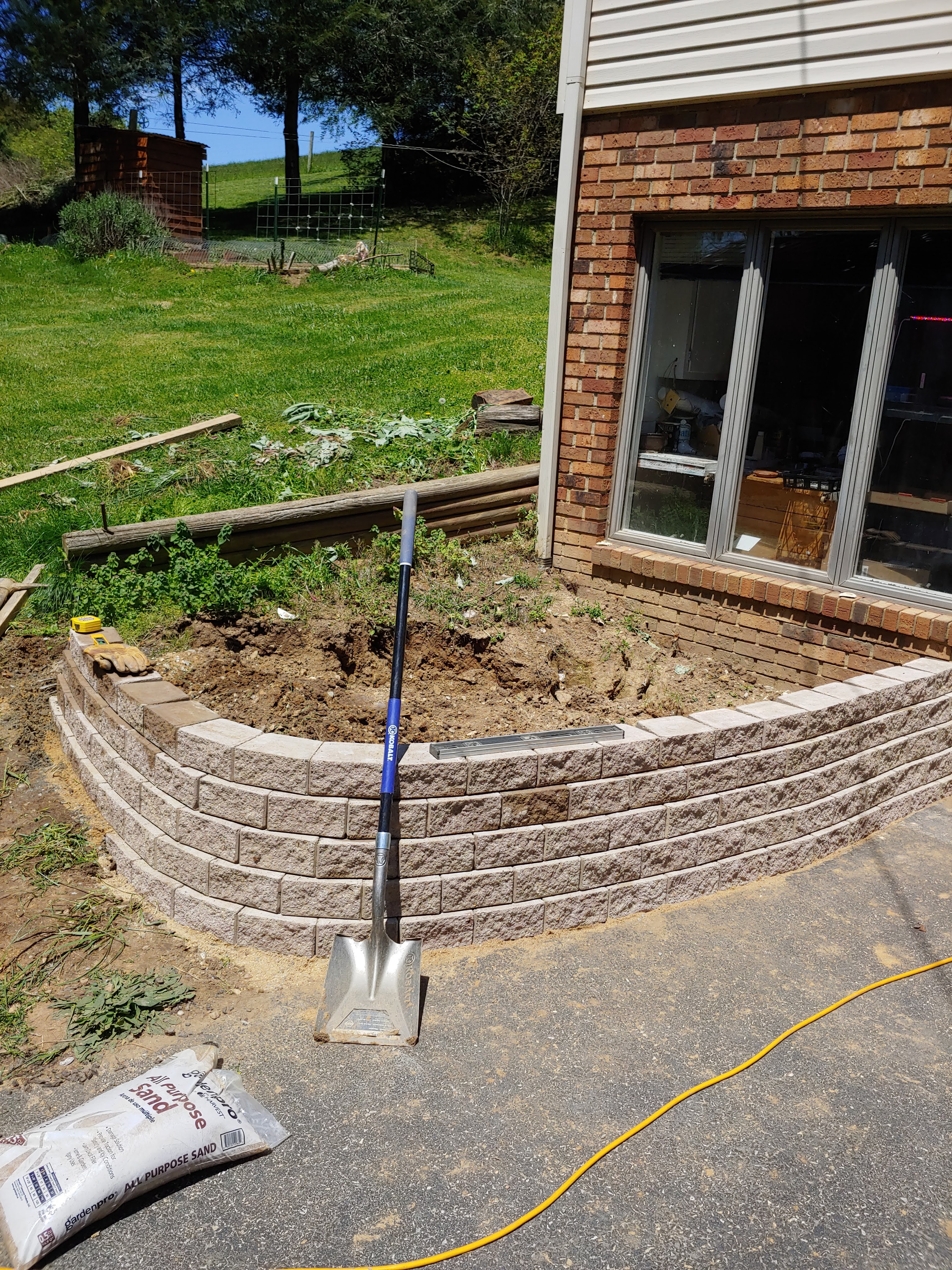
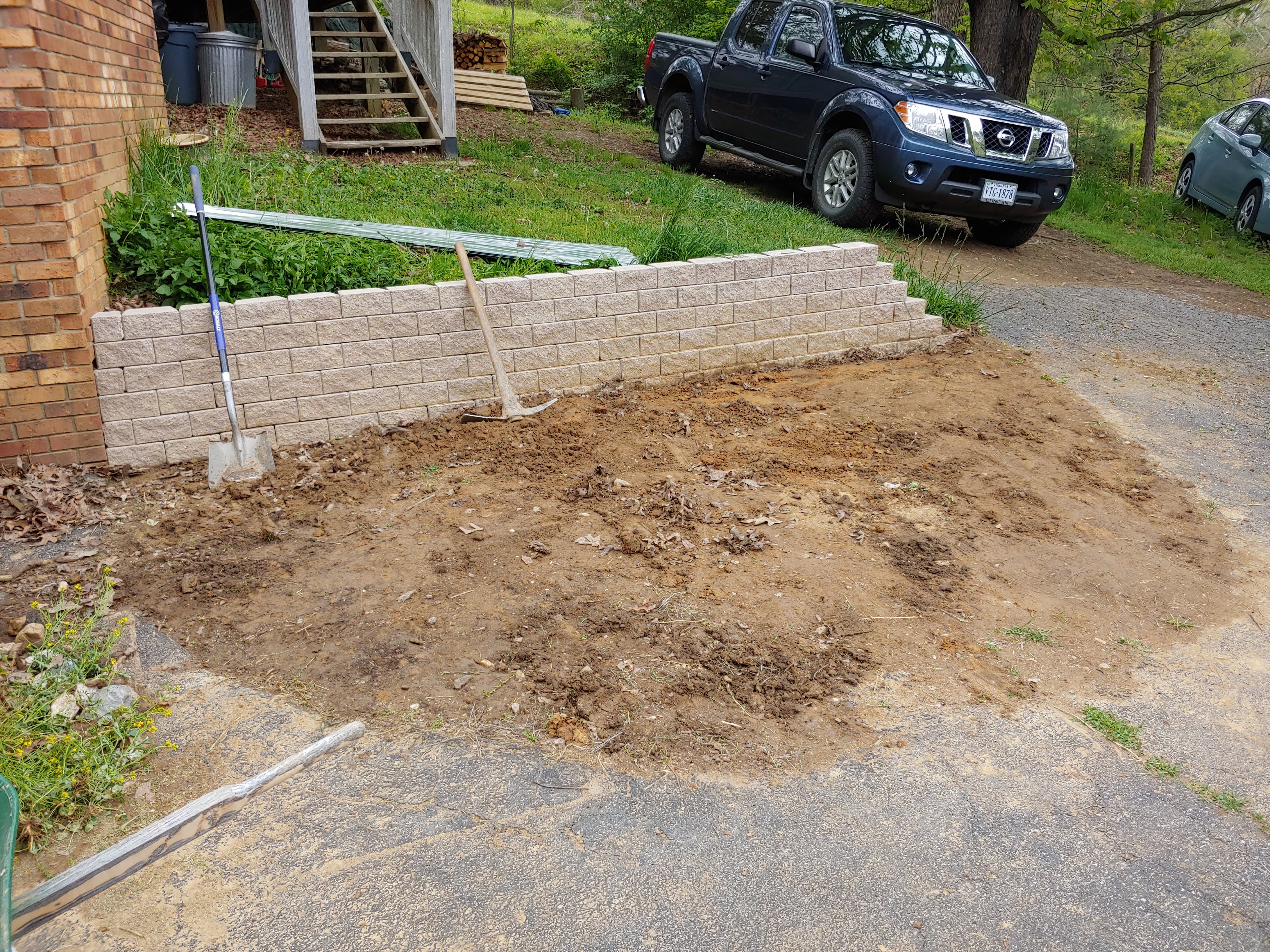
After working up the garden plots and fixing the shed, I turned to a job that had been in the procrastination list for quite some time. Two spots at the basement where the previous owner grew flowers and a holly tree were weed choked eyesores. I had in mind to landscape them and add raised beds. Lydeana and Shayley grow a lot of our herbs to cook with and this would be perfect.

First order of business was removal of the stumps from the holly and a cherry tree that sprang up next to it. The roots were endless and deep, forcing me to dig each one and follow it for a distance to truly clear it out. When the house was built, a lot of gravel, rocks and chunks of brick were disposed in the spot, causing severe damage to any edged tool if not carefully cleared and manipulated. It took two days of digging and cutting to finally wrench the blasted thing out of the ground. Slinging that stump and roots over the fence into the woods was the epitome of satisfaction.

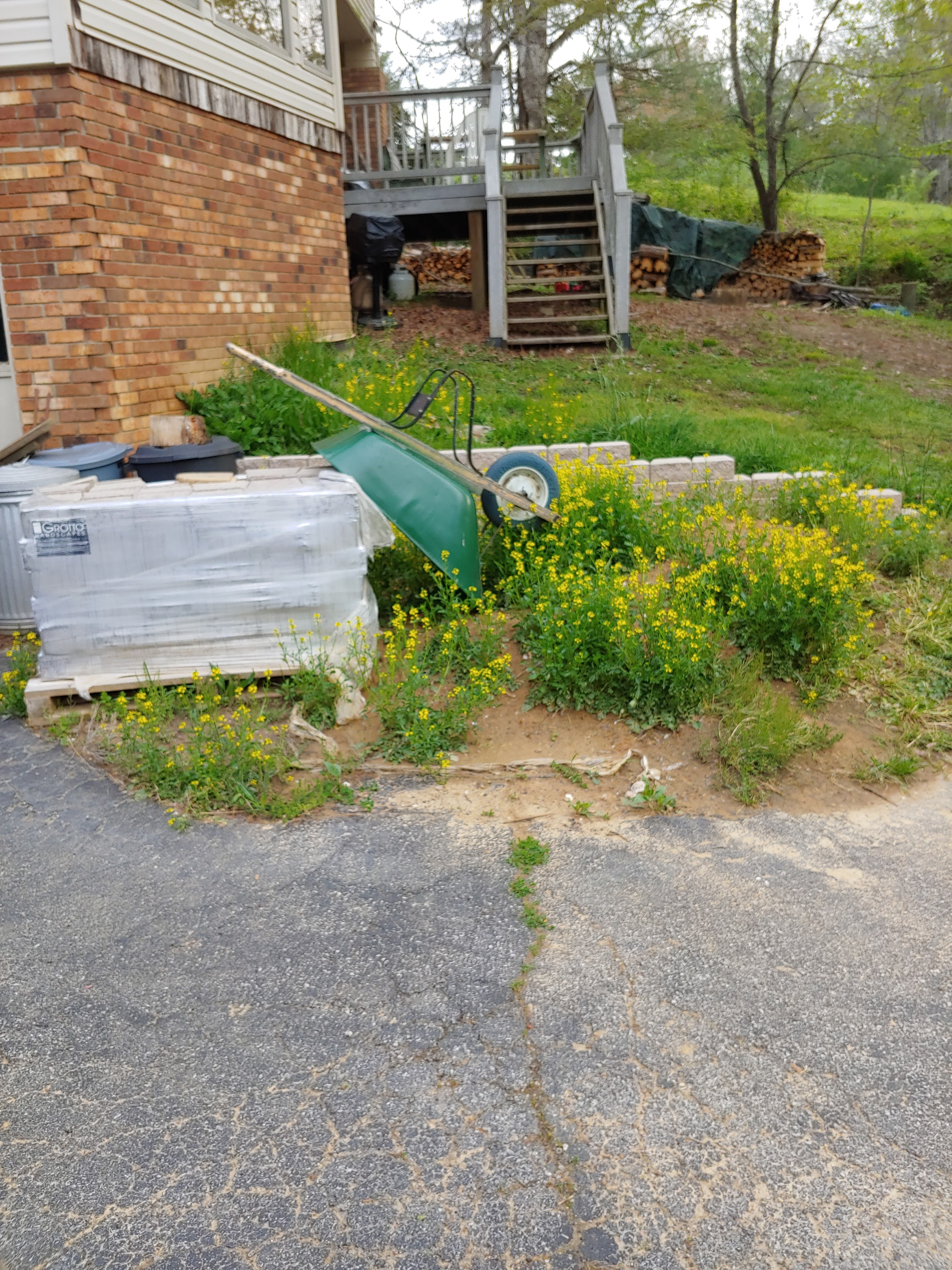
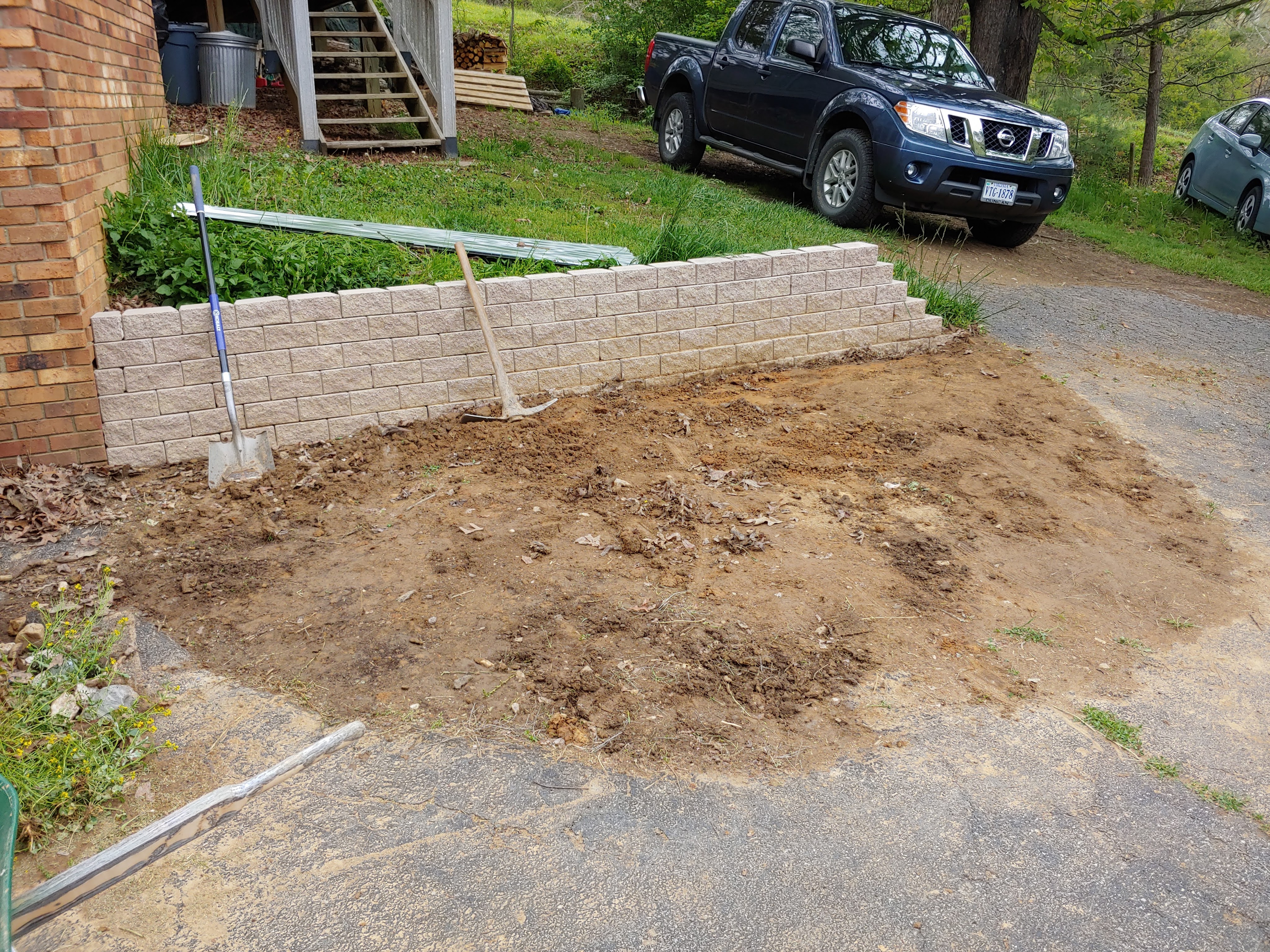
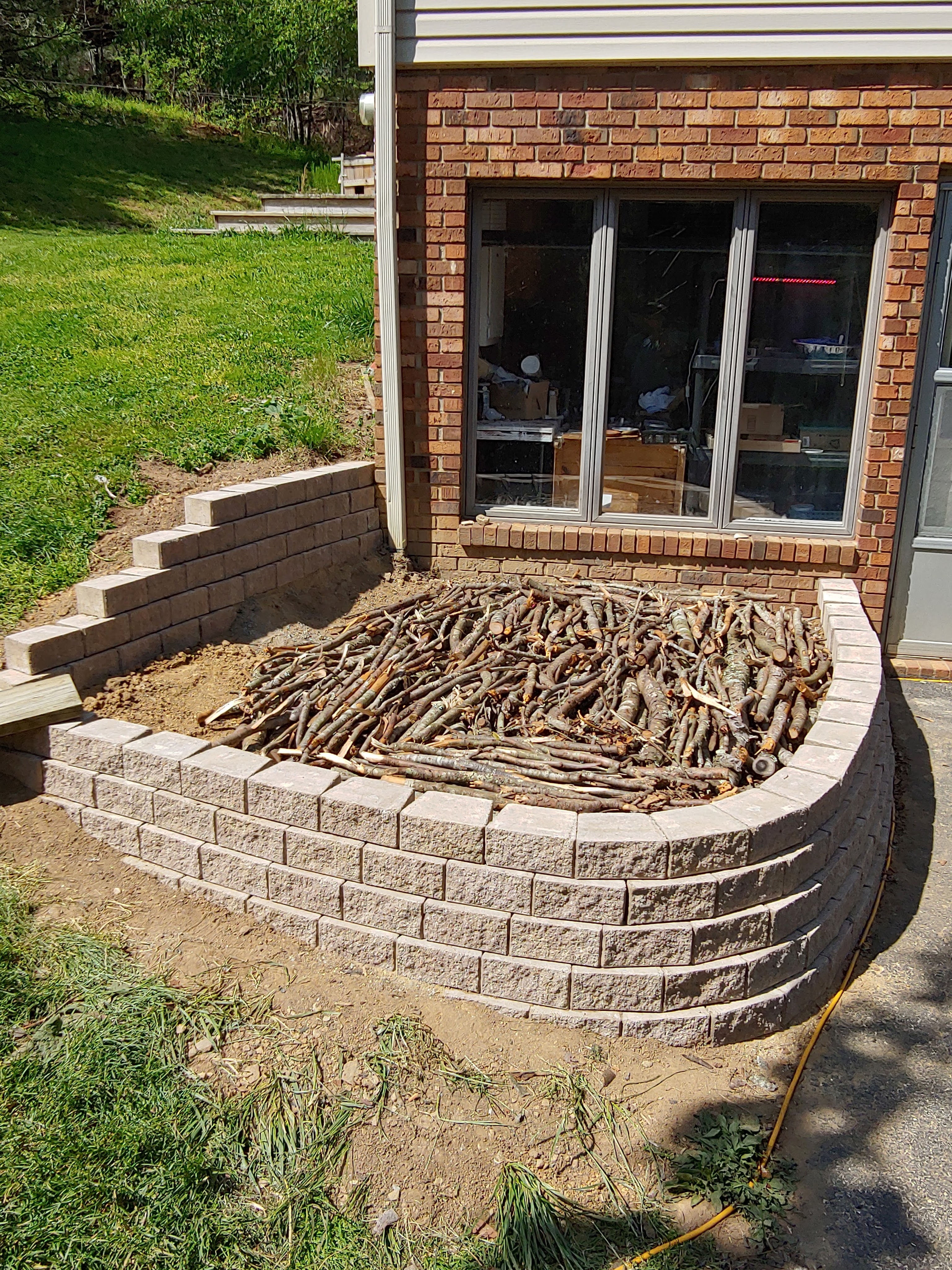
In anticipation of this project I had purchased a pallet of over 300 landscaping wall blocks long before. Digging the trench for the foundation and leveling the first layer was the most crucial aspect. The rest stacked up quickly and I could start leveling dirt and backfilling. As much as I dig I don’t have a lot of extra dirt laying around. The other weed choked spot was actually a pile from starting to level it the previous year and building a wall. I had pulled up all the weeds as I leveled it. You can never clear all those little roots out, so more sprang up to laugh at me. Again I pulled up the new weeds and proceeded to backfill the old stump spot. I was going to completely cover it with weed proof material so nothing could grow back. I’m sure someday those little dormant weed roots will see the light of day and get their revenge. Hopefully long after I’m gone.

The dirt wasn’t enough. Another present left by the previous owner would save me. She had planted a bunch of hemlock trees too close together and in some very poor locations, such as under power lines and close to the driveway. A pile of limbs from some of them beside the driveway from the previous year were waiting for my chainsaw to get running. I was using a handsaw because I hadn’t had the chance to take it to the shop. Insects don’t like hemlock and it would make the perfect filler for my raised bed area. Some folks make raised beds with limbs under the dirt in the box to add volume and rot to add to the mix. Hemlock isn’t good for that. I cut and stacked pieces as tight as possible then added some dirt reserved for the purpose of leveling over it. Weed cloth was used to cover both sites and raised bed boxes were built.

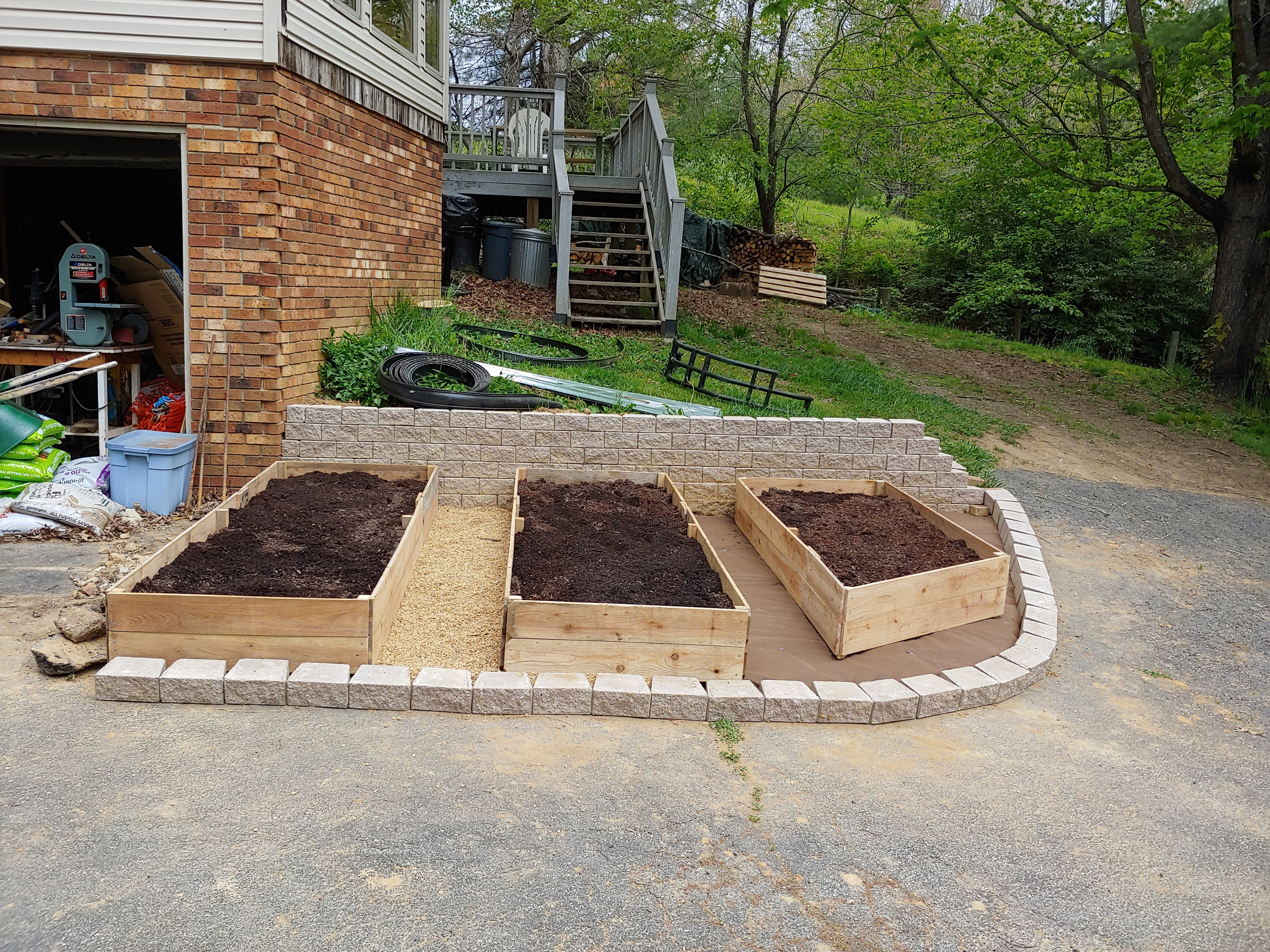
The boxes were built with those cedar fence boards I had already been using for my tent floor. The plan was to use them for the boxes all along, they just detoured along the way. The impact driver echoed down through the holler and made short work of it once I figured out the dimensions. The sites were rounded, demanding some creative geometry. To fill them took a couple of big truck loads of raised bed soil.

The planting area of the boxes was small for the amount of labor and cost involved. A huge cloud lifted off of me after completion since I had been diverting my eyes and thoughts away from the initial eyesores for far too long. I could never quite get Lydeana to picture what I had in mind and she was nonchalant about spending the money and time. When I called her out to inspect it, I believe she would have hugged and kissed me no matter how grubby and foul smelling I was.

Contemplating my dirty hands I was reminded that my hand-washing station was sub-par. The soap jug required one hand to operate while wetting or rinsing the other with no good way not to contaminate the button for the nozzle. Also the jug sat in the sunshine with potential to grow any number of life forms. With the water just splashing on the ground, a small splash guard had to be positioned below to keep my feet dry. Quick solutions rarely have good long term results.

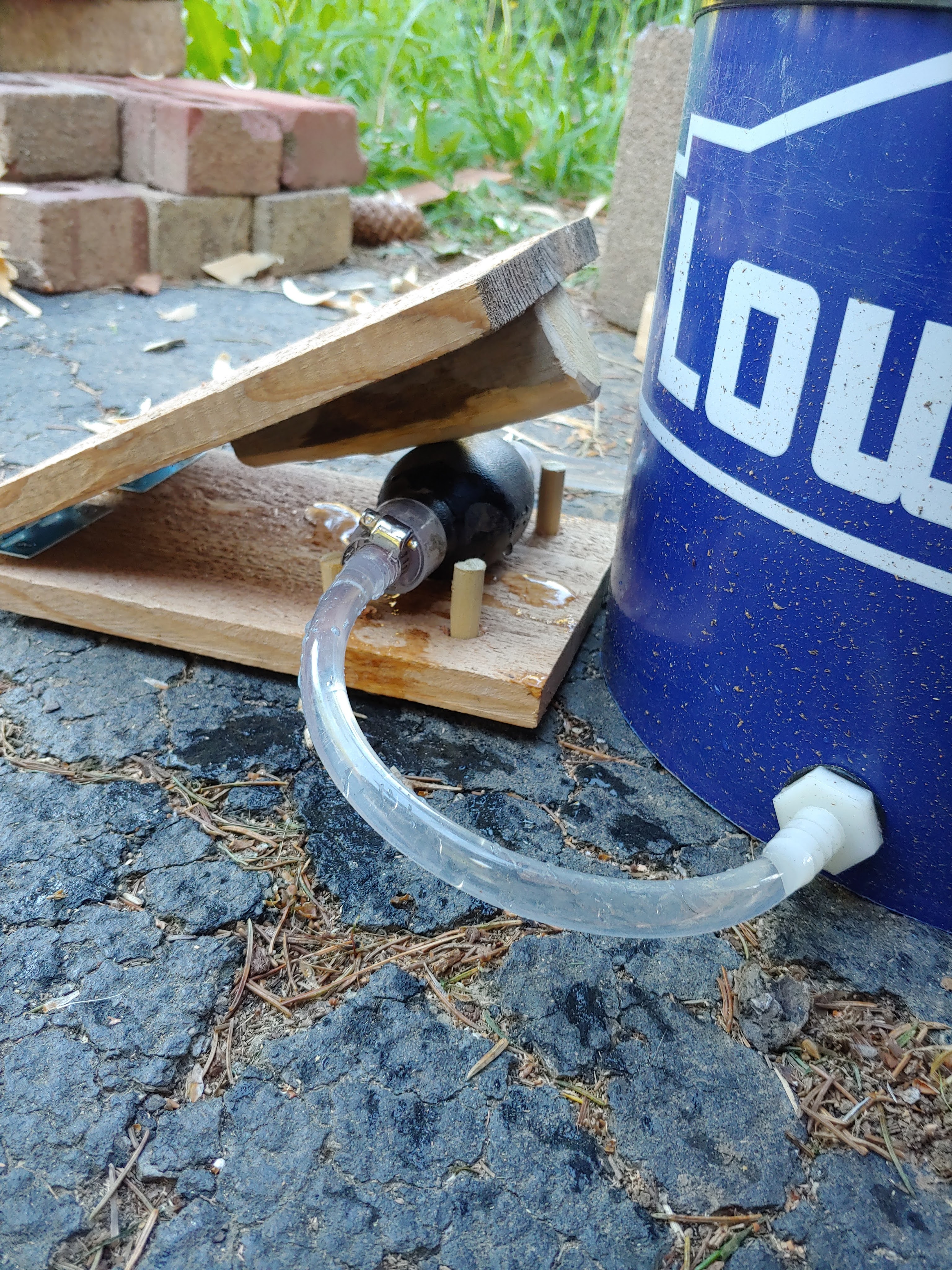
I got my water from an outside spigot we use for everything. I only handled it with gloves used solely for that purpose since Lydeana and Shayley also handled it on a regular basis. Located on the south side of the house it was in the sun so I figured it was reasonably safe. Back to the drawing board and the internet I went for a better solution. There seems to be no more useful object in the world than a five gallon bucket. A search and a few forums later and I had a new plan. A bucket with a drain, connected to a syphon using a compression bulb, would force water up at will to another empty bucket above with a catch basin. PVC pipe was used to direct the hose and give it structure. $9 for three buckets, $4 for a syphon from Harbor Freight, PVC pipe with elbows I already had and some extra long zip ties and I had a sink with running water. One bucket bottom five inches deep was fashioned into a sink on top with several holes to drain to the empty bucket underneath. The siphon bulb didn’t work too well alone so I made a pedal from wood scraps and two hinges to help it along. The result was a totally hands free sink I use to this day which does the job very well and is a water miser to boot. Better yet, it works without electricity. I’m not exactly off the grid, though getting pretty close.

AN INSIDE JOB

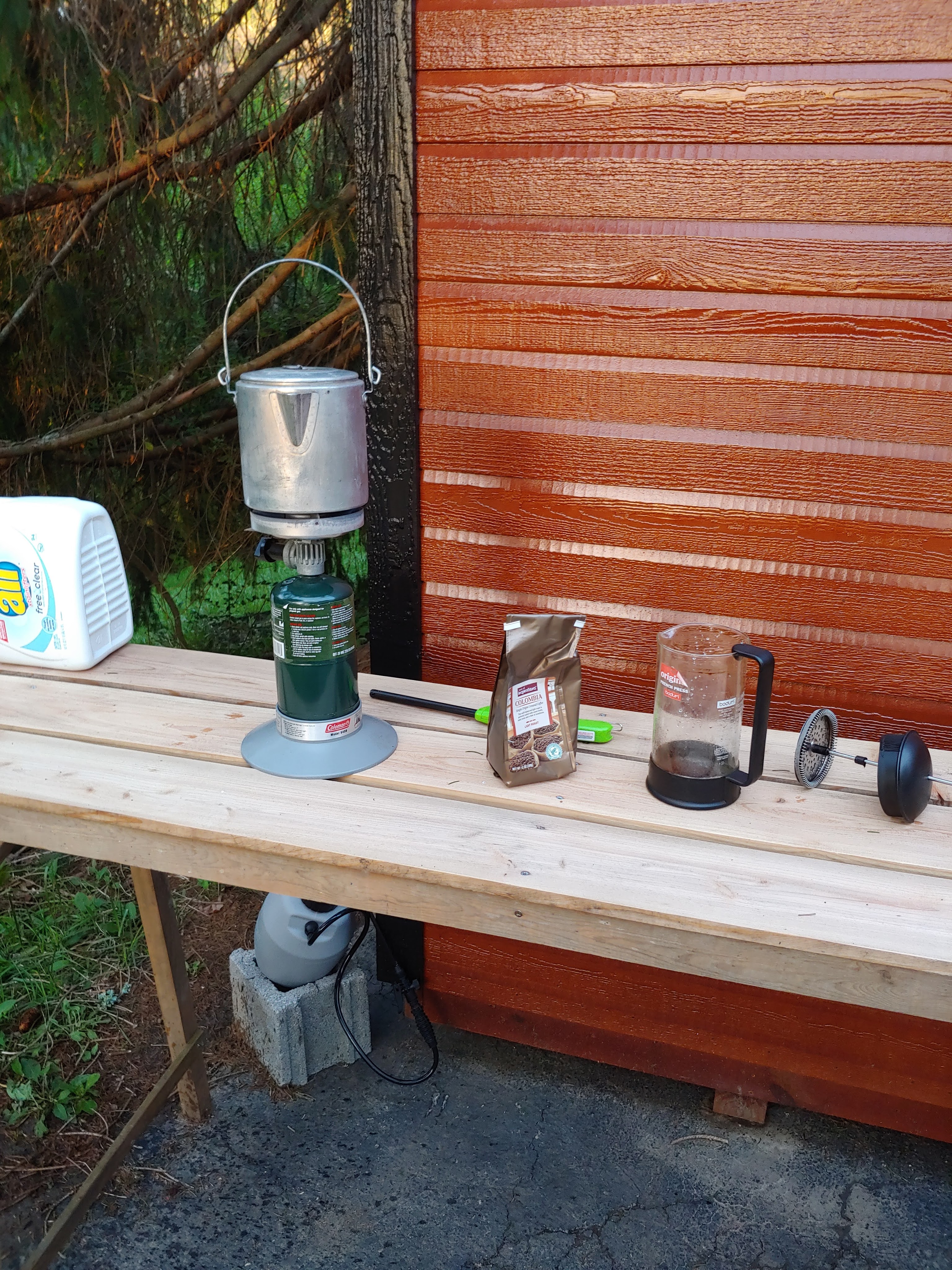
The more pleasant version of spring began to show itself, so one day I decided to build a table for outside to cook, clean and work on. I’m not a fan of propane indoors. Many people have unvented gas logs in their houses. Having appraised so many houses through the years, you start noticing things. The first couple minutes in a house you can smell anything different before your brain compensates to the point you don’t notice it anymore. The smell from long-term propane use is a big one. It’s very noticeable to start, but not so harsh as something like cigarettes, which my brain never compensated for. People and industries can make all the claims they want, but there always seemed to be issues with the house and the occupants’ health. Carbon monoxide was the other worry in a small space like mine. All of my propane use was going to be outside.

I used some of my cedar fence boards for the tabletop and 2 x 2″ strips for the legs and braces. It was tall enough I would never have to bend or stoop to use it. I would use it as a cooking platform and hand washing station with a laundry soap jug that had a handy push-button nozzle. Soon after, I made a companion table for Lydeana at the basement door for her planting and garden prep work. The time was coming we would be working up the gardens and managing our outdoor life more.

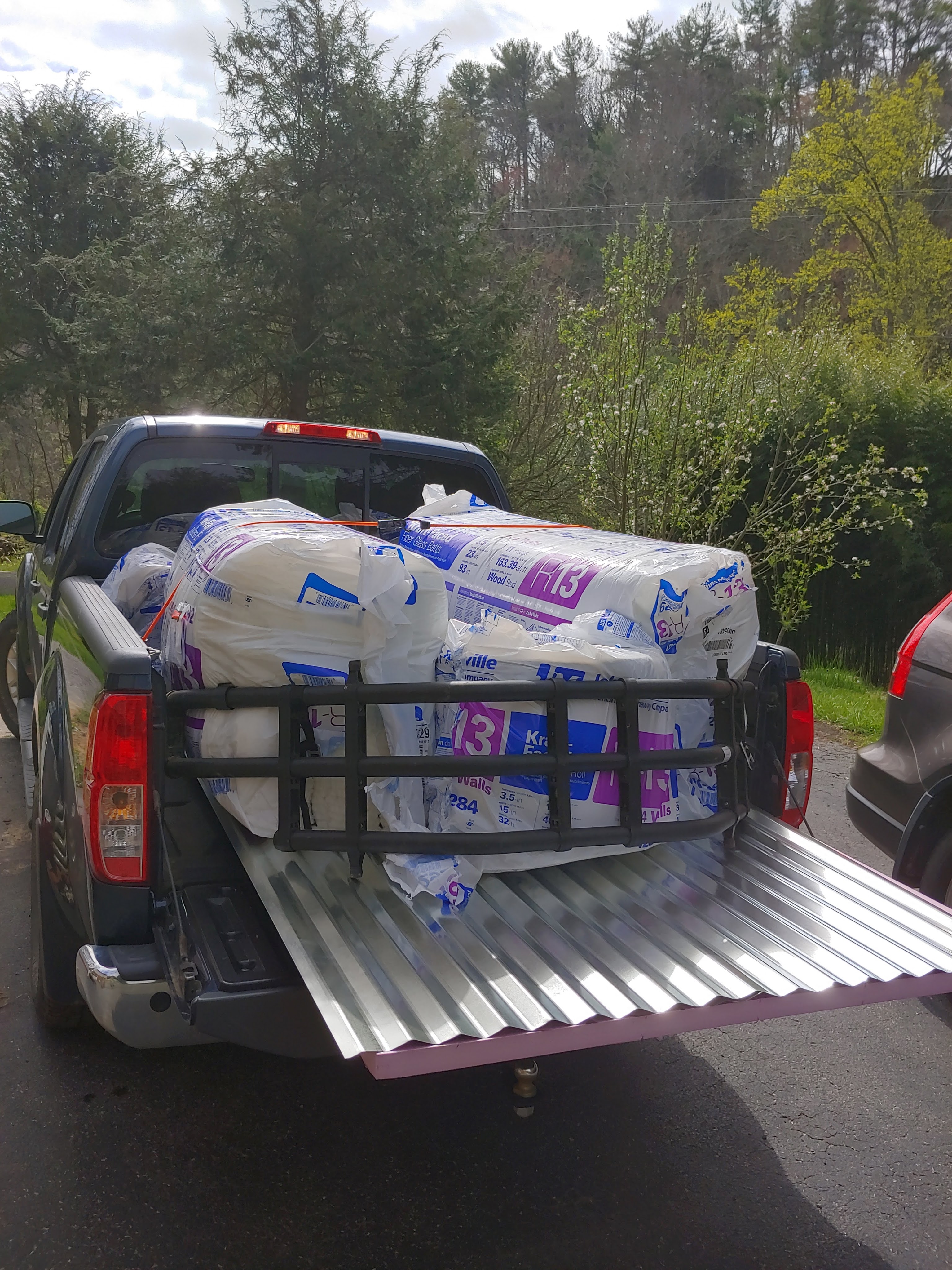
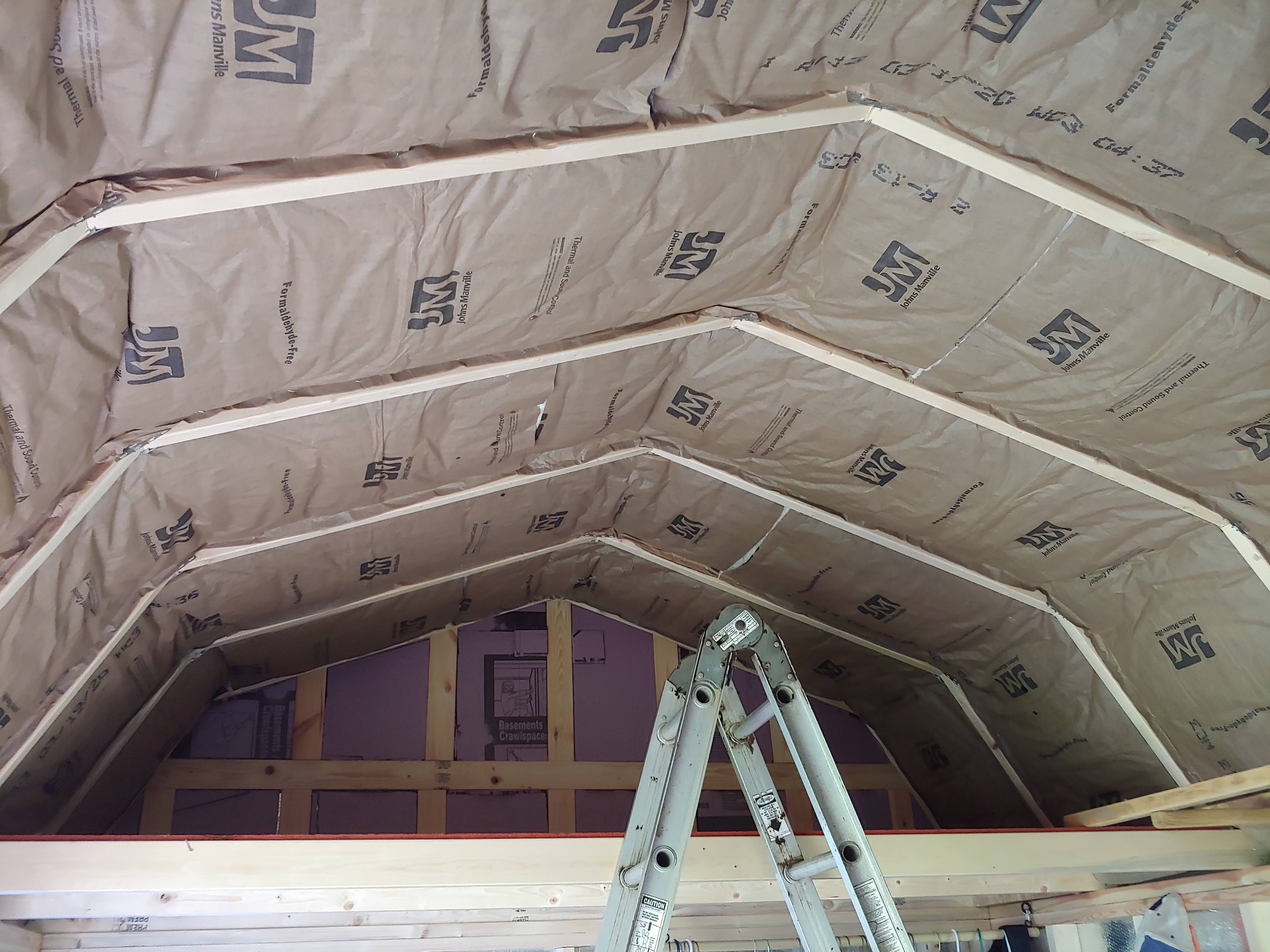
With the table done, the next order of business was insulating the building. A trip to town garnered a truck load of fiberglass insulation, 2″ thick foam board and the metal roofing for the outhouse. Fiberglass insulation is a pain to work with when you can’t take a long hot shower afterward. You cut it and those fibers get in your skin, eyes and whatever crevice or pore you have that you don’t want irritated. A day and a half and a couple thousand staples later, I was once again racing to beat evening showers to finish the job. All this required moving or removing everything in the building. Fiberglass in your food, bed or clothes more than sucks. It has a particular smell as well that isn’t what I consider nice. The place was considerably warmer at night, but now was a much higher fire risk until I got walls up.

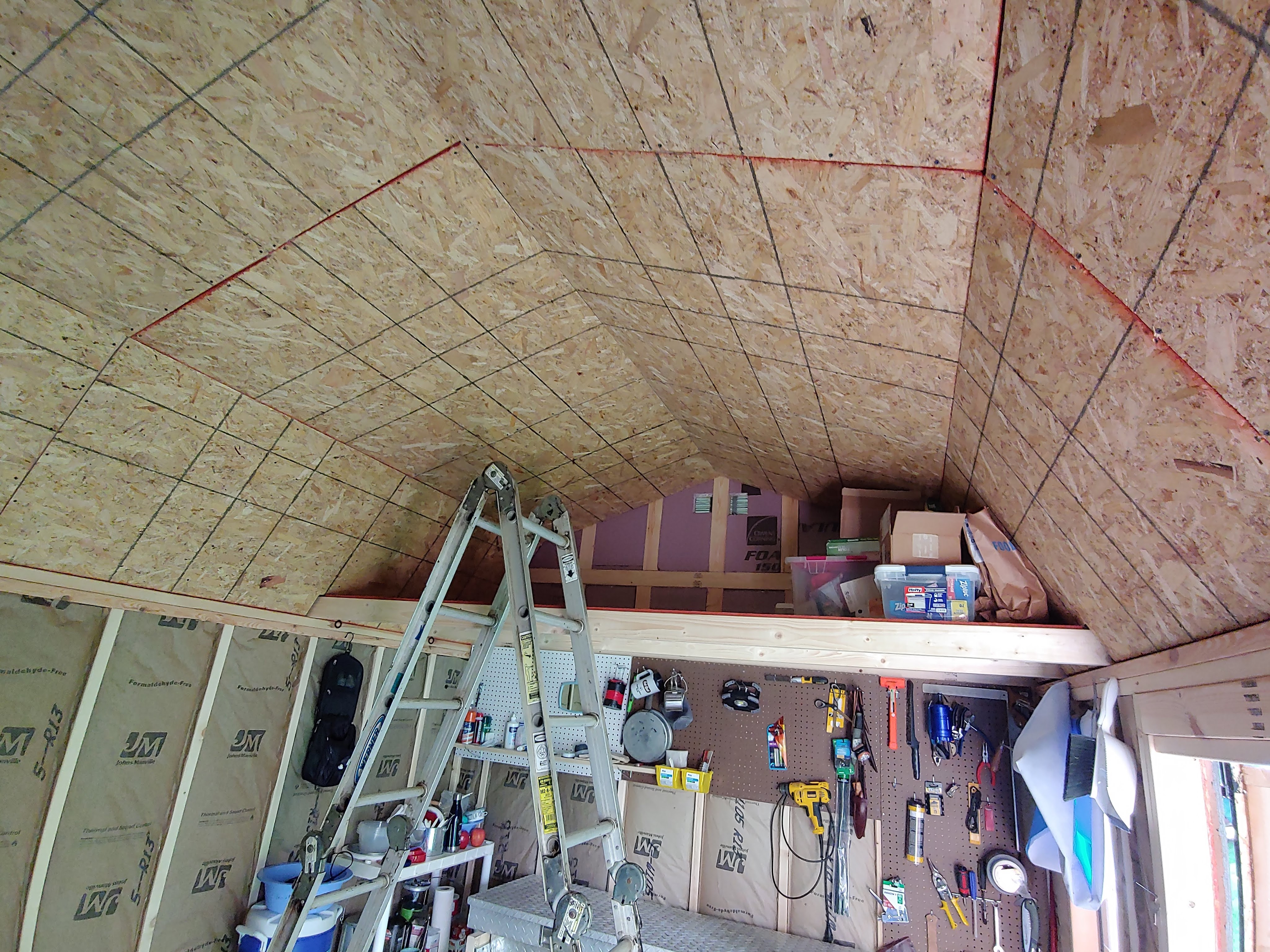
I measured the place and planned out how many pieces of 4 x 8′ wall board I would need with just a little extra. I knew from the start that when each piece needs to be cut and there are odd smaller pieces needed in various spots, I am going to screw some up with the wrong cut. I decided to use OSB board (oriented strand board) because it was much cheaper than plywood and much sturdier and more adaptable for my purpose than sheetrock. I also wanted to use my scraps plus some extra sheets to do some cabinets of sorts. I was worried about throwing too much money into all this and realize I should have used plywood for the cabinets in the end.

I lost count of how many times I measured the interior to estimate what I needed and how to cut each piece. I finally drew it out and listed each piece, size and location to idiot-proof the process a little. I ended up making two trips to town for 24 sheets of OSB because my front tires would practically be off the ground with 12. That should have clued me in. I falsely assumed I would put all this stuff on the ceilings and other odd places in half- and full-size sheets. I’m here to tell you there’s got to be a kryptonite mine under my place. My superman abilities completely crapped out with the first sheet I managed to drag in and introduce to its new home. The stuff was new and still damp from manufacture, so it gained a spot on the periodic table just under lead. Another issue I would pay for over the next three to four months was failing to recall it’s made with formaldehyde glue. After it cures and finishes off gassing, it’s okay. Until then, I had incentive to air the place out with a fan and remain outside as much as possible. Cheap is the new expensive.

I tried cutting it in half and it was still too much to hold in place overhead either on my back in the lofts or with a ladder in the middle section. I had to cut particular dimensions for the ceiling anyway, so they were more like quarter-size pieces. They were still pretty heavy, but I managed it. The one thing that saved me was the new impact driver I bought. I had used a plain drill for screws before this, and it would strip them out half the time. I picked up a cordless Milwaukee impact driver and drill set and immediately fell in love. My construction times would be cut down to a quarter of anything previously. I had screws of all sorts and lengths for every job. If something didn’t have a screw in it, then it got several. The cats even gave me leery glances, probably suspecting they would end up permanently affixed to the nearest chunk of wood if they stood still too long.

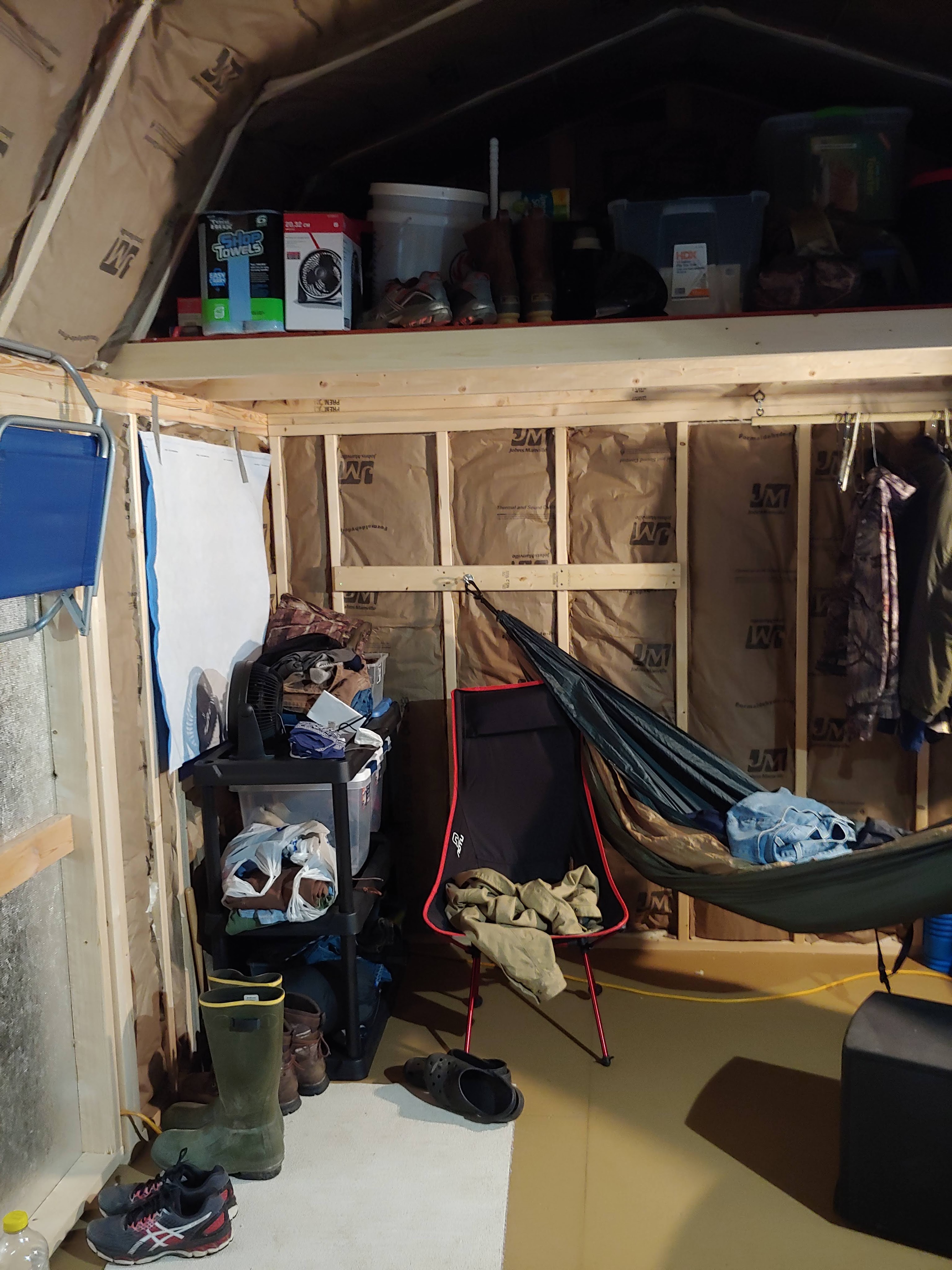
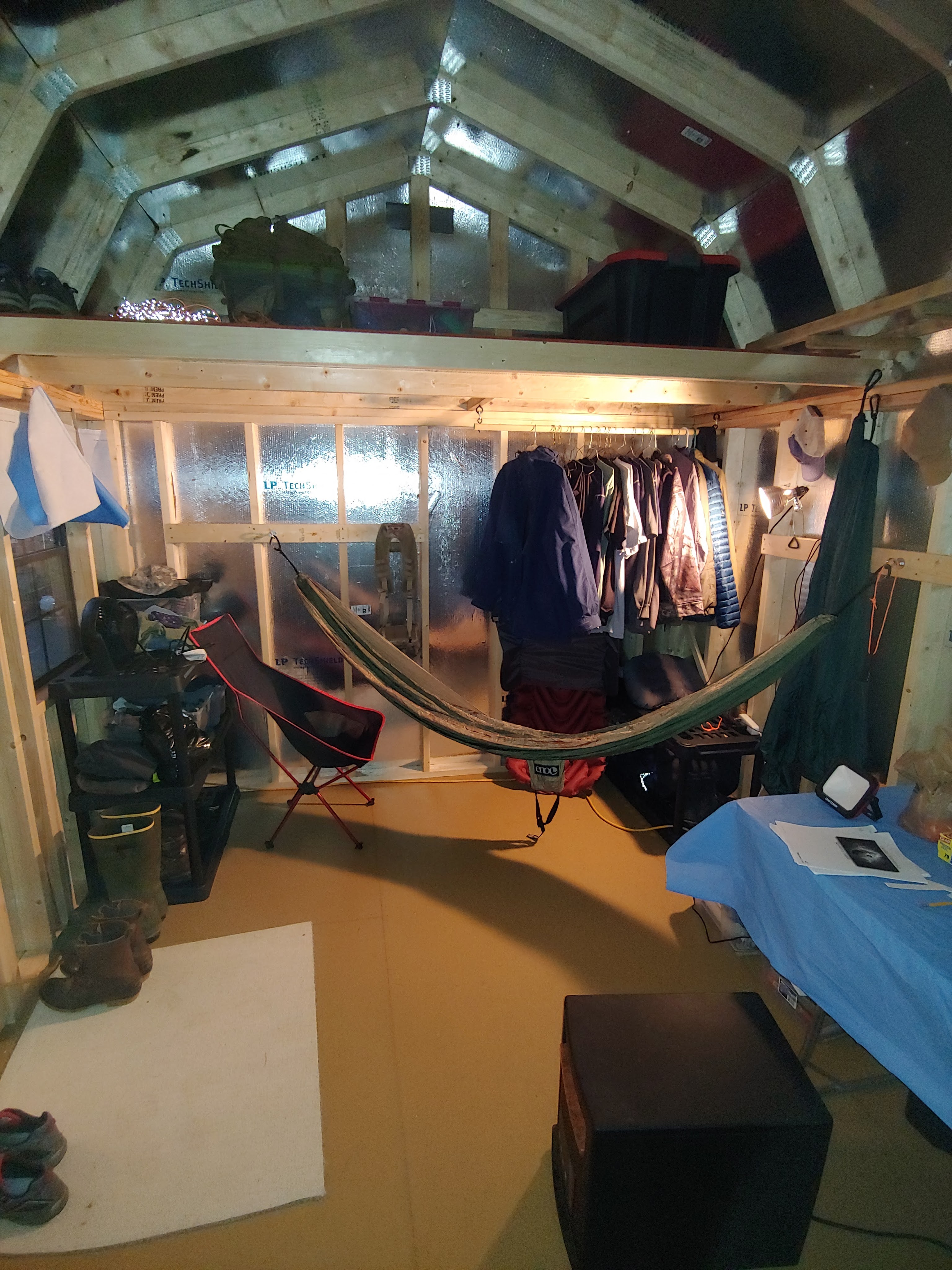
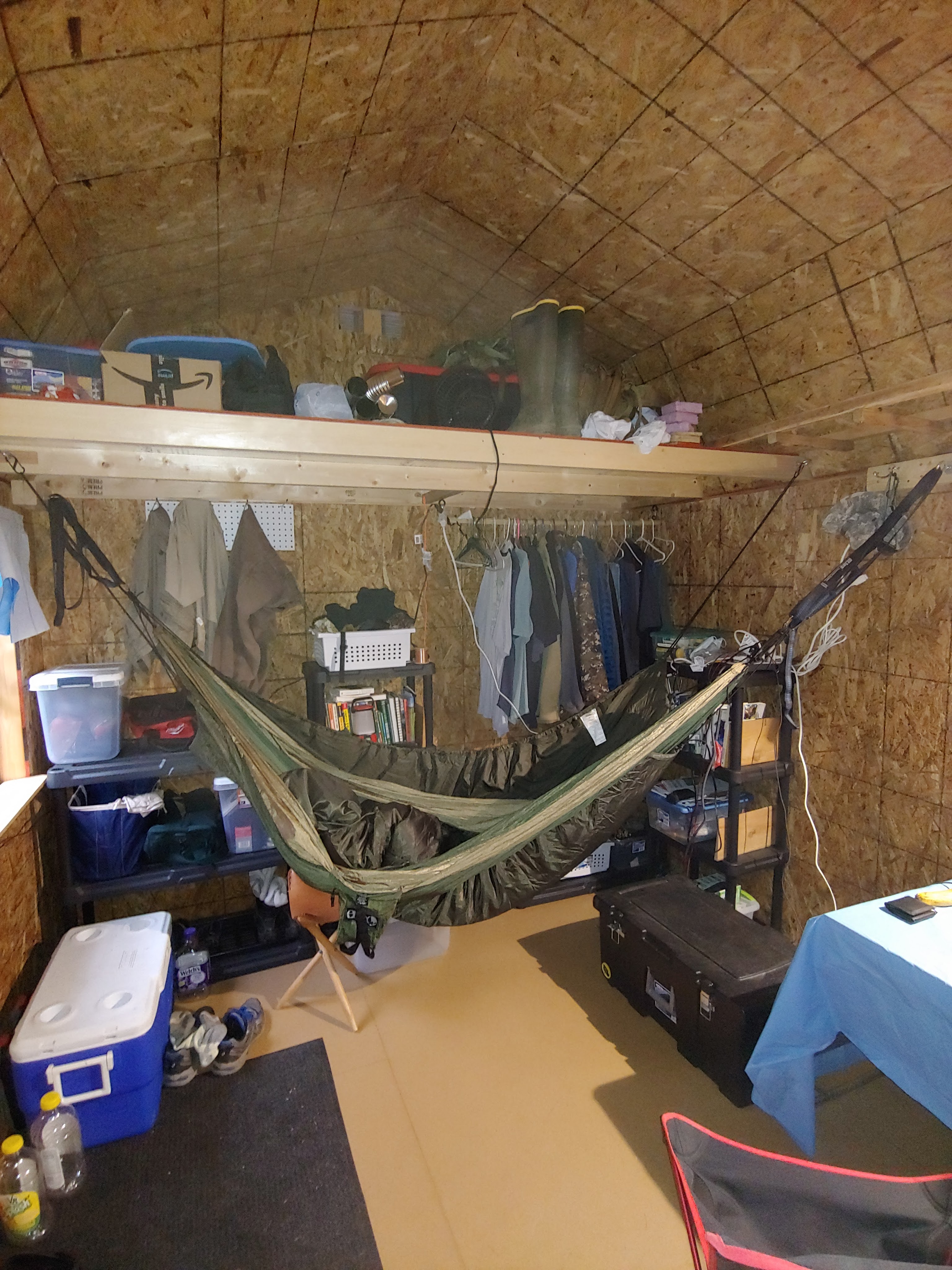
Walls and ceiling in place, I reapplied some peg board on my “kitchen” side wall to organize stuff and took out the bamboo pole with hooks. I moved my stuff back in place and then put up new braces to hang the hammock. This time the angles worked out better, but I still had to experiment with it to make it fit around shelves and cabinets later. Inside temperatures stabilized far better, and the only cold spot was the floor.

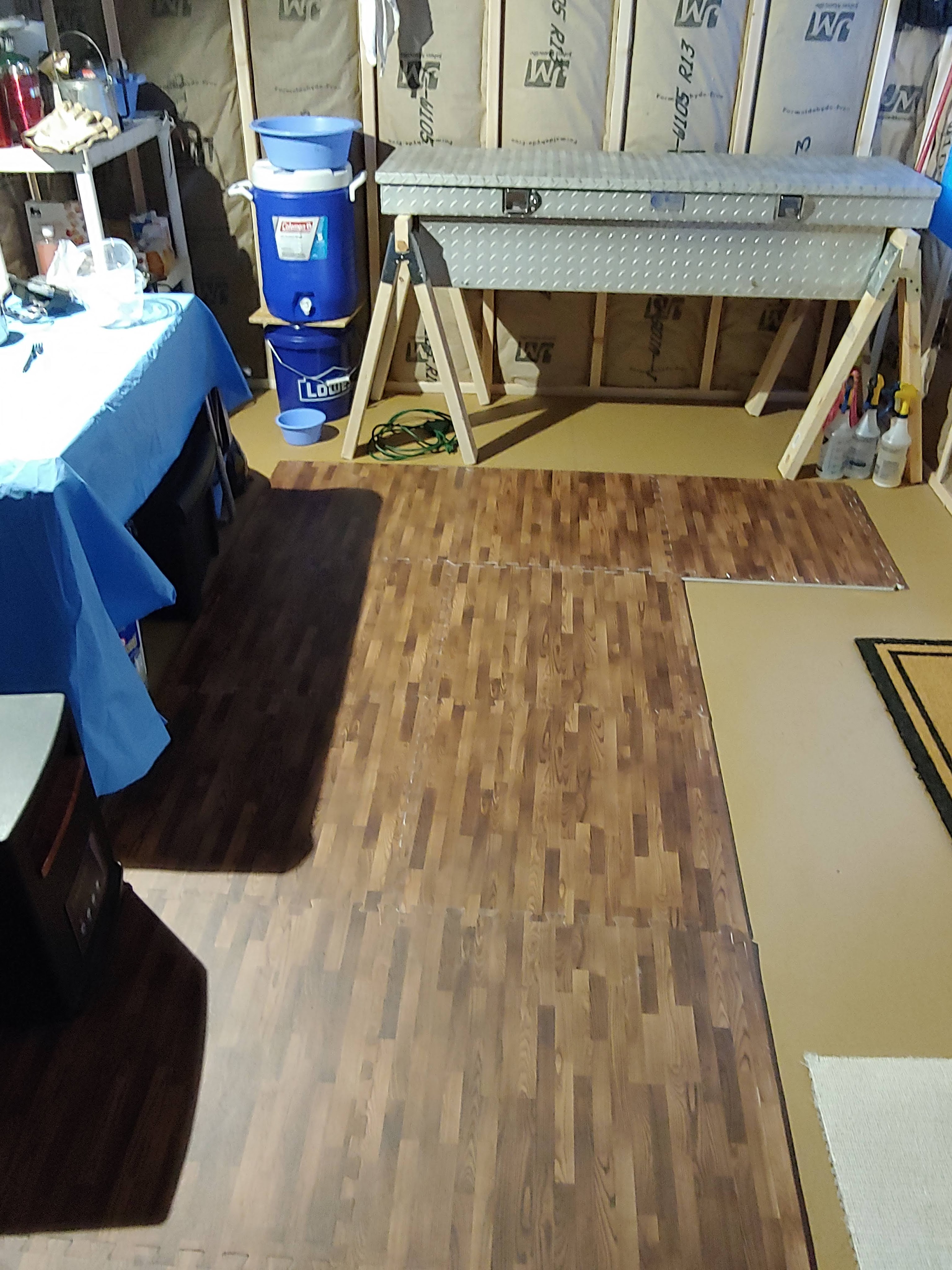
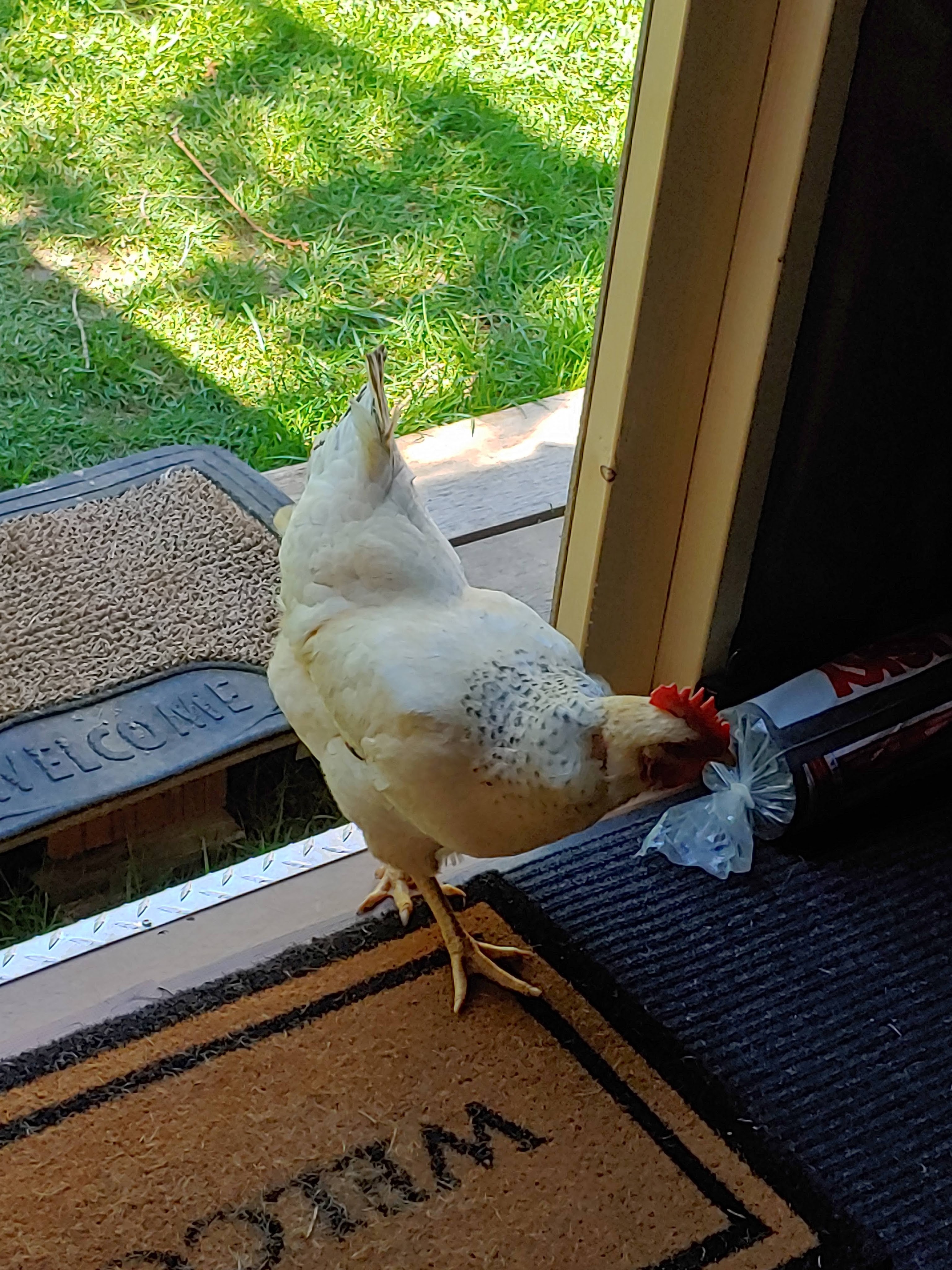
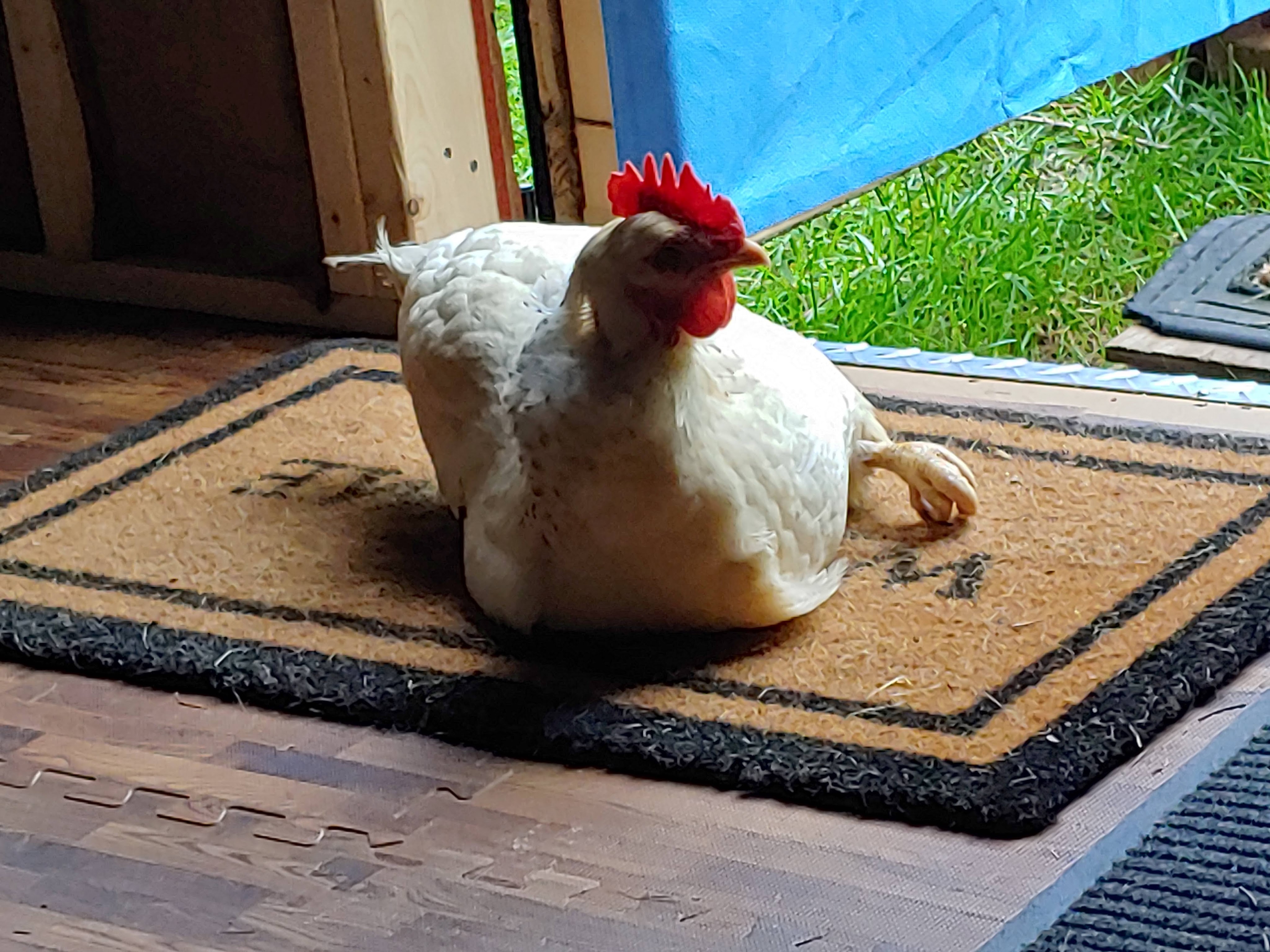
When Shayley was little we picked up some 1/2″ foam mats that connected with puzzle edges to make our hardwood floors more tolerable to play on. She didn’t mind the floors, but our bones didn’t agree. With that in mind, I found some at the hardware store with wood floor print on one side and marble on the other. I laid it on the floor where I would mostly be standing. They only had two packs of it, so I had to be strategic. More was acquired as it came available to fill it in better. With a rug at the door to wipe feet and take off shoes I could keep it in reasonable shape. A few visits from Manny and the cats trying to make a bed or sharpen claws, and that wouldn’t matter for long. Either way, it insulated the floor rather well, and the overall comfort and ambiance of the place improved significantly. I opted not to paint the OSB because it was interesting to look at when bored. Nice idea, but barely ever happened. I would paint a couple of cabinets I made later to seal the OSB odor and brighten up the place a little. Most importantly, Lucky approved after a thorough inspection.

Two 2×4’s and a couple cheap sawhorse brackets allowed me to raise my toolbox a little higher and make some more space. The extension cord feeding two lights and an Edenpure heater, requisitioned from the house and plugged into a surge protector with a couple of USB ports, made up the electrical system. I had an electric cooking eye to try inside, so I could cook and brew coffee when it rained. I couldn’t use it and the heater at the same time or it would throw the breaker. Knowing exactly where my headlamps hung was crucial when suddenly finding myself in darkness. The little propane tanks used for my outside cooking seemed to run out fast so I ultimately replaced them completely with the electric eye. But not until after I tried my hand at a new dish.

With things coming together inside, the weather was improving to the point it was time to start working outside. With several years of neglect around the property and growing season looming on the horizon, I had my work cut out for me.

MOVIN’ IN…AGAIN

With my new home in place, I quickly hauled my stuff inside and somewhat organized the piles where I roughly imagined things would go. There were 4′ deep lofts at each end to store things out of the way, so I quickly cobbled together a ladder to reach them more easily. I made it long enough to reach across from one to the other so that I could store it up out of the way. I thought about sleeping in one. After climbing up and testing it, I decided my head wasn’t hard enough to sustain multiple concussions upon sitting up in a sleepy fog. Nor was my body ready for a six-and-a-half-foot fall while attempting to descend a shifty ladder in the dark. I’d heard that in Australia they would lay babies on a sheepskin on the floor, negating the risk of falls from a bed. That settled it, I would follow suit.

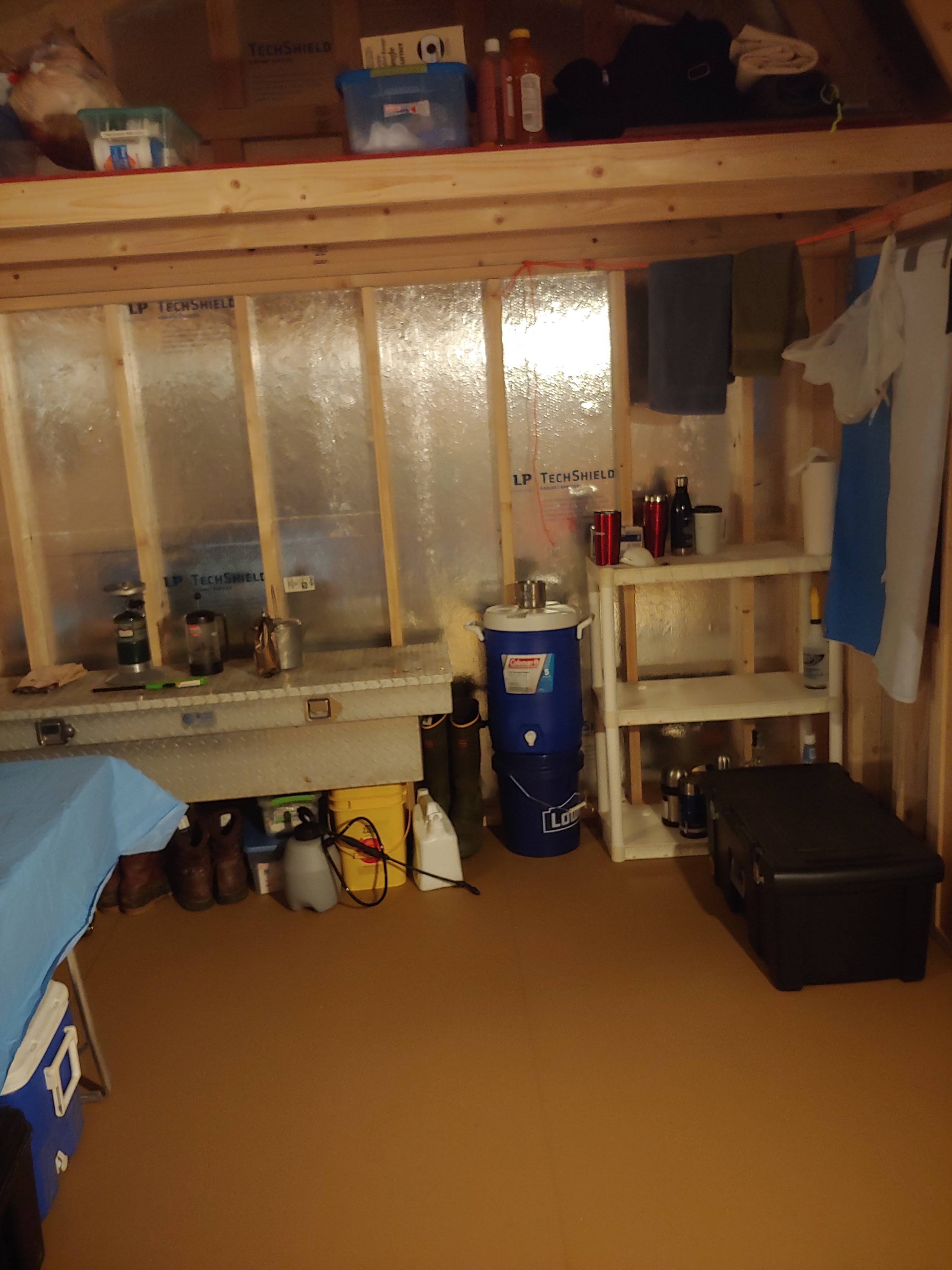
I set my toolbox on a couple of kitty litter buckets, bringing it up to a useable height and keeping it as a safe cooktop. Some plastic shelves salvaged from the shed and pressure washed, a folding camp chair and an old folding aluminum framed table with a thin, sagging masonite top rounded out my furniture. I used a surgical table cover that had to be wasted for a tablecloth and wraps for surgical tool sets that would otherwise be thrown away as curtains. So much waste is produced in the medical business, but it’s necessary to ensure sterility for the process. Perks of the job: clean garbage.

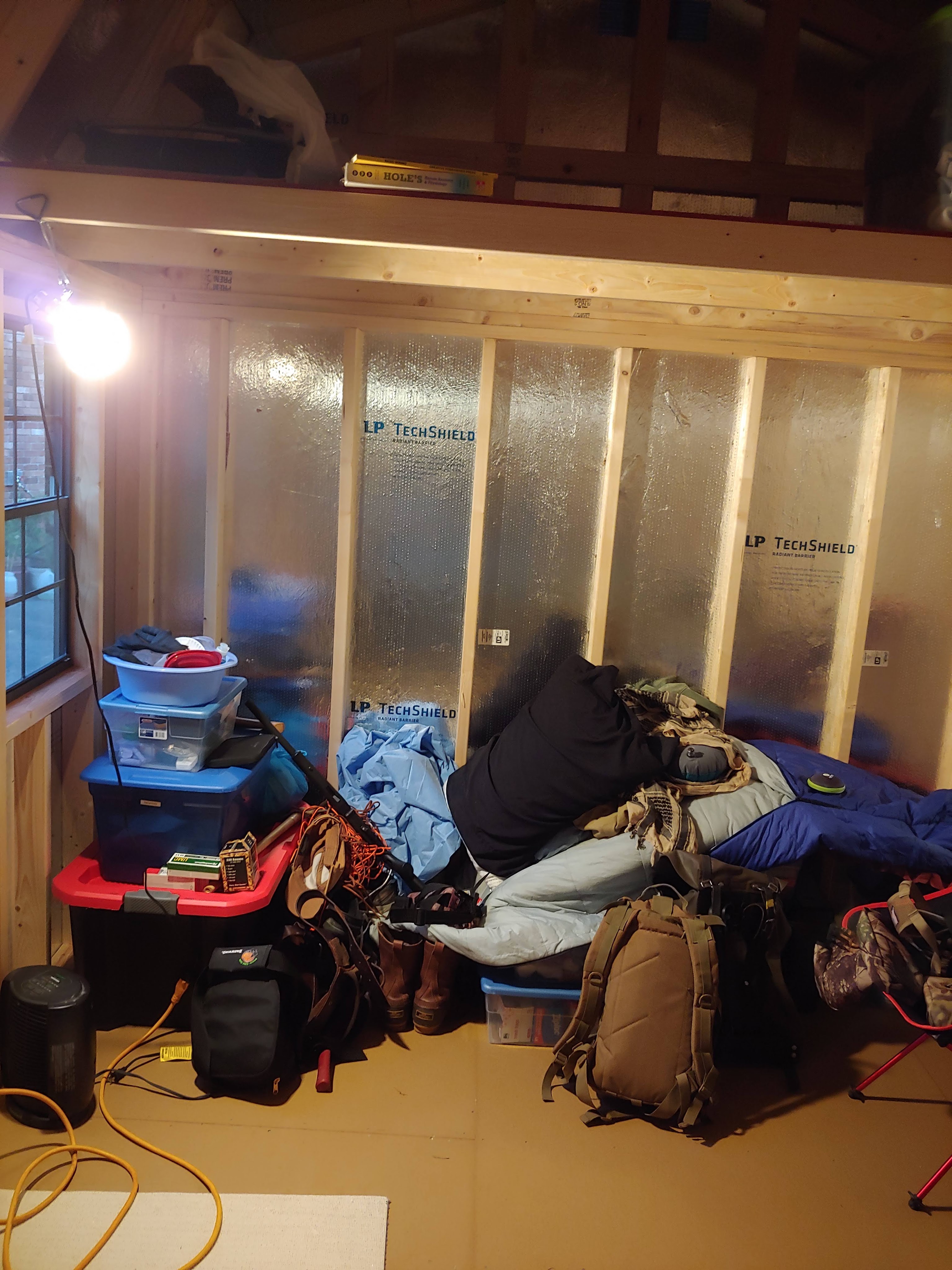
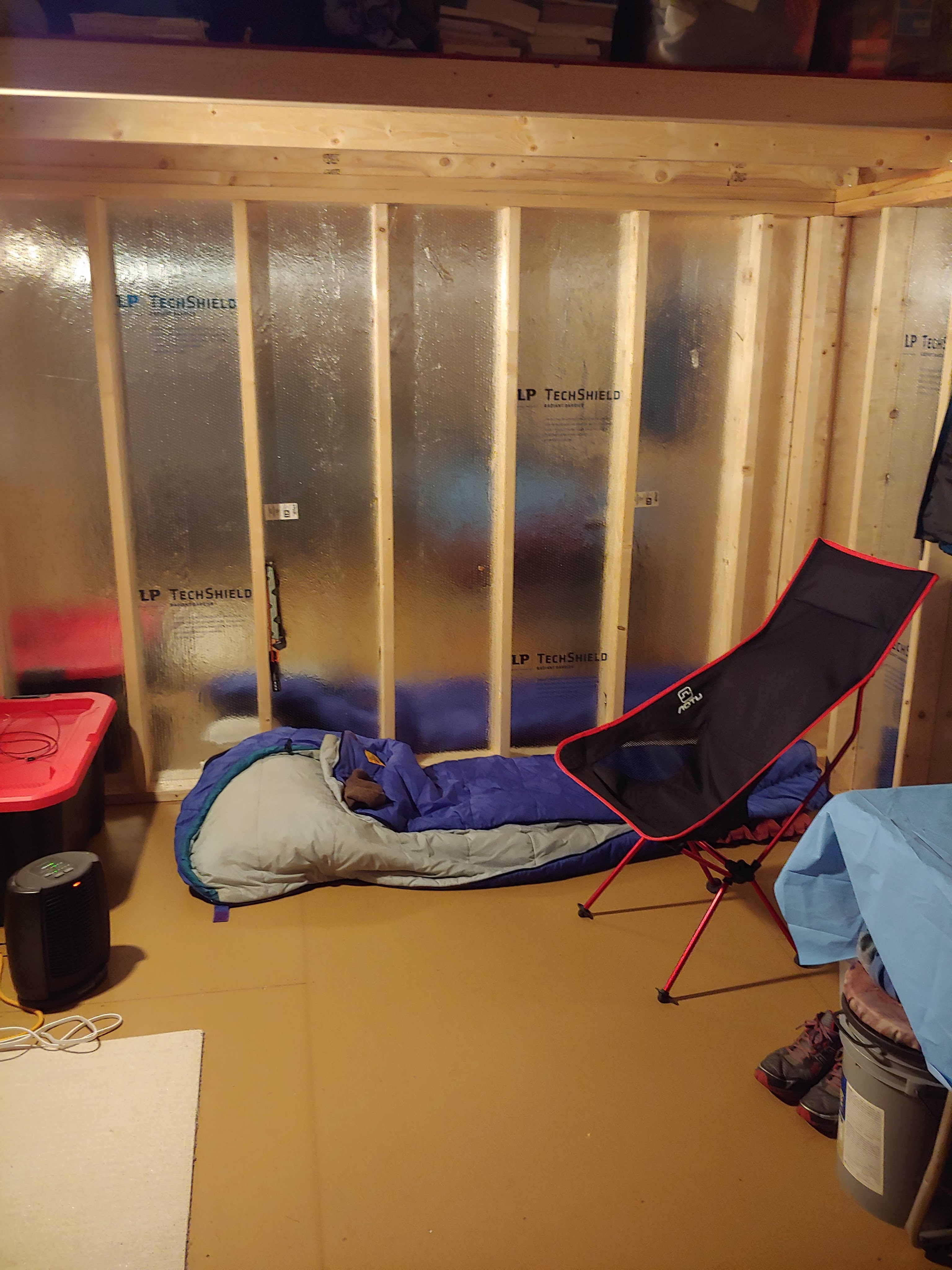
I ran the extension cord up through the bottom corner of the nearest door for the light and heater. One light was plenty since the interior layer of the chipboard sheathing had a metallic layer called TechShield adhered to it for energy efficiency. Its main function was to radiate heat back into the building. The unfortunate side effect would be to significantly block wifi signal from the house. Crouching by a window or open door for phone signal and using the small Kindle I own was and still is an irritation. The computer I now use works much better, and we had Citizens Co-op, our internet provider, come by and help troubleshoot to improve it. Like life in general, everything still boiled down to compromises with every new twist and turn. I really only needed the phone to always work, for nights I’m on call. Everything else was luxury.

The heater knocked the chill off far more easily, and the wind though vaguely heard, was not felt. At night the comparative silence was deafening, but gone was any anxiety over structural integrity. I managed to adapt to that rather quickly. The cats couldn’t find holes in this fortress, so I could sleep peacefully and actually move around in the sleeping bag to get comfortable. I’d never really slept well or comfortably in my life, but that was soon to change.

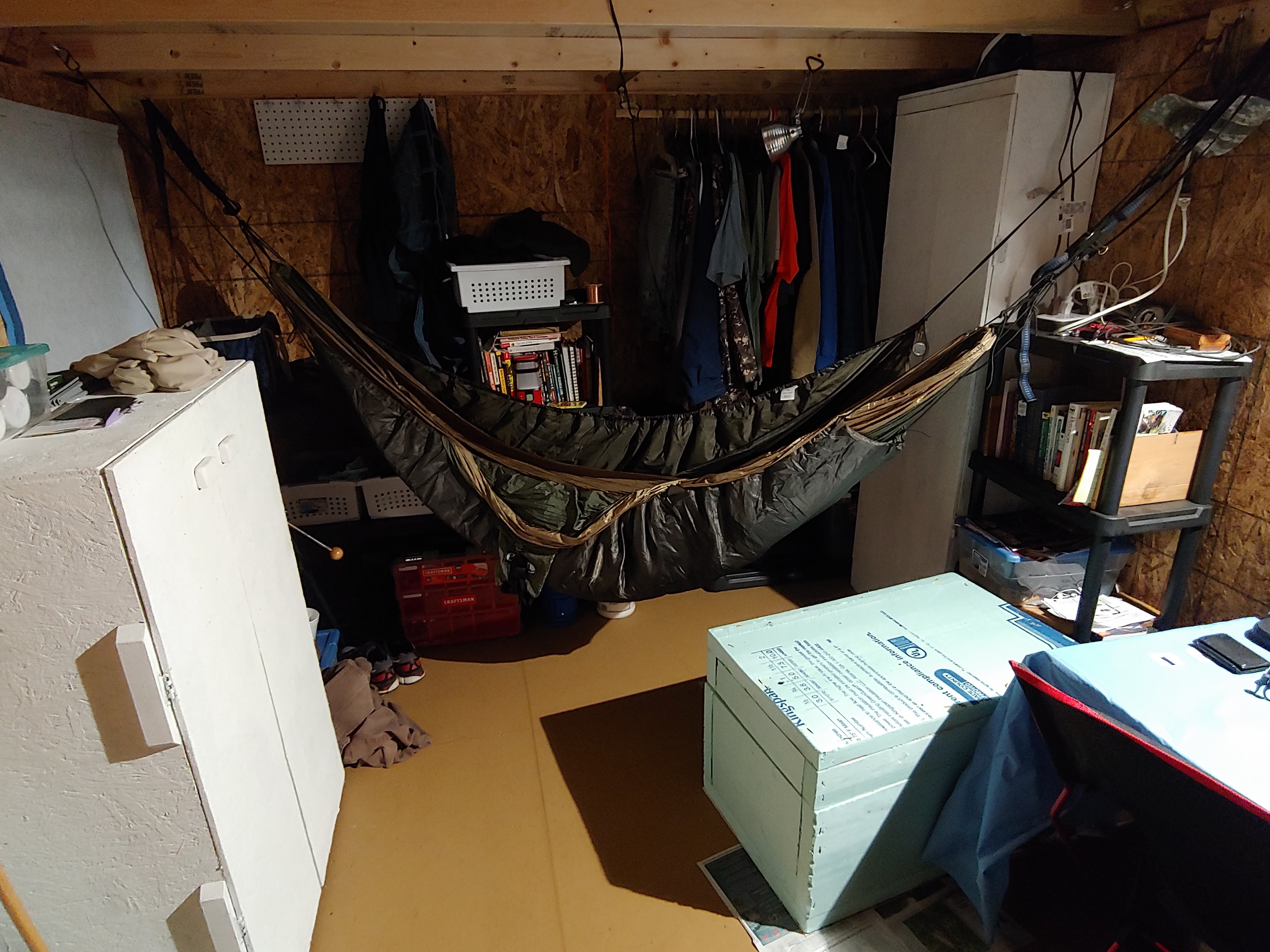
I started experimenting with hammocks for camping several years ago before they exploded onto the scene for long distance hiking. I tried all kinds, with varying success. In the late ’90s I appraised a house in Fries for an old man with a litany of interesting stories. I was there talking for three hours before ever looking at the house. He was involved with the early formation and building of the Appalachian Trail as a young man. He and some friends decided to travel by horseback as far as Asheville in the late ’40s. Riding through steep mountainous terrain with no shelters and no flat spots, he reasoned he would take a canvas hammock since there were always trees. The horses carried the bulky hammock, wool blankets and heavy gear they had, and he said they stopped wherever they wanted to camp and he slept the best in his life. When a light bulb turns on and you hear a voice, it’s wise to perk up and listen. The best lessons I’ve learned outside of hard-earned experience is from my elders– carefully gleaning from their hard-earned experience.

I had a hammock among my stuff since I was expecting this to be a long term proposition and wanted to try some of the gear out more thoroughly in the process. To be practical it needed good insulation underneath. I’d tried all combinations of sleeping pads and bags, with some success and comfort. A mummy bag in a hammock is a pain that I hoped to avoid on a regular basis. Special under quilts and over quilts are made for camping now that run from the super expensive ultralight versions for gram weenie backpackers(ultralight fanatics) to somewhat bulky and heavier things that don’t make your wallet appear to be on a diet. I wasn’t going to be carrying this down a trail and didn’t want to spend a lot on a regret, so the cheapest set with a reasonable review was soon to arrive.

Two large eyebolts with double nuts and wide washers were bought and installed on four-foot 2 x 4’s which spanned 3 wall studs each to distribute the load. I weighed roughly 200 pounds, but the force exerted in a swinging hammock increases exponentially. A lag bolt in a solitary stud would soon give way to a catastrophic failure and an unpleasant impact with the floor. The proper way to lay in a hammock is with the ends at a 30-degree angle up to the tie-offs if you put a weight in the center. You lay at an angle across the center line, which results in a fairly flat laying position. I put screws at varying heights to test the positioning so it would still be the right height to get in and out of. Too high or low and it was difficult to get in and out, and not comfortable to sit in with your feet on the floor. The thing stretched a lot with full body weight, so it took some fiddling for the next month to get it just right. I tolerated a slippery camp pad and mummy bag until the quilts arrived.

People give me funny looks when I try to explain my particular brand of allergy. Anything man-made with an added scent and many chemicals tears me up. All clothes sent from overseas are covered with insecticides and sundry other poisons that most people can’t seem to sense. There have been times I couldn’t walk into a store of any kind without breaking out in hives and feeling like my nerves were on fire. Those quilts arrived and I quickly put them on the hammock. I could smell the crap on them and felt the familiar ice cold pinpricks through my nervous system, and yet I laid down anyway. Five minutes later the quilts came off. I had to wash them and let them air out for a week while my body tried to get back on track. My whole family suffered from this sensitivity, so maybe I’m not crazy.

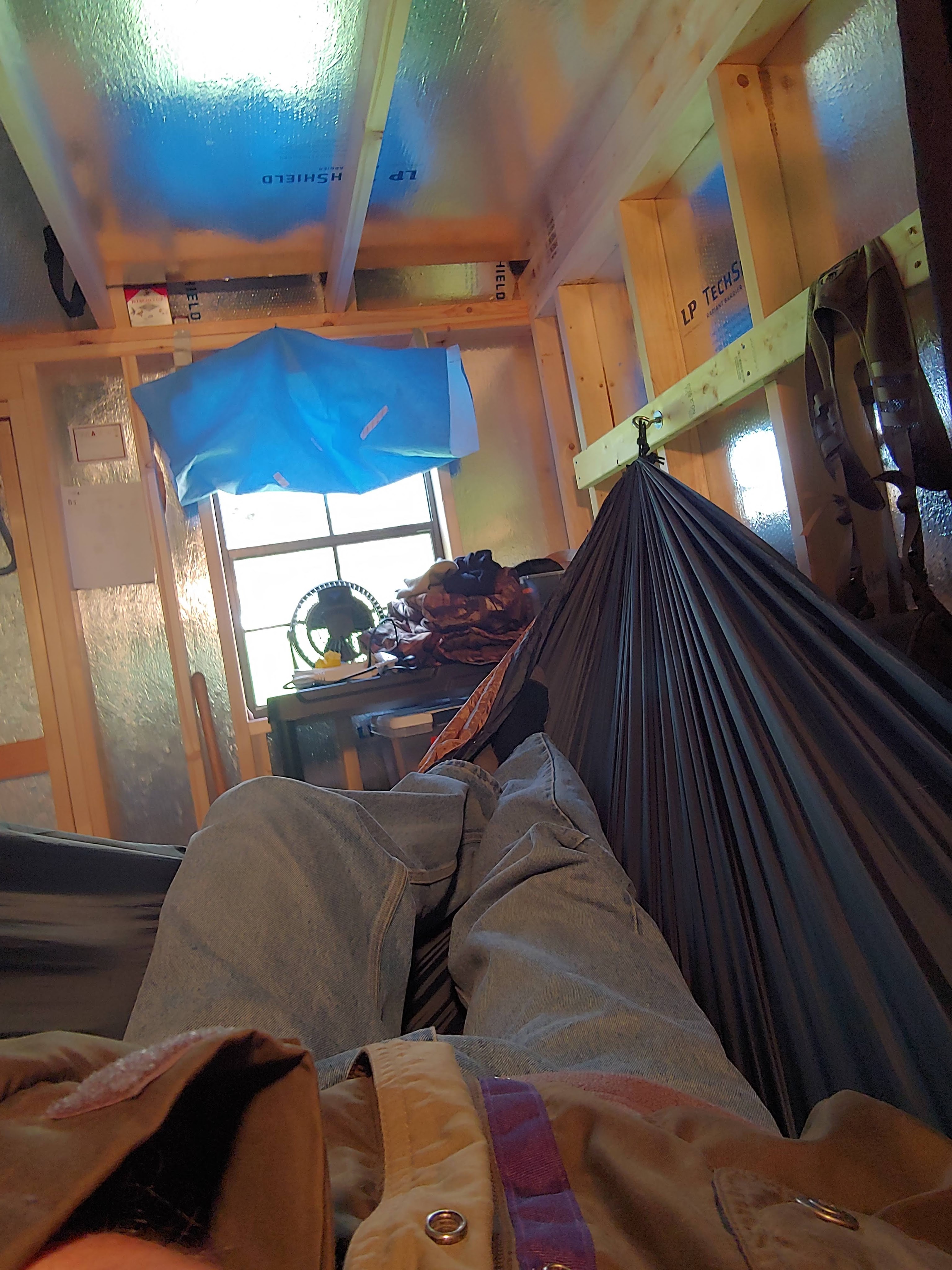
It took a while to get the kinks worked out of the whole rig. The final problem to resolve was that the edge of the hammock would give way and let my head fall off. I finally sewed a pleat along the side where my head lay, and it effectively cradled it from the side so I didn’t even need a pillow. I started sleeping like a baby for the first time since outgrowing that phase of life.

Of course, about the time I start sleeping good, a tornado warning came along. I don’t recall if one showed up anywhere. The sky looked ominous, the weather emergency alarms were sounding off and Lydeana insisted I come in the basement. I sat at the bottom of the stairs and they were at the top for about an hour. Nothing like a possible disaster to bring a family together. The building is on runners sitting on flat concrete blocks and isn’t tied down. I just prayed it wouldn’t lift off as soon as I got it.

After the scare I got busy with organizing more and messing with the hammock in relation to where things like shelves and a hanging rod would go. A couple of thick poplar dowels were hung for clothes and towels while a length of bamboo was placed across one end with strings and hooks for various implements. I did and made everything to be temporary as I figured out what I wanted. I hadn’t had any time to apply the 6 P’s: Prior Planning Prevents Piss Poor Performance. I knew that things would be done I’d regret, so no holes were made in anything and no major permanent items installed that couldn’t be reversed. Some cheap plastic modular shelves were bought and strategically placed. I’d get in the hammock and swing a little to see what I bumped into. This procedure continued into the future until for every addition or rearrangement. Any little irritant resulted in a new game plan.

The major irritants I needed to address were heat and cold. An uninsulated building wasn’t going to be any more fun in the summer heat than in the winter cold. I am usually less tolerant of heat than cold, although the time I would spend working in the driveway in the sun in the following months would cure that temporarily. In the meantime, it was still cold out and I began pricing insulation and different materials for interior wall sheathing. My three criteria for the walls were qualities I considered to be my strong points: cheap, durable and adaptable. My situation was about to receive another upgrade, and the real work was just beginning.